* A reflection for the column 'My favorite book'
Therefore, today I want to introduce Zen Master Thich Nhat Hanh's book, 'No death, no fear,' to anyone in a similar situation, grieving over a loved one's health or passing.
I recently experienced a major upheaval in my life. I lost both my parents within one year. My 38 years had been bright, but suddenly everything turned bleak. I could not accept this reality. Almost every day, I found myself shedding tears, often on the drive home from work. Amidst heavy traffic, with my face mask on, my eyes fixed on the road ahead, my mind wandered through the past. Images of my parents, my past mistakes, their love, and the emptiness made my eyes sting.
I had been preparing for this moment for a long time. Since I was 5, then 10 years old, I began contemplating life and death. I wondered why I was born, where I was before birth, and where I would go after death. These unanswered questions filled me with dread. I deeply feared a day without my parents by my side.
I read numerous books on life and death, encompassing scientific, spiritual, and religious perspectives. The most cherished idea came from a teacher whose name I cannot recall, the gist of it being, 'If you grieve and cannot accept the death of a loved one, it is because you cannot accept your own death.' Indeed, everyone must die; we all know this obvious and certain truth. Yet, we often treat each other as if we will live forever, for 300 or 1,000 years, leading us to anger, hold grudges, and hurt each other. Three years ago, my close friend's mother passed away. My friend was devastated and also cried almost every day when no one was around. Hearing her story, I felt confused, unsure how to advise her. I offered platitudes: 'If you grieve and cannot accept the death of a loved one, it is because you cannot accept your own death.' At that time, these were truly empty words to me because my parents were still alive. I had not yet experienced what my friend was going through.
'Nothing is born, and nothing dies.' Birth is becoming something from nothing. Death is becoming nothing from something. Nothing comes into being from nothing. Nothing ceases to be from being. Even if you are a person of empirical science, you will understand this truth through the law of conservation of energy.
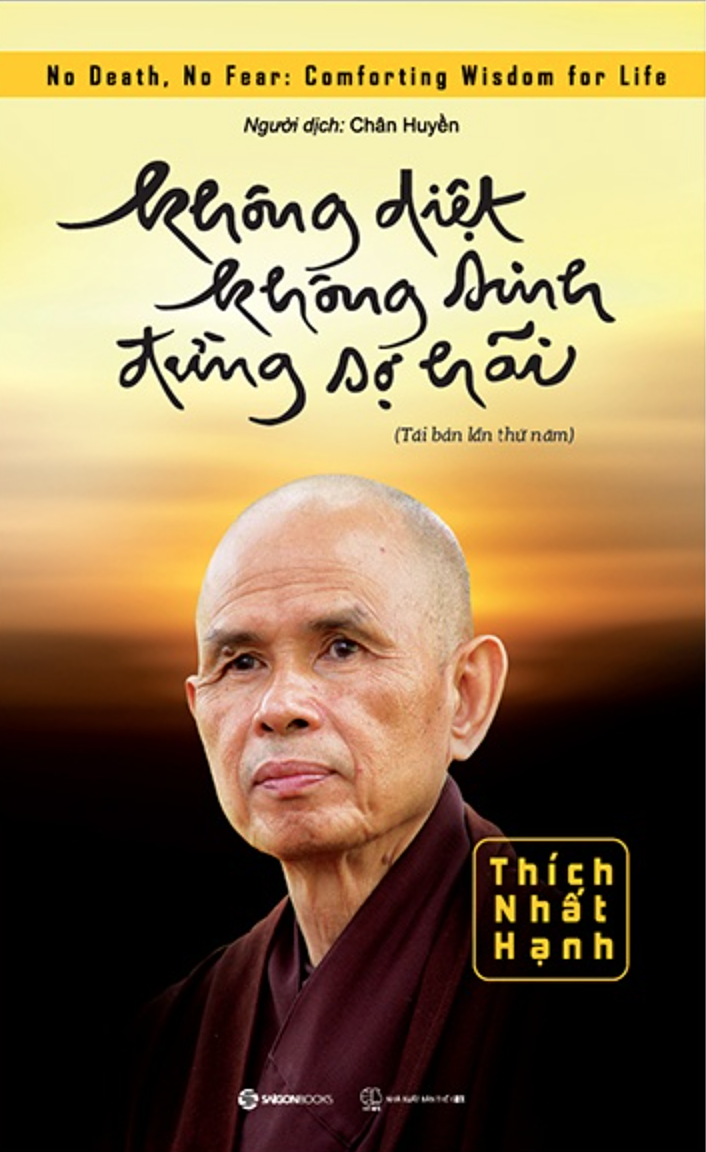 |
Zen Master Thich Nhat Hanh's book, 'No death, no fear,' translated by Chan Huyen. *Photo: The Gioi Publishing House*
Initially, the book might seem complex due to Buddhist terms like impermanence, non-self, nirvana, and dependent origination. However, Zen Master Thich Nhat Hanh illustrates these concepts using specific life phenomena. For example, a cloud becomes rain, then a river, then water vapor, and then a cloud again. Similarly, flowers bloom in spring, branches dry in winter, and then flowers bloom again in the next spring. Where do these flowers come from? Is the flower of this spring the same flower as last spring?
The book's final chapter, 'Living with the Dying,' is essential for all of us. Perhaps everyone seeks to understand and master the art of living, but few concern themselves with 'the art of dying.' Although we know death is an obvious truth, we often choose to avoid it.
I sobbed uncontrollably when the doctor informed me my father would not recover. The doctor, concerned about my state, offered a few words: 'Please calm down, do you need any support?' I needed nothing but my father. I cried loudly. Suddenly, a cleaner passing by gently reminded me, 'Don't cry; if you cry, your loved one in there will suffer greatly. Chant Buddhist prayers for your father.' When we brought my father home, I cried again, and my neighbor came over to remind me, 'Don't cry; chant Buddhist prayers for your father.' I calmed myself and sat peacefully, holding my father's hand. With my eyes closed, I experienced a moment of serenity. I suddenly felt a ray of light before me, and when I opened my eyes, my father had passed away.
'If we know how to practice and deeply absorb the reality of no birth, no death, if we understand that coming and going, arriving and departing are merely concepts, and if we are present in a stable, peaceful way, then we can help those who are dying. We can help them significantly reduce their fear and suffering. We can help them die peacefully. We can help ourselves understand that there is no death, which means there is no fear. There is only continuation.'
I suddenly realized that by understanding the art of dying, one grasps the art of living.
Question: Where is the address of happiness? Answer: Here is the address: 'Now and here.' It has everything you want to know, including the zip code.
(Excerpt from chapter 6 - 'No death, no fear')
Huong Huynh