Authored by French anthropologist Claude Levi-Strauss, this concise essay is part of a series on global nationalism published by UNESCO in 1952. Originally titled "Race et Histoire", the 10-chapter work presents various anti-racist perspectives grounded in the study of civilizations. Through this, Levi-Strauss raises a fundamental question: "Does 'progress' equate to 'superiority', or is it simply a localized Western viewpoint?".
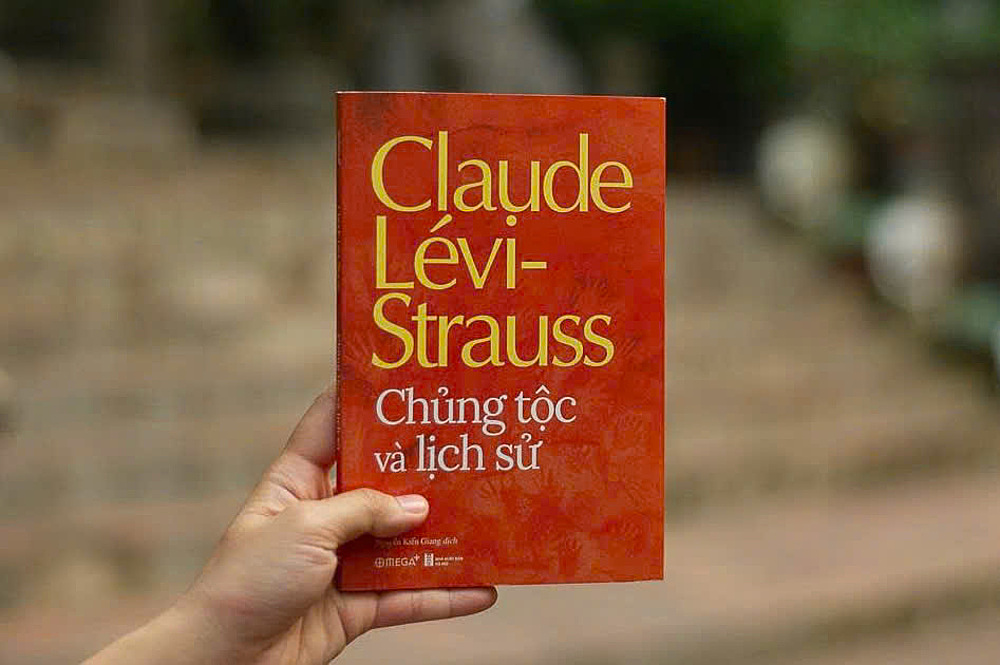 |
The Vietnamese translation, rendered by Nguyen Kien Giang, was released in November by Hanoi Publishing House in collaboration with Omega+ company. Photo: Omega+
According to Levi-Strauss, human history does not unfold along a linear path but rather as networks of "cumulative history" and "stationary history". Within this framework, each culture finds its unique meaning when viewed in relation to other cultural identities. Despite differences in developmental stages among many communities, Claude Levi-Strauss asserts the intellectual parity of all people, rejecting the hierarchical division of "savage" and "civilized". Consequently, his essay is regarded as a powerful declaration of humanity's intellectual equality.
Amazon describes the original text as having an accessible style with minimal technical jargon, yet it effectively introduces core principles of structuralism—one of Claude Levi-Strauss's renowned theories. For the domestic translation, the publisher stated that the edition was edited based on the late translator Nguyen Kien Giang's 1996 print, honoring his dignified yet simple translation style.
 |
Portrait of master anthropologist Claude Levi-Strauss. Photo: AFP
"Race et Histoire" has received widespread acclaim on reading and book-buying forums, earning 4,6/5 points on Amazon and 3,8/5 points on Goodreads, respectively. Most readers praised its concise content and balanced perspective on different civilizations. A Goodreads reader's review states: "The work reveals the scholar's deep understanding of human issues faced in the past and present, as well as those that might arise in the future".
Claude Levi-Strauss (1908-2009) was a French-Jewish anthropologist, born in Belgium. He is considered the father of modern anthropology and one of the 20th century's most influential thinkers. Throughout his research career, he undertook numerous expeditions to central Brazil, developing theories on the similarities between tribal and industrial societies. Some of his works translated into Vietnamese include "Totemism", "Anthropology Facing Modern World Problems", and "Tristes Tropiques".
Phuong Thao