Early year spring excursions, known as "du xuan," are a cherished Vietnamese tradition, observed even within the ancient imperial court. According to *Vietnamese Kings and Untold Stories* by Le Tien Long, historical records do not detail the specific Tet activities of Ly and Tran dynasty kings. It was not until the Le Thai Tong era that official histories recorded on the first day of Tet in the year Giap Dan (1434), "the king led officials to pay respects at the Thai Mieu temple". In the year At Mao (1435), emperor Le Thai Tong allowed all officials to enjoy Tet, "hosting a five-day banquet for civil and military mandarins, both inside and outside the court".
Documents from the National Museum of History indicate that the Le Dynasty had a custom of royal spring excursions during the new year. In *Hue Capital and Spring Imperial Festivals* by Doctor Phan Thanh Hai, Nguyen Dynasty kings typically began these activities on the 5th day, though it was not formally codified as a ritual. Only from the reign of Dong Khanh onwards did Nguyen Dynasty emperors establish the custom of spring excursions starting on the first day.
*Nine Lords and Thirteen Kings of the Nguyen Dynasty* states that when the capital fell (5/7/1885), emperor Ham Nghi abdicated and initiated the Can Vuong movement against the French. Subsequently, the colonial government enthroned emperor Ham Nghi's elder brother, who adopted the reign title Dong Khanh. At that time, public opinion suggested that this emperor was being held under house arrest by the French within the imperial palace. Therefore, French general Prudhomme, the representative of the French government in Hue, organized a spring excursion on the afternoon of the first day of Tet Binh Tuat (1886) to convince the populace that the emperor remained free.
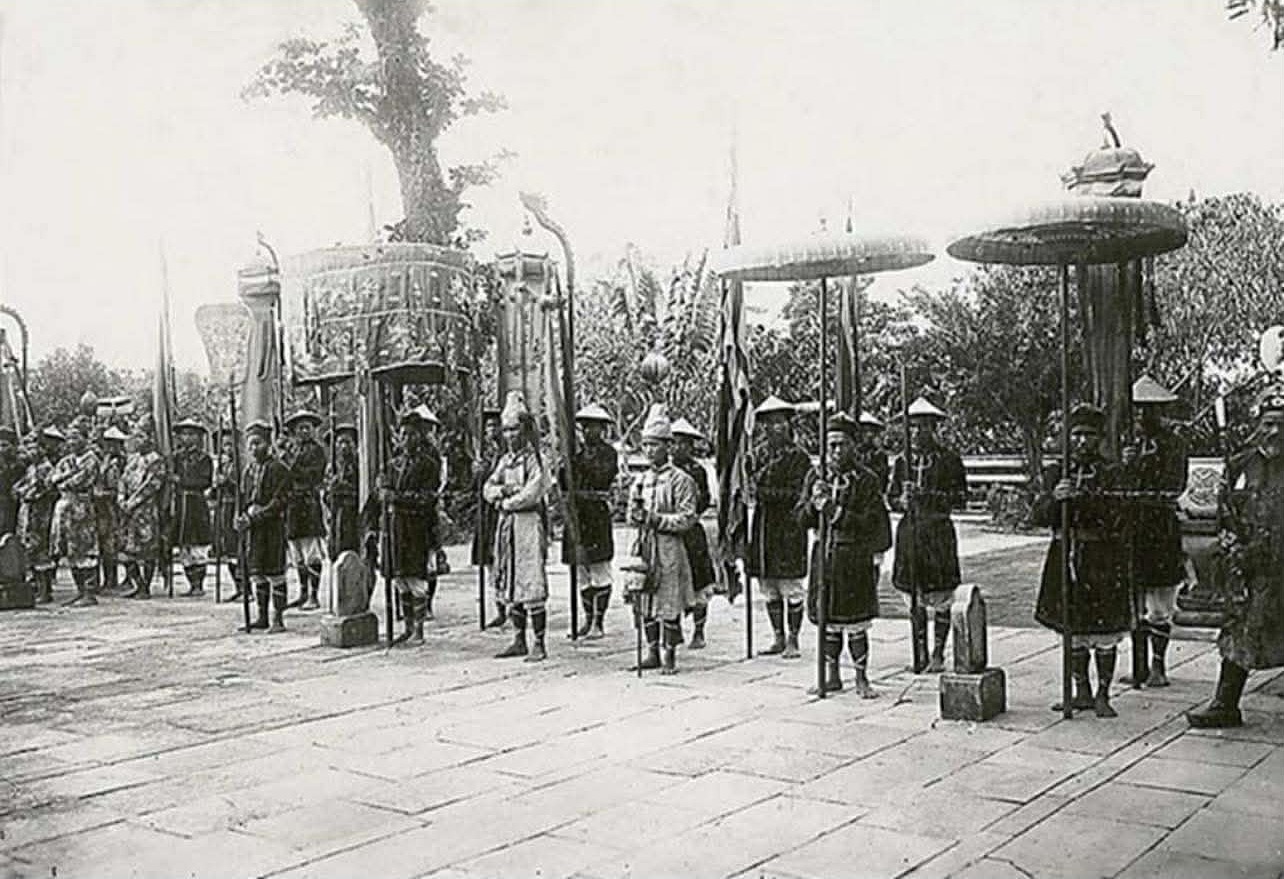 |
Soldiers carrying a palanquin stand in front of the Thai Hoa Palace. *Photo: National Archives Center I* |
Following the Khanh Ha ceremony at Thai Hoa and Can Chanh palaces, and at an auspicious hour chosen by the Imperial Observatory (Kham Thien Giam), emperor Dong Khanh would ascend his palanquin. Civil and military mandarins, along with soldiers carrying swords, spears, flags, and fans, would follow as his escort. The soldiers carrying the palanquin would circle the capital and visit a few places the emperor favored for his spring excursion and to observe the people's Tet celebrations.
According to Hue researcher Phan Thuan An, the emperor's palanquin was kept open so the public could see his face. After traversing roads near the capital, the emperor would stop for a pre-arranged feast along the Perfume River. At 17h, the feast concluded, and the emperor returned to the Imperial City (Dai Noi). Three signal shots were fired from the Flag Tower (Ky Dai), marking the end of the spring excursion.
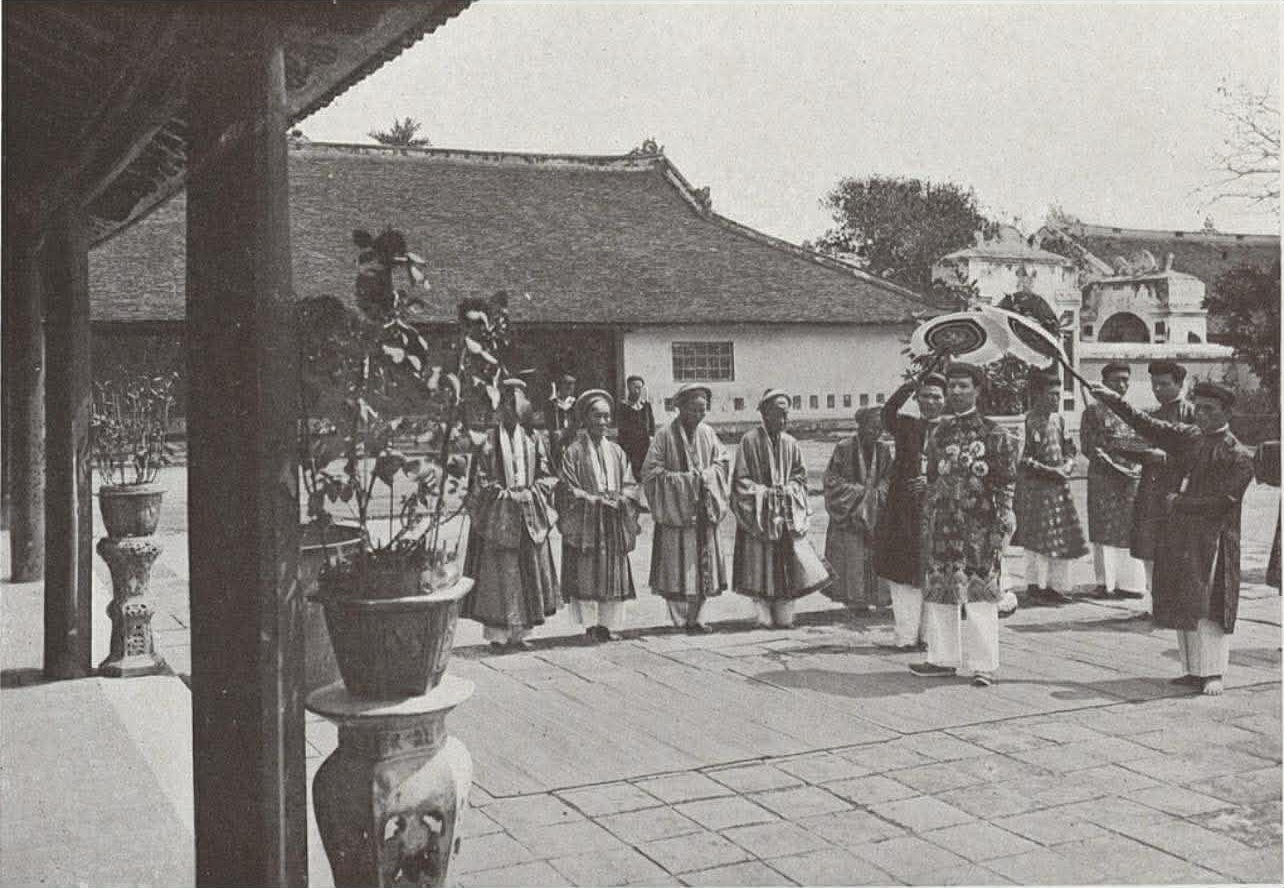 |
Emperor Khai Dinh pays respects to the empress dowager. *Photo: National Archives Center I* |
Subsequent emperors, Thanh Thai, Duy Tan, and Khai Dinh, organized similar events to those of Dong Khanh's era. However, emperor Bao Dai's spring excursions differed significantly, influenced by European culture. After the court ceremony at Thai Hoa Palace on the early morning of the first day, raising a champagne glass with high-ranking officials and foreign friends, he would begin his Tet celebrations.
Ms. Tran Thi Vui, the last court lady of the Nguyen Dynasty, recounted that emperor Bao Dai was not overly ceremonial. When the emperor visited Dien Tho Palace from Kien Trung Pavilion to see Empress Tu Cung (Empress Dowager), court ladies would prepare a dominoes table for him to play with the empress dowager on New Year's Day. Sometimes, he played chess with his wife or high-ranking officials.
The emperor disliked Hue royal court music (Nha Nhac) and instead chose popular Western romantic songs to listen to while playing chess. On the afternoon of the first day or morning of the second day of Tet, he played golf in the Da Le hills (Hue). Hue researcher Nguyen Dac Xuan once stated: "While other Nguyen emperors went boating on the Perfume River during Tet, emperor Bao Dai performed jet ski, a completely new sport in Hue and Vietnam at that time. People often gathered on both banks of the river to watch the emperor perform".
Phuong Linh