Hwang Sun-mi’s acclaimed novel, "The Hen Who Dreamed She Could Fly", continues to resonate deeply with Vietnamese audiences, a decade after its initial translation and publication in the country. The book, first released in Korea in 2000 and translated by Nguyen Thi Thu Van in 2013, is a staple for literary competitions in Vietnam, according to Korea. Its enduring popularity was evident during the author's recent visit to Vietnam, where she expressed gratitude for the warm reception.
On the afternoon of 23/9, hundreds of readers, including university students, gathered at the Youth Theater to meet Hwang Sun-mi and hear her insights into her work. The author shared her joy at reconnecting with readers after 10 years since her first interaction in Vietnam, calling herself "blessed".
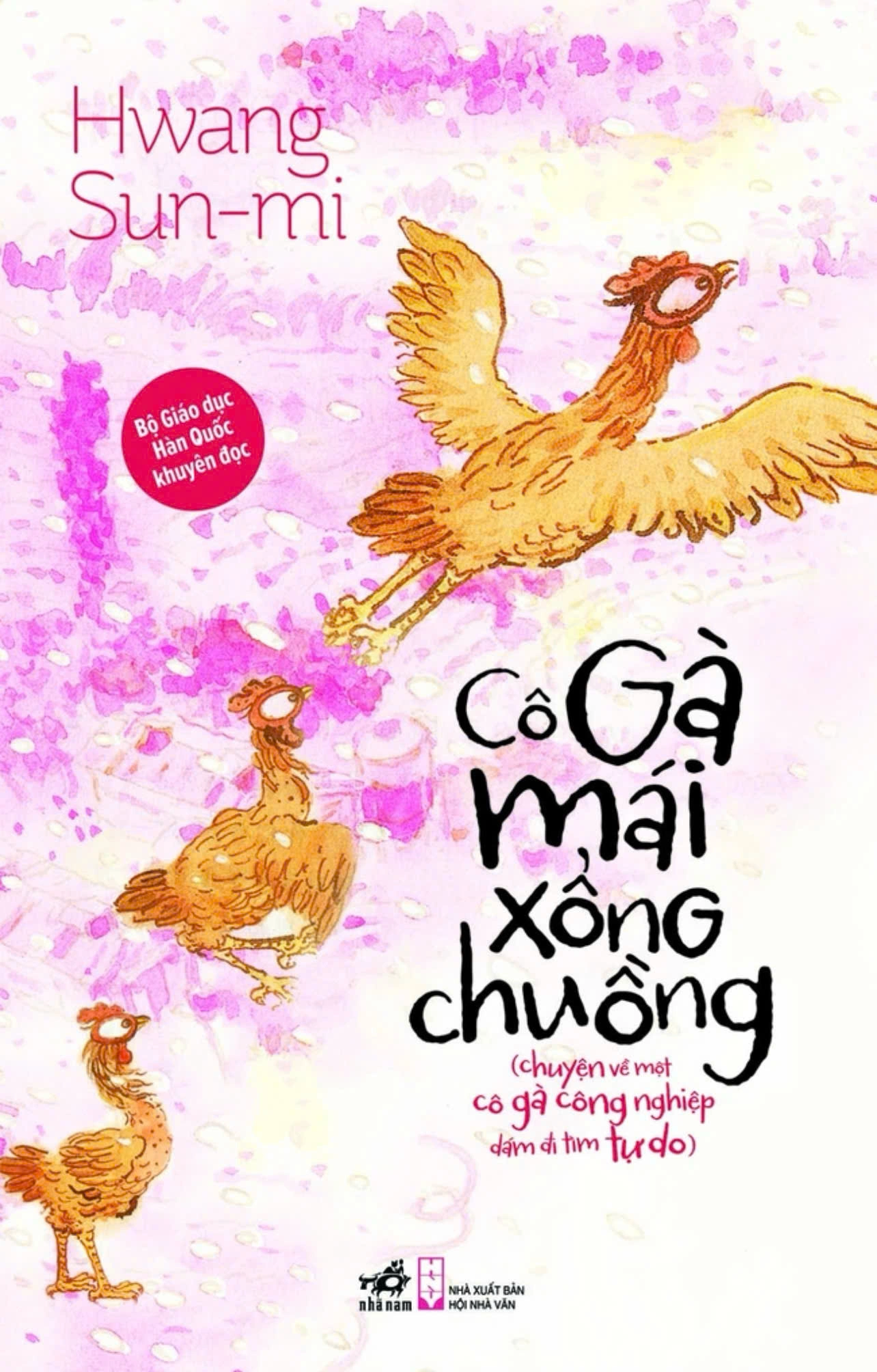 |
The book "The Hen Who Dreamed She Could Fly" is recommended by the Korean Ministry of Education. The work was adapted into the animated film "Leafie, A Hen into the Wild" (2011), a traditional play, and a musical. Photo: Nha Nam |
The book "The Hen Who Dreamed She Could Fly" is recommended by the Korean Ministry of Education. The work was adapted into the animated film "Leafie, A Hen into the Wild" (2011), a traditional play, and a musical. Photo: Nha Nam
The story centers on Leafie, an industrial hen bred for laying eggs, who yearns to escape the confines of her farm to experience freedom and the world outside. After accidentally breaking free from her wire cage, Leafie embarks on a journey to change her destiny. This quest for freedom, however, brings many dangers. With the help of Wanderer, a wild duck, Leafie manages to evade the constant threat of the Weasel.
While seeking refuge from the Weasel, Leafie discovers an abandoned egg, unaware that it belongs to Wanderer and a white duck. The hen decides to incubate the egg, naming the duckling Greenie, and dedicating her love to the wild duckling despite their different species.
Hwang Sun-mi explained that beyond the tale of maternal love, she wanted to emphasize the message of striving for one's dreams. She believes everyone possesses an "egg" to nurture, just like Leafie, symbolizing the aspirations they hold within themselves.
The author's greatest inspiration for creating Leafie came from her father, who suffered from a terminal illness during the time she was writing the book. Despite lacking a formal education, he worked hard and dedicated his life to his children. "Each of us is a bright star in our own lives", she said.
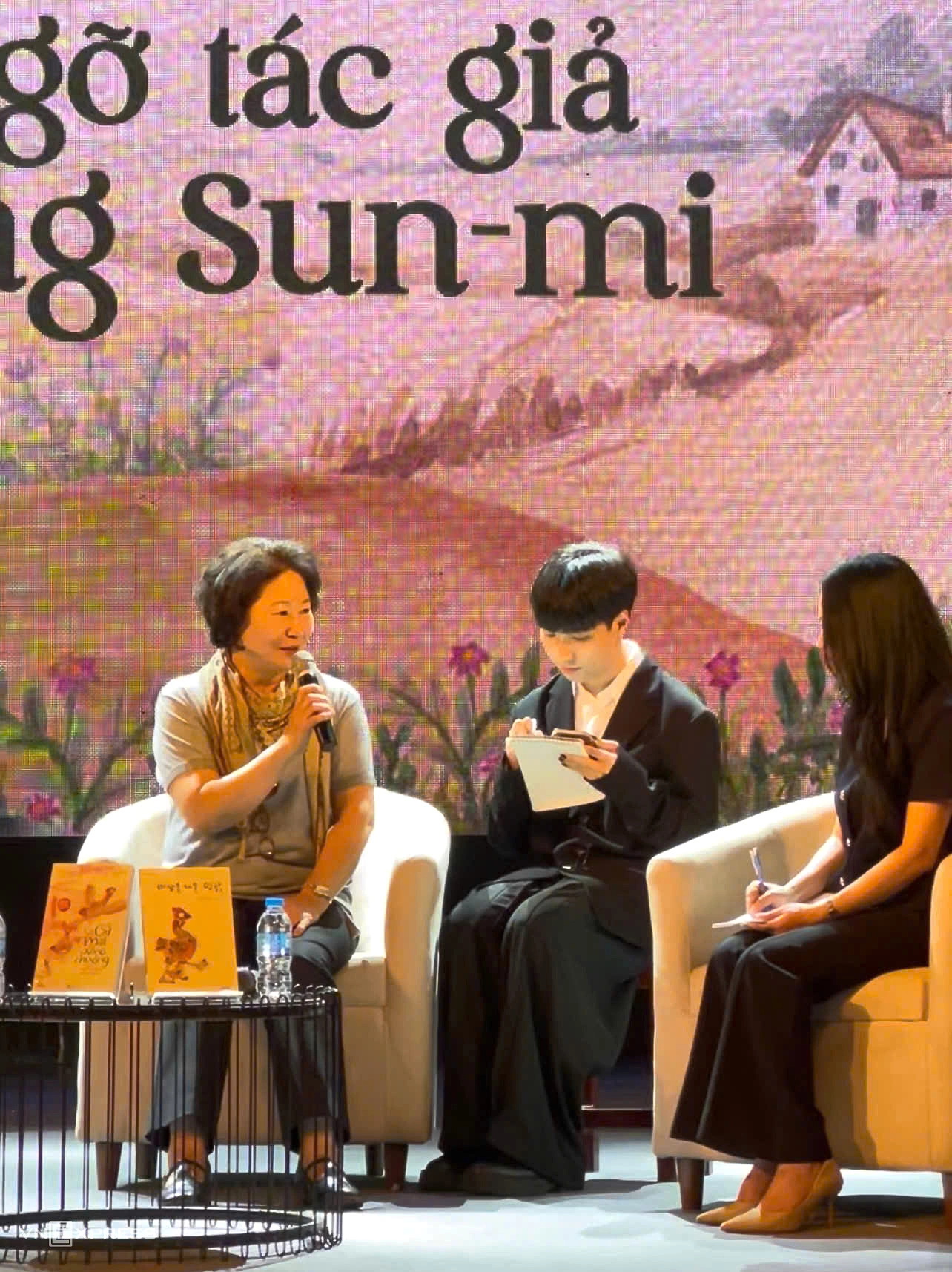 |
Author Hwang Sun-mi (far left) at the meeting with Vietnamese readers. Photo: Phuong Linh |
Author Hwang Sun-mi (far left) at the meeting with Vietnamese readers. Photo: Phuong Linh
For Nguyen Thi Thu Van, "The Hen Who Dreamed She Could Fly" was her first translated work. Over a decade later, she remains moved by the book's imagery: Leafie meeting her duckling for the first time, or the poignant moment the hen bids farewell to Greenie as he flies north, leaving herself to face the Weasel. In her final moments, Leafie feels light, seeing a blue sky above and a vast field and lake below.
The translator agrees with the ending, noting that the story concludes not in sadness or despair. Ultimately, Leafie fulfills her desire to be the protagonist of her own life, living freely, incubating and raising her child, and experiencing a full spectrum of emotions.
An excerpt from the play "The Hen Who Dreamed She Could Fly" performed by students from Hanoi University. Video: Phuong Linh
According to Nguyen Thi Thu Van, the reason "The Hen Who Dreamed She Could Fly" holds a special place in the hearts of many readers is its appeal beyond children's literature. While telling pure stories for children, Hwang Sun-mi also conveys perspectives that adult readers can reflect upon regarding maternal love, separation, and coping with loss. The book contains a passage: "In every corner of the meadow, something is always happening, never ceasing. If someone dies, someone else is born. Experiences of parting and meeting happen simultaneously. Therefore, at some point, sadness cannot last".
Hwang Sun-mi, 63 years old, was born in Hongseong, Korea. She studied creative writing at Seoul Institute of the Arts. She has published over 30 books across various genres and themes. Besides "The Hen Who Dreamed She Could Fly", she is known for works such as "The Dog Who Dared to Dream", "The Friends of the Sunrise Valley", and "The Naughty Little Book". She received the SBS Children's Media Award in 2001 and the Se-jong Children's Literature Award in 2003.
Phuong Linh