"Leaves and Flowers on the Way Home" compiles the venerable's answers to various personal dilemmas, aiming to resolve life's challenges through Buddhist principles. VnExpress is publishing two excerpts from the book, with section titles provided by the editorial board.
How to teach children to live righteously
Dear Venerable, how can parents educate their children to live more righteously? Thank you.
Teaching children depends on many factors: your guidance contributes one part, the child’s merit another, and your own merit a third. If you lack sufficient merit, your words may not be heard. Likewise, if your child lacks enough merit, they may not absorb wise advice. Furthermore, it also depends on the child's daily environment: how much time do they spend with friends at school or colleagues at work, compared to the time they spend with you?
Moreover, if you wish for your child to embrace a spiritual, ethical life, but there are no easily accessible resources in your community to guide them, it becomes challenging. Thus, educating children to live righteously relies on many elements, not just parents.
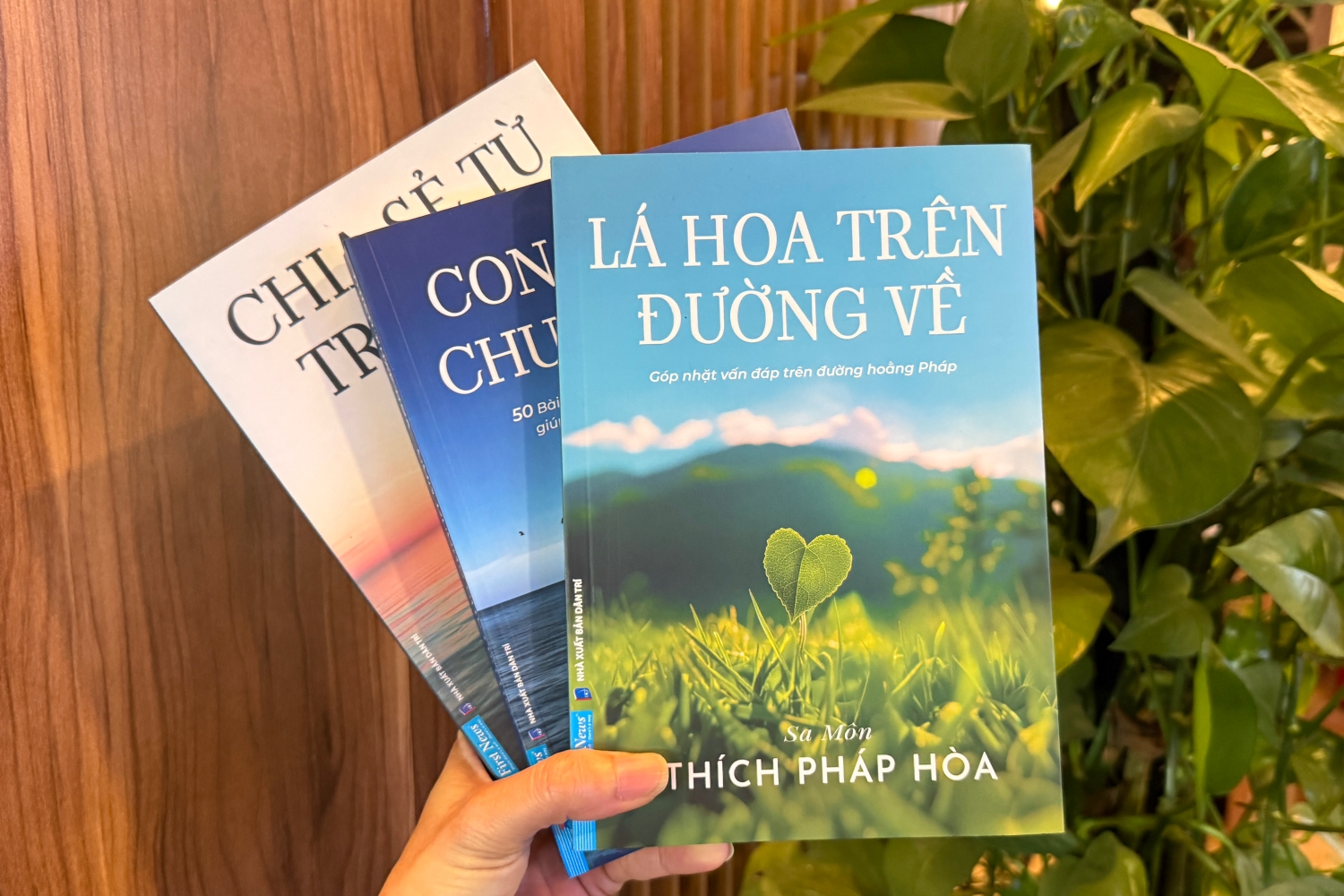 |
Sach "La hia tren duong ve" cung hai cuon phat hanh truoc do cua nha su Thich Phap Hoa. Publisher provided
Phap Hoa offers an example: you might want your children to go to the temple, but most temples do not speak English or French, which are the children's languages. Additionally, a typical chanting session lasts one hour to one and a half hours; how can they be expected to sit still for so long? Even if they make the effort to sit with you, if they open a sutra and do not understand it, how can they follow along?
Let us not even speak of children; consider ourselves as adults. Many Buddhists go to the temple, open the sutras, and read them all: "Thus have I heard. At one time the Buddha was dwelling in the Jetavana monastery in Savatthi..." But if asked, "Do you understand anything?", the answer is often "No". They understand nothing. Therefore, we must recognize that we currently lack a proper means to guide children.
What if children ask you, "Mom, why do we bow to the Buddha three times?" How do you answer? "I don't know. Since I was little, I saw people bow three times at the temple, so I do too." Or if they ask, "Mom, why do you bow to monks younger than you?" You might say, "I don't know. I just see others bow, so I bow." Or they might ask, "Why do we have to wear such long robes to the temple, Mom?" "I don't know." If we do not truly understand the meaning of certain rituals ourselves, how can we guide children? While good intentions are important, we must also understand the practical circumstances. Therefore, we only need to do our best in our daily family life, as we are the closest and most influential figures to our children.
Dear assembly, Phap Hoa would like to reveal a small secret: do not think children do not pay attention to how you practice. Often, when you return home, friends call to discuss temple matters or gossip. Your children listen and understand everything. They might even remain silent but shake their heads, thinking, "This approach is not for me." Phap Hoa knows this because children tell him about the things they hear from adults, such as stories about Mrs. Nam, Mrs. Tam, and Mrs. Bay – all just talk about other people. There are also stories about temples, saying one venerable is good and another is not. Do not think children do not understand; they are like "Bodhisattvas", observing and understanding everything.
Therefore, dear assembly, it is often like the folk saying: "Mother shrimp tells her young to walk straight, not crooked, lest the world mock! The child replies, 'Mother, I honor you, I follow you! But mother, you first try to walk straight!'" We must practice and live daily in a way that our children and grandchildren can witness our spiritual practice.
Phap Hoa does not mean that we must wear robes for a certain number of hours or bow a certain number of times; what matters is our conduct. Everything we do in our daily lives serves as an example for our children.
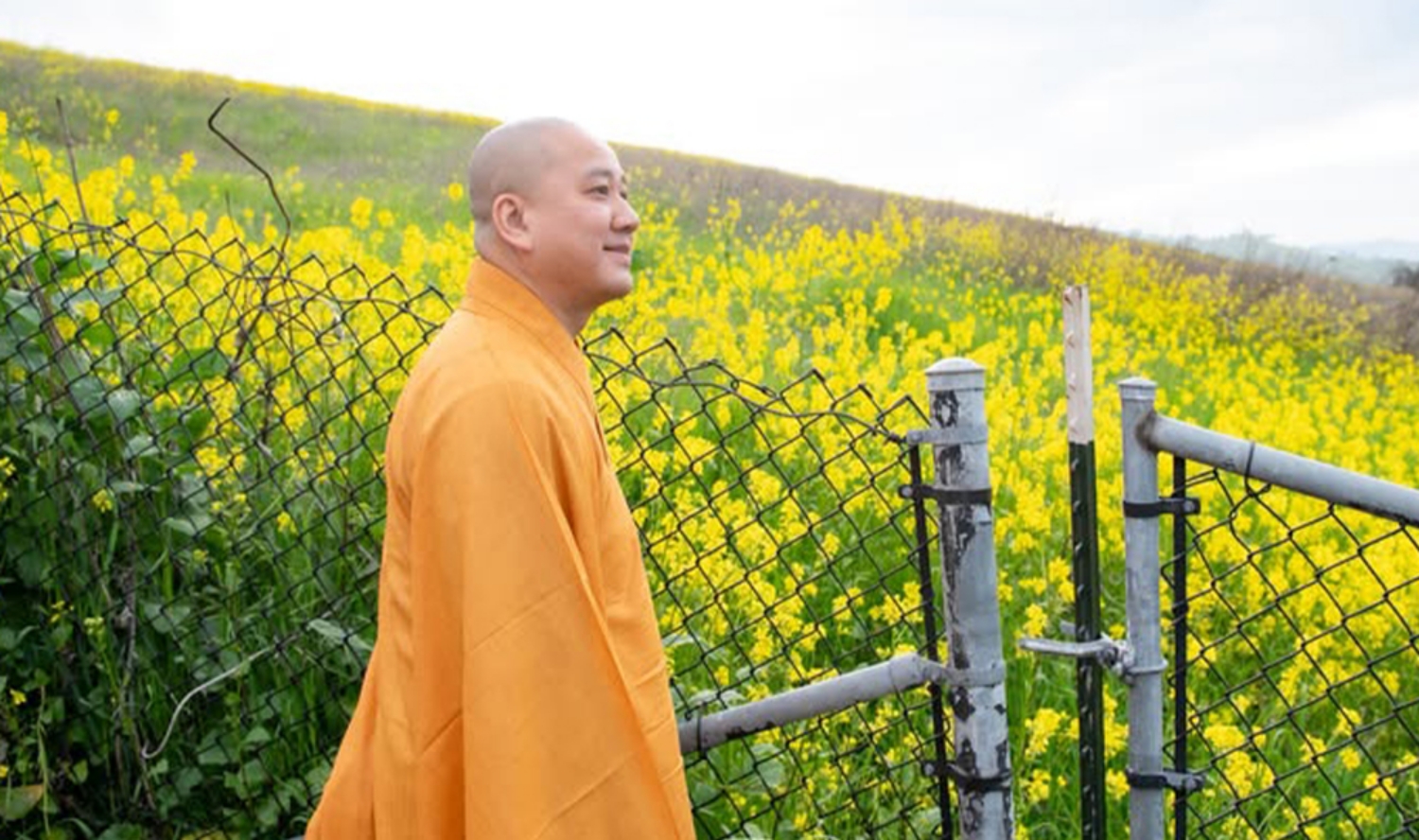 |
Nha su Thich Phap Hoa. Publisher provided
Dear assembly, even in a temple, a teacher has a great influence on their disciples. If a monastic is generous, compassionate, and skilled at guiding disciples, then their disciples will absorb the teacher's character from a young age and grow up to become exemplary teachers themselves. A young monastic is like a child living in a family. The disciple’s development is partly shaped by the teacher's daily life, much like parents influence their children.
Even the way we speak is crucial; children will imitate everything. If you use overly familiar or potentially rude language daily, they will too. They might not understand the meaning but hear you speak, so they assume the words can be used without distinguishing right from wrong or appropriate from inappropriate. Therefore, we must be careful in guiding and educating children.
Furthermore, we sometimes inadvertently fail to encourage our children when they act kindly towards others. For example, a child comes home from school and says, "Mom, my lunch was so good today, my friend saw it and asked for some." "And did you give it to them?" "Yes." "Why are you so foolish?" Instead, we should say, "Oh, it's okay, dear. If your friend liked your food, it's good to share." Or if we hear our child say, "Mom, my friend hit me today," we immediately ask, "Did you hit them back?" We often want our children to be smarter or tougher than others' children. We might even teach our daughters, "In this country, women are supreme, dear; do not let your husband lead you by the nose." But with sons, we teach differently: "You are a man; do not let your wife control you."
Thus, if we have a daughter, we want her to control her husband; if we have a son, we want him to control his wife. These are just simple daily life examples Phap Hoa offers, not even touching on ethical aspects. For instance, you go shopping with your child, buy something expensive, but instruct them not to tell the truth at home for fear of your husband's reprimand: "Later, when your father asks, tell him Mom bought this for ten dollars."
We inadvertently teach our children to lie, do we not? Or someone calls the house, you recognize the number as someone you dislike, and you tell your child, "Answer the phone and say Mom is not home," when you are actually there. You could instead say, "Please answer the phone for Mom and say I am busy." This way, you still state you are home but occupied. So, in life, we sometimes have bad habits and unintentionally teach them to our children.
Regarding spiritual life, we sometimes think, "My children are grown; I will let them decide for themselves and not worry." When they were young, we rarely took them to the temple, believing parents should let children freely choose as they grow up. We even spoke English or French with them at home instead of Vietnamese. At the most basic level of language, they have lost their roots. Children are capable of learning both languages, but if we do not speak Vietnamese to them, how can they learn it?
Therefore, wanting something is one thing, but difficulties exist, and if we do not fully grasp this, we cannot overcome them. We need to remember: many factors contribute to a child's character, from circumstances and the surrounding environment to the lifestyle of family members.
For example, at dinner, no matter what, everyone should sit together at dinnertime so the child always sees the image of a reunited family. Instead, daily after school, at mealtime, the child sees father with a bowl, mother with a bowl, child with a bowl—everyone eating separately, each with their own focus. The child has video games, the mother has Korean dramas, the father has basketball or football on television. If only at dinner, everyone goes in their own direction, how can they find a common direction?
Even now, every home has a television and a computer; after eating, everyone retreats to their room, each with their own world—this is also a challenge. Even on weekends, often the mother goes to the temple, the father goes fishing, and the children go with friends, with no shared activities. Thus, we must skillfully create a common direction for our family. However, this cannot be done by the wife or husband alone; it requires both, and even the help of grandparents. The parents teach one way, then go to work, leaving the children with grandparents at home, who teach them another way. People often say, "Grandparents spoil grandchildren foolishly." Grandparents indulge them in every way; if the parents speak up, the grandparents get angry and say, "I will not look after your children anymore."
There are many issues in daily life and within families that cannot be fully discussed in a short time. For this, we need to create opportunities for parents to come together. For example, occasionally, temples can organize dharma talks where parents can share their challenges in raising children.
At Phap Hoa's retreats, when children are present, he often arranges for them to sit together and share the difficulties they encounter with their parents. This is a convenient time for children to speak, or many write notes and put them in a cookie box to be passed to Phap Hoa. When he opens and reads them, he truly sees the children's feelings.
Therefore, teaching or guiding children is a significant issue, not something that can be addressed in a few sentences. In daily life, for example, with routines or worship, we must guide them gently so that children gradually become accustomed. For instance, you take them to the temple, and after they bow to the Buddha, you either let them sit through a short chanting session and then leave, or allow them to go outside to play, as they cannot yet absorb much. Even adults get tired after sitting for a while; many people chanting keep checking how many pages are left, let alone children. So, the assembly must have this understanding.
To be continued
(Excerpt from "Leaves and Flowers on the Way Home", First News Publishing)