


In february, The Guardian published an analysis by 62-year-old British writer Francis Spufford on the appeal of fantasy literature, coinciding with the release of his new novel, Nonsuch. As an author who specializes in and is passionate about fictional narratives, Spufford argues that this genre reflects the wildness and extraordinary dreams within each person – aspects often hidden by everyday life. He also points out the paradox that fantastical literature is a form of reality, truthfully depicting ordinary human experiences under a magical guise.
Below is the original article by Spufford:
Fantasy literature does not need our defense. It is one of the great cultural forms today, widespread and popular everywhere. It might even be the dominant form of writing in contemporary literature, fitting the bookseller's joke that the publishing industry is now divided into two groups: A - romantasy, and B - everything else.
However, perhaps a brief explanation is needed for those who do not understand the appeal of this genre – those who still view it as wish fulfillment, or a lesser form disdained by literary fiction or tolerated in some incomprehensible way. As a writer of speculative fiction who has borrowed from and been fascinated by fantastical motifs for many years, I am now releasing another fantasy work without shame. I have read and loved fantasy literature my entire life. To me, the excellent creative writers in this genre deserve to be considered on par with masters of any other genre. Yet, I still feel a vague unease, as if I must explain why I write fantasy. As if I need an excuse to write about dragons, regardless of how culturally prevalent they are.
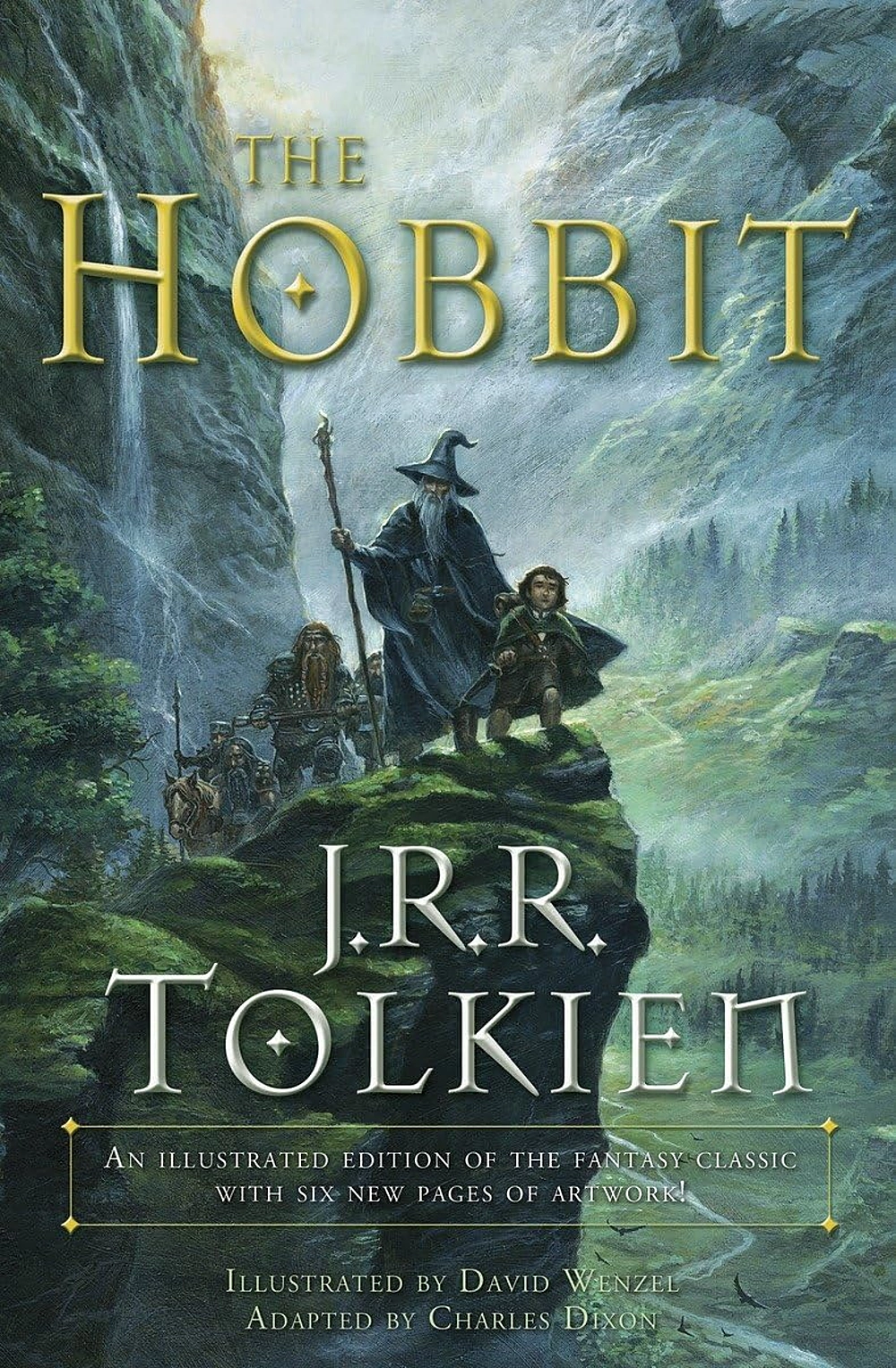 |
The cover of an English edition of "The Hobbit" – a prequel to "The Lord of the Rings" trilogy. Photo: Del Rey |
The cover of an English edition of "The Hobbit" – a prequel to "The Lord of the Rings" trilogy. Photo: Del Rey
What I am about to say is probably unnecessary for those who love this type of story. We take for granted the joy it brings, viewing it as a literary form that includes both solid, excellent works and some of the "molded plastic" variety – then we discuss the details. Is it portal fantasy or epic? Set in an urban environment or focused on customs? Romantic or grim? Warm or terrifying? And then, which lineage does your aesthetic belong to? Is it part of Tolkien's infinitely branched family (in The Lord of the Rings), or the feminist lineage stemming from Ursula K. Le Guin's creations that truly matters? Are you interested in the idea of decolonization in NK Jemisin's books, Katherine Addison's LGBTQ+ inclusivity, Guy Gavriel Kay's re-imagined history, Jeff VanderMeer's surrealism, China Mieville's political satire, or Tamsyn Muir's queered gothic? For any topic, a conversation awaits, a corner where we can happily chat.
But for others, this is a defense of fantasy literature from the start. First, this genre is truthful to the human mental experience. Specifically, it is truthful to the wild part within us – something the daytime world of rationality, consensus, and moderation does not easily reveal, but which everyone feels. Children and adolescents perceive this deeply because they experience conflicts between living dependently and how they sense their own great stature – a vague power they dimly recognize within themselves. Furthermore, the way the world's evil appears so vast and new in children's eyes makes dragons and monsters feel natural. But this is also true for people of all ages, in many different ways. As philosopher Charles Taylor says, we live within the constraints and protection of the "buffered self". We view the mortal realm as a place devoid of magic; believing there is a safe boundary between our inner selves and everything else, preventing demons, ghosts, fairies, illusions, spirits, and benevolent or malevolent forces from crossing over.
This keeps us safe, but it also cuts off and diminishes our exuberance and imagination. It makes us long in a confused way for the magic it itself dismisses, making us wish that magic might sometimes be allowed to surge forth.
 |
Novelist Francis Spufford, a professor of creative writing at Goldsmiths, University of London, has had his work longlisted for the Booker Prize. Photo: The Observer |
Novelist Francis Spufford, a professor of creative writing at Goldsmiths, University of London, has had his work longlisted for the Booker Prize. Photo: The Observer
Or perhaps it is more a matter of need than desire. A world entirely devoid of magic – with nothing but physical processes that can describe everything without metaphor, where even consciousness is just a material problem awaiting resolution – can be a barren place. It leaves the heart and mind in a state of deprivation. This is a point writer Philip Pullman made in The Rose Field – the final volume of his novel series The Book of Dust (known as Bui Ki in Vietnam), where he has his character Lyra ponder humanity's need for things we cannot prove, but would suffocate without. Above all is imagination. He wrote: "Perhaps imagination is a kind of wind blowing through all worlds... It shows us things that are true". For Pullman, the enemy of imagination is clearly religious dogma more than narrow scientific materialism – but there are many different ways to identify what is paralyzing the modern world, as well as ways to name the indefinable wind that blows through all realms, showing us countless truths.
Nevertheless, there are many things we exclude from the world by eliminating magic and do not truly want them back. At least, we do not truly want them to return. There is an interesting story about the origin of the fantasy genre – you can find it analyzed brilliantly and subtly in novelist Adam Roberts' recent book, Fantasy: A Short History. In it, this literature functions as "the controlled return of the repressed". A kind of partial haunting. With kings and conquests, with chosen ones and powerful battles between heaven and earth, it brings back everything we lack in a world of science, contracts, work, and regularity, but we do not want them to return completely. Roberts identifies World War one as a turning point that gave a generation of young men like Tolkien and CS Lewis (author of The Chronicles of Narnia) an experience of a brutal, mechanically cold modernity; fostering in them a desire for a literature where ancient myths – spaces for individual will – returned, told in the form of modern works. We like to dream of having bulging muscles like Conan (a character in American writer Robert E. Howard's Conan the Barbarian series) while office life turns us into weaklings; we like to think of ourselves as unique and remarkable "chosen ones" even though in real life we are just a pixel in the crowd. But when we have such dreams, we prefer to safely dismiss them, rather than try to confront a world where irresponsible kings and uncontrolled barbarians shape our destiny. With this argument, we package magical things into trilogies with conclusions and books with final pages.
Trailer for the film "Conan the Barbarian", adapted from Robert E. Howard's work. The character Conan, played by actor Arnold Schwarzenegger, appears from 0:59. Video: YouTube Film Trailer Channel
But there is another story about fantasy that needs to be told. In this narrative, fantasy literature is not just magical books that express impulses, or an organized nostalgia for a more romantic world. It exists (paradoxically) as a necessary form of reality, appearing in response to characteristics of the contemporary world that we cannot otherwise notice or recount. I believe that beyond expressing human disappointment with a world that lacks wonder, fantasy literature is the best means to grasp how humanity still retains its mystique despite all our "buffering" efforts. I read and write fantasy because it is a genre that sees human experience as consistently extraordinary. It understands that we are desperate creatures living by metaphor, finding meaning in life by connecting similar patterns no different from incantations. It understands that there are risky struggles, and that good and evil in their purest forms revolve around countless human choices. Fantasy literature understands that embarking on risky love is stepping out of one's comfort zone, venturing into strange lands on journeys that are both dangerous and wonderful.
Trinh Lam (according to The Guardian)


