A 64-year-old man experienced a sudden cardiac arrest on new year's eve while being transported to the emergency room. Upon arrival at Gia Dinh People's Hospital, his heart had stopped, accompanied by critical ventricular arrhythmia. The hospital's extracorporeal membrane oxygenation (ECMO) team, comprising specialists from the cardiology intensive care unit and interventional cardiology department, was immediately mobilized, foregoing their new year's eve celebrations to rush to the hospital. Their rapid deployment of the E-CPR system, combined with emergency revascularization of a blocked coronary artery, spectacularly pulled the patient back from the brink of death. His health has since stabilized, concluding a week-long battle for survival.
E-CPR, or extracorporeal cardiopulmonary resuscitation, is hailed by medical professionals as a "lifesaver" and a significant advancement in modern medicine. This technique is employed when traditional cardiopulmonary resuscitation methods prove unsuccessful. It involves the simultaneous initiation of a veno-arterial ECMO (extracorporeal membrane oxygenation) system while chest compressions and artificial respiration are being performed. This device temporarily takes over the functions of the heart and lungs, pumping oxygenated blood to vital organs and offering a crucial chance of survival for patients.
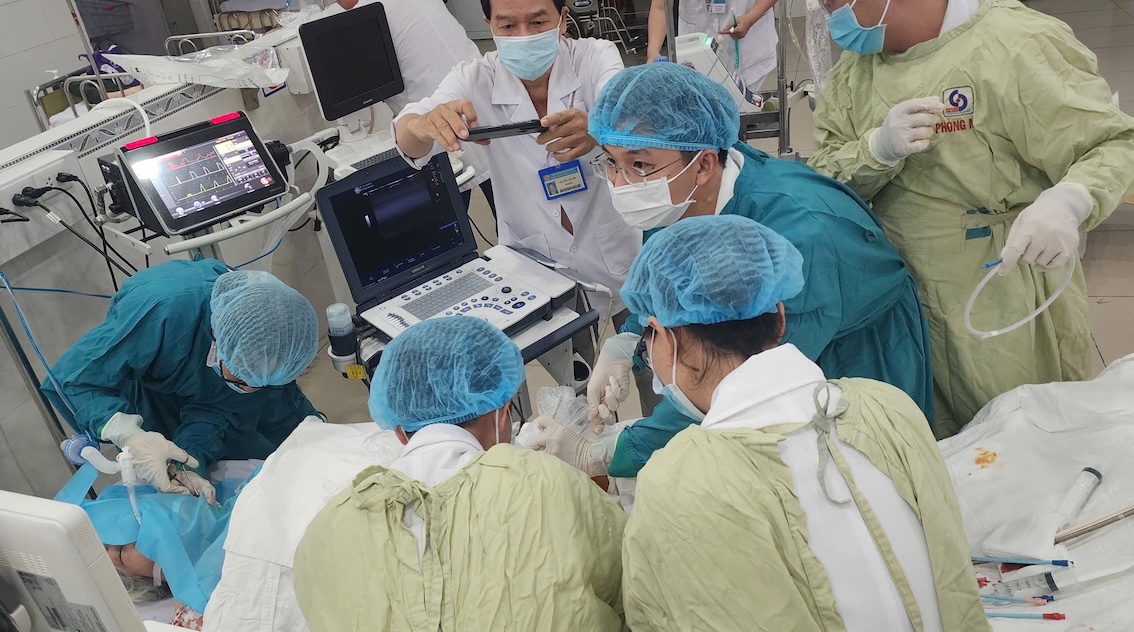 |
Doctors and medical staff at Gia Dinh People's Hospital during an E-CPR procedure. *Photo: Hospital provided* |
Clinical trials have demonstrated that E-CPR can increase the survival rate for out-of-hospital cardiac arrest cases by three to four times compared to traditional methods. Medical centers that successfully implement this technique can achieve survival rates of 30% to 40%. However, E-CPR demands extremely precise and seamless coordination among various specialties. Crucially, doctors must establish the ECMO system within 60 minutes of cardiac arrest for optimal effectiveness.
Under the direction of the Ho Chi Minh City Department of Health, Gia Dinh People's Hospital has been a pioneer in implementing a 24/7 E-CPR protocol for both in-hospital and out-of-hospital patients since 2025. When an alarm is triggered, resuscitation experts are on site within five minutes, and the ECMO system is established in just 15 to 20 minutes. Expanding its reach, from September 2025, Gia Dinh People's Hospital partnered with Saigon General Hospital to provide out-of-hospital emergency care. The dedicated ECMO team brings equipment directly to the scene, setting up the machine even while medical personnel are performing chest compressions. In the last four months of 2025 alone, this technique was used to save two out of five community cardiac arrest cases.
Assoc. Prof. Dr. Nguyen Hoang Hai, Director of Gia Dinh People's Hospital, reported that in 2025, the hospital applied E-CPR in 14 cases, encompassing both in-hospital and out-of-hospital scenarios. The survival rate with good neurological recovery reached 36%. This figure surpasses the 31% success rate reported by the Extracorporeal Life Support Organization (ELSO) for major centers worldwide. Beyond immediate life-saving interventions, the hospital also utilizes advanced imaging techniques, such as 4D ultrasound and cardiac MRI, alongside genetic testing, to accurately diagnose the underlying causes of sudden death. The ultimate goal of the medical team is to ensure patients can truly return to a normal quality of life.
Le Phuong