Eng English
China 中国人

Eng English
China 中国人
  • News
  • World
  • Business
  • Entertainment
  • Sports
  • Law
  • Education
  • Health
  • Lifestyle
  • Travel
  • Science
  • Digital
  • Automobiles
  • Trở lại Thể thao
  • Health
Wednesday, 19/11/2025 | 09:01 GMT+7

Saving a premature baby with stopped breathing and congenital heart disease

A baby girl born at 25 weeks gestation, weighing 700 g, was cyanotic, had stopped breathing, and suffered from congenital heart disease; doctors stabilized her body temperature, provided mechanical ventilation, and after two months of care, she weighed 3 kg.

The baby's mother had a history of premature birth 7 years prior. This pregnancy was achieved through in vitro fertilization (IVF). At 22 weeks gestation, she experienced membrane rupture and went into labor. Doctors admitted her to the hospital and administered medication to reduce contractions and performed a cervical cerclage to prolong the pregnancy.

The membrane rupture recurred at 25 weeks gestation. Dr. Nguyen Thu Van, Deputy Head of the Neonatal Department at Tam Anh General Hospital Hanoi, and her team provided emergency prophylactic treatment with antibiotics and corticosteroids to mature the baby's lungs, helping prevent infection. The pregnant woman then showed signs of umbilical cord prolapse, necessitating an emergency C-section.

A 25-week fetus is considered extremely premature, with underdeveloped organs such as the lungs, brain, digestive system, and immune system. The baby could not breathe independently at birth because her lungs had not produced enough surfactant, her blood vessels and nervous system were fragile, and her intestines were not yet fully developed. The medical team prepared resuscitation equipment and resources, including a mechanical ventilator, specialized monitors, resuscitation medications, and adjusted the operating room temperature to ensure the best conditions for the baby's arrival.
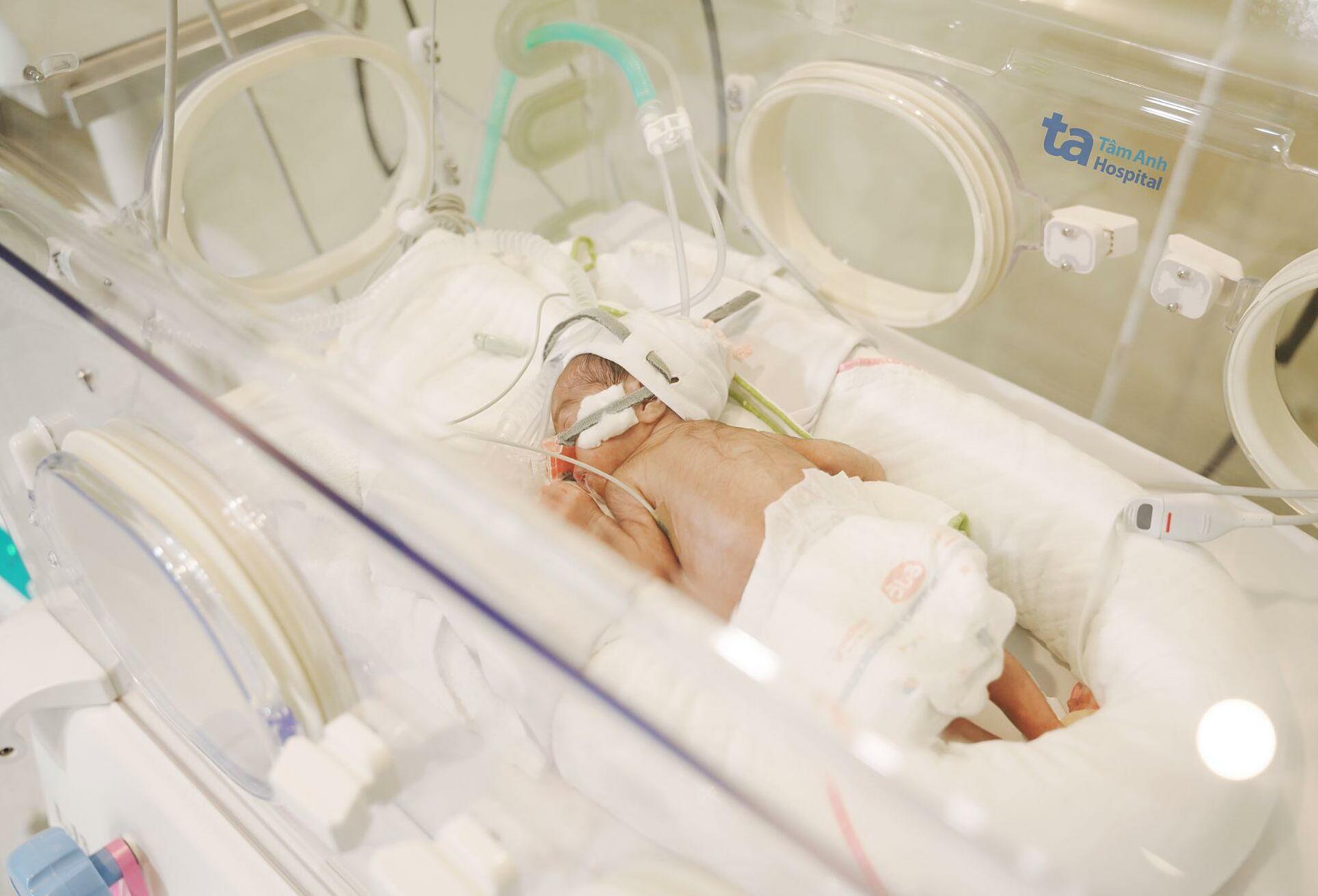
The baby was cared for in an incubator. *Photo: Tam Anh General Hospital*

The baby was born without reflexes, had stopped breathing, and weighed only 700 g. Doctors immediately performed intensive resuscitation on the mother's abdomen, using late cord clamping to allow the baby to receive blood from the placenta. Afterward, the baby was quickly transferred to the Neonatal Department, where her body temperature was stabilized, mechanical ventilation was initiated, antibiotics were started, and intravenous nutrition was administered within the first hour after birth.

On the third day, the baby developed chest retraction and feeding intolerance. An echocardiogram revealed a large patent ductus arteriosus (a type of congenital heart disease). Doctors prescribed treatment to close the patent ductus arteriosus while simultaneously treating enteritis with antibiotics and continuing intravenous nutrition. The baby's respiratory condition improved by the fifth day, allowing a transition to non-invasive respiratory support (CPAP). In the subsequent weeks, the baby received minimal oral feeding.

Premature infants, especially those born between 23 and 32 weeks, lack sufficient muscle tone, have very soft joints, and possess delicate lungs and nervous systems. Incorrect positioning can affect a baby's respiration and lead to head and limb deformities. Therefore, even while on mechanical ventilation, the baby received care in a standard position. Additionally, doctors incorporated Kangaroo Mother Care (skin-to-skin contact between mother and baby) to promote optimal recovery.

After more than two months of respiratory support and intensive treatment, the baby transitioned to oxygen therapy, gained weight well, and began practicing feeding. She was discharged from the hospital when she could breathe and feed independently, weighing 3 kg, and in stable health. A follow-up visit two months later showed the baby continued to gain weight according to the growth chart for premature infants. Neurological, motor, respiratory, and cardiovascular examinations detected no abnormalities. The baby received vaccinations with a schedule adjusted for premature infants.

To prevent premature birth and reduce the risk of complications, pregnant women require close prenatal monitoring, a scientific nutrition regimen, and adequate rest.


By VnExpress: https://vnexpress.net/nuoi-song-be-sinh-non-ngung-tho-benh-tim-bam-sinh-4965638.html
Tags: premature birth Hanoi congenital heart disease

News in the same category

Questions about hepatitis B vaccine for newborns

Questions about hepatitis B vaccine for newborns

Experts address common questions regarding the hepatitis B vaccine for newborns, including why infants need it even if their mothers do not have hepatitis B, and why vaccination should not be delayed until two months of age.

8 simple ways to clean dust at home

8 simple ways to clean dust at home

Regular vacuuming, periodic laundry, tidy arrangements, and sealing door gaps help reduce dust in living spaces.

Causes of early waking

Causes of early waking

Early waking can stem from insomnia, sleep apnea syndrome, or the effects of aging.

First monkeypox case of the year recorded in Dong Nai

First monkeypox case of the year recorded in Dong Nai

The Trang Bom regional medical center has reported a 33-year-old freelance vendor from a market infected with the monkeypox virus, marking the first case this year in Dong Nai.

How many hours a day can children use electronic devices?

How many hours a day can children use electronic devices?

Infants should avoid electronic screens, while adolescents can engage with online content for up to 2 hours daily for appropriate learning and entertainment.

Student suffers kidney failure, coma after trying e-cigarettes

Student suffers kidney failure, coma after trying e-cigarettes

After taking a few puffs of an e-cigarette with friends, a 19-year-old man suddenly collapsed, convulsed, and fell into a coma, developing acute kidney failure.

Seborrheic dermatitis causes itchy, burning scalp

Seborrheic dermatitis causes itchy, burning scalp

Quoc, 40, has experienced severe scalp itching for the past three years, diagnosed by doctors as seborrheic dermatitis.

5 Regularly Consumed Drinks for a Healthy Liver and Gut

5 Regularly Consumed Drinks for a Healthy Liver and Gut

Coffee, rich in antioxidants, safeguards the liver and minimizes fat buildup, while lemon water stimulates digestive enzymes, enhancing gut health.

What happens when there is a lack of vitamin c?

What happens when there is a lack of vitamin c?

A body lacking vitamin c will experience problems with bones and joints, skin, slow wound healing, anemia, and a weakened immune system.

Doctors suggest six fruits to support kidney blood filtration and prevent stones

Doctors suggest six fruits to support kidney blood filtration and prevent stones

Six fruits such as red grapes, apples, lemons, and pineapples are rich in antioxidants, fiber, and low in potassium, helping protect kidney function, control blood sugar, and prevent kidney stones.

Eng English
China 中国人
  • News
  • World
  • Business
  • Entertainment
  • Sports
  • Law
  • Education
  • Health
  • Lifestyle
  • Travel
  • Science
  • Digital
  • Automobiles
FPT Tower, 10 Pham Van Bach Street, Dich Vong Ward,
Cau Giay District, Hanoi, Vietnam
Email: contacts@vnportal.net
Tel: 028 7300 9999 - Ext 8556
Advertise with us: 090 293 9644
Register
© Copyright 2025 vnnow.net. All rights reserved.
Terms of use Privacy policy Cookies