Mr. Hung had a history of hypertension for many years, type 2 diabetes, and dyslipidemia. Two weeks prior, he experienced an acute myocardial infarction and underwent coronary artery stenting at a hospital, followed by treatment for heart failure.
Three days ago, he developed slurred speech and limb weakness, leading him to Tam Anh General Hospital Hanoi. Master of Science, Doctor Nguyen Xuan Duy, from the Cardiology Department, noted Mr. Hung's difficulty speaking and a left-sided hemiparesis with muscle strength reduced to 4/5. The patient had an infarction in the left lentiform nucleus, approximately 14x19 mm, with severe stenosis of the right internal carotid artery, calcified to 95%, and the contralateral carotid artery narrowed by about 50%.
Widespread atherosclerosis affected multiple vascular systems, causing the patient to suffer recurrent myocardial infarctions due to coronary artery stenosis and ischemic strokes due to carotid artery stenosis. For individuals with symptomatic carotid artery stenosis, the risk of recurrent stroke can be up to 10-20% within the first two weeks if timely revascularization is not performed.
This patient had recently experienced a myocardial infarction and was on potent dual antiplatelet therapy, which posed a high bleeding risk if surgery were performed. The doctors prioritized a minimally invasive endovascular intervention.
Doctor Duy noted a significant challenge due to the heavily calcified carotid artery lesion. A 360-degree calcified ring around the vessel lumen prevented conventional balloons from expanding the lesion, and even with various assistive measures, stents could not pass through the narrowed site.
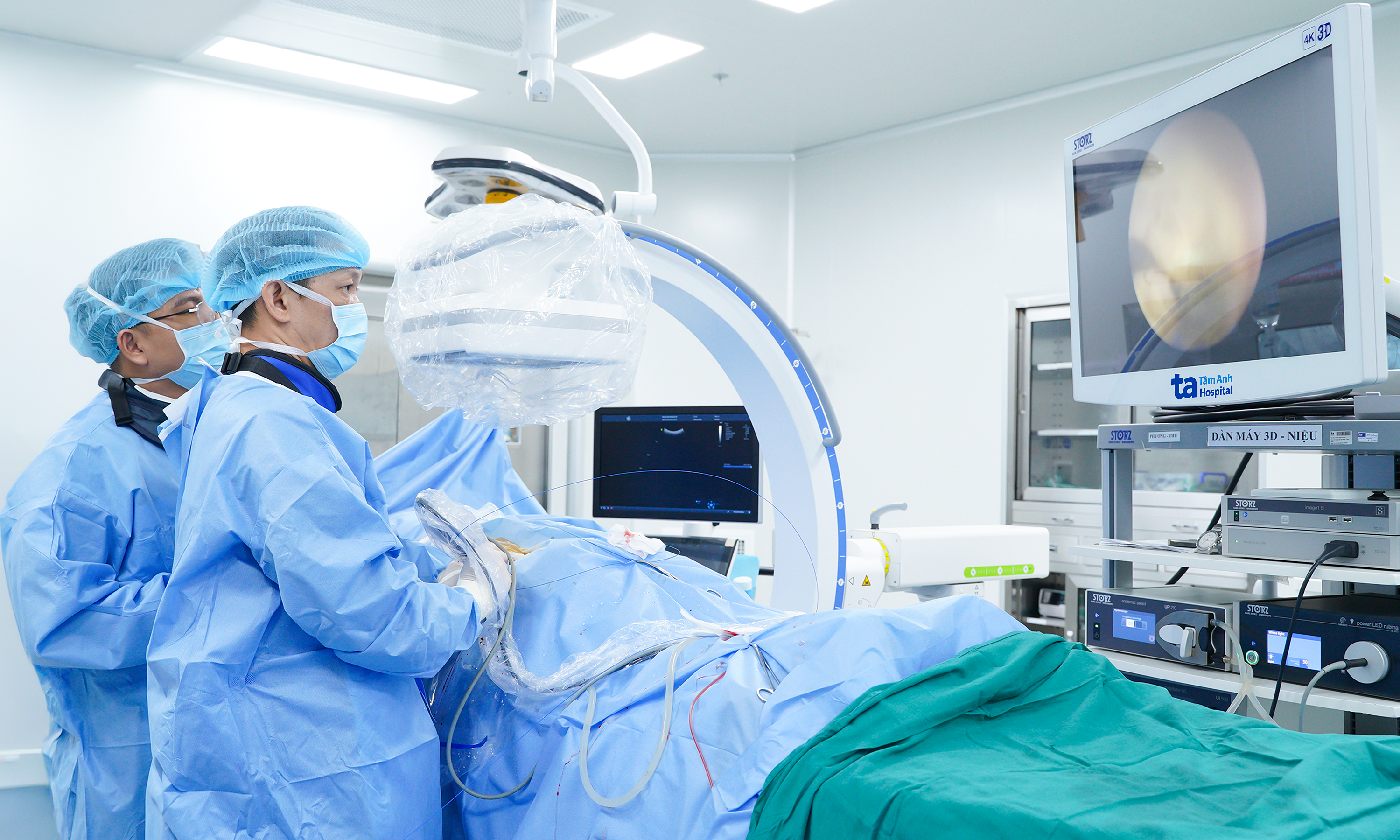
The team decided to use intravascular lithotripsy (IVL) with a shockwave-emitting balloon to crack and soften the calcified plaque, allowing the balloon and stent to pass safely. Doctors successfully placed a carotid artery stent under an embolic protection system, restoring blood flow to the patient's brain. Post-intervention ultrasound results showed optimal vessel lumen expansion and good blood flow.
 |
The team performed intravascular lithotripsy with a shockwave-emitting balloon, followed by stent placement to restore blood flow to the patient's brain. Photo: Tam Anh General Hospital |
The team performed intravascular lithotripsy with a shockwave-emitting balloon, followed by stent placement to restore blood flow to the patient's brain. Photo: Tam Anh General Hospital
According to Doctor Duy, intravascular lithotripsy with a shockwave-emitting balloon is widely used in coronary and peripheral interventions, but its application for severely calcified carotid artery lesions is less common. This technique offers more safe treatment opportunities for elderly patients with multiple comorbidities.
Doctors recommend that individuals with atherosclerotic cardiovascular disease or multiple risk factors such as hypertension, diabetes, dyslipidemia, and smoking undergo comprehensive vascular ultrasound screening. Patients must adhere to medical treatment and attend regular follow-up appointments.
If warning signs of a stroke appear, such as facial drooping, slurred speech, sudden weakness or paralysis in limbs, loss of balance, or visual disturbances, patients should seek immediate medical attention.
Ly Nguyen
*Patient's name has been changed
| Readers can submit questions about cardiovascular disease here for doctors to answer. |