A premature girl from Dong Nai, who had regular eye exams since birth with no abnormalities detected, is now 4 years old. Over the past year, her vision has progressively weakened. Doctors at VISI Eye Hospital, Ho Chi Minh City, diagnosed her with strabismus accompanied by mild farsightedness and recommended surgery to adjust her extraocular muscles.
Another child in Ho Chi Minh City showed signs of eye misalignment around the age of two. The condition became more pronounced as the child grew older, diagnosed as bilateral exotropia, and also underwent surgery.
Doctor Tran Ba Kien, Chairman of the Senior Professional Council at VISI Medical Group, noted that many parents only observe their child's eye misalignment when the child looks into the distance, is tired, or loses focus, leading them to adopt a wait-and-see approach. However, strabismus in children affects more than just their appearance.
"When both eyes are not aligned, the development of binocular vision can be disrupted, increasing the risk of amblyopia, especially when the brain consistently ignores the image from one eye," the doctor explained.
Strabismus is a condition where both eyes do not align to focus on the same object. One eye might look straight while the other deviates inward, outward, upward, or downward. This is not a contagious disease and cannot be "caught" through contact, play, or study. However, the noticeable facial difference often leads children to face prejudice from an early age.
A study published in the British Journal of Ophthalmology involved 118 children aged 3 to 12, who were shown images of normal faces and faces digitally altered to simulate strabismus. When asked whom they would invite to a birthday party, children aged around 6 and older were less likely to choose faces with strabismus. Although a hypothetical scenario, the results indicated that eye appearance can influence children's social choices.
Another study involving 128 children aged 5 to 6 observed that 60,9% chose to share toys with faces having straight eyes, compared to 39,1% for faces simulating exotropia. This suggests that some children may be judged before they have the opportunity to demonstrate their personality or abilities.
According to Doctor Kien, adult reactions sometimes inadvertently intensify prejudice. If parents pull their child away from a playmate with strabismus, the child will internalize the message that differences in appearance are something to be feared. In reality, what is transmitted from adults to children is not a medical condition, but rather an attitude of discrimination.
Prejudice is further reinforced by character portrayals on screen. A 2024 study published in Pediatrics analyzed 125 animated films from Disney, Pixar, DreamWorks, and Studio Ghibli, identifying 46 characters with strabismus across 33 movies. Approximately 30% were depicted as unintelligent, 35% as clumsy, 24% as scary, and over half had minimal to no dialogue. Notably, no main characters were shown with strabismus.
The study did not conclude that watching these films directly causes children to discriminate against peers with strabismus. However, the repeated portrayal of misaligned eyes associated with foolish or villainous characters can turn a medical condition into a comedic element, despite strabismus having no bearing on a person's intelligence or character.
These harms extend beyond mere teasing. A 2023 study involving 202 children aged 8 to 18 in India revealed that children with strabismus exhibited lower self-esteem, higher feelings of loneliness, and greater social dissatisfaction compared to their peers without the condition. These children also frequently felt insecure about their appearance and faced a higher risk of social isolation.
Another study tracked 407 individuals who had strabismus since childhood and 407 who did not, revealing that the rates of being diagnosed with at least one psychiatric disorder as adults were 41,3% and 30,7%, respectively. Specifically, the group with a history of exotropia had approximately three times higher risk of a psychiatric disorder diagnosis. The authors noted that this indicates a correlation, not direct causation between strabismus and psychiatric disorders. Nevertheless, this evidence suggests that adults should not view strabismus merely as a cosmetic flaw.
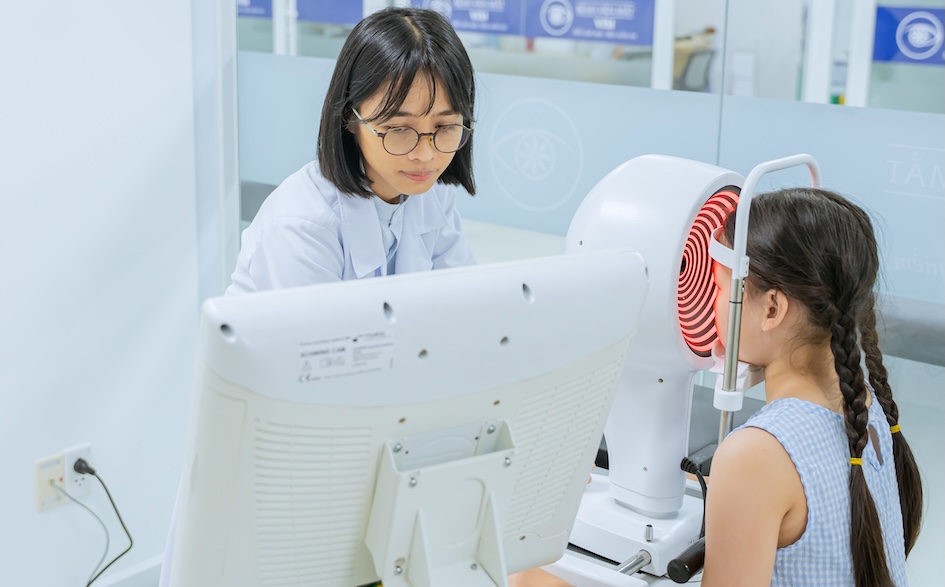 |
A doctor examines a child's eyes. Photo: Hospital provided |
According to Doctor Kien, treatment needs to be individualized, as not all cases require surgery. Depending on the cause, type of strabismus, age, visual acuity, and risk of amblyopia, children may be monitored, prescribed glasses, eye patching, or other methods. Even after eye alignment improves, children still need follow-up appointments to address any remaining amblyopia or refractive errors.
For instance, an 18-year-old female patient had undergone two strabismus surgeries, yet her eyes remained misaligned, causing her to become withdrawn, hesitant to communicate, and miss many opportunities. After a re-evaluation and a more appropriate surgical approach, her eye alignment improved.
Parents should take their child for a specialized eye exam if they notice one eye deviating inward or outward, even if it occurs intermittently. Other warning signs include the child frequently squinting or closing one eye, tilting their head when looking, complaining of double vision, bumping into objects, or showing signs of uneven binocular vision. Family photographs taken at different times can also help detect eye misalignment.
Beyond visual concerns, parents should also be attentive if their child avoids eye contact, is reluctant to be photographed, fears going to school, shows disinterest in group activities, or frequently expresses feelings of being unattractive or unloved by friends. Persistent sadness, prolonged social withdrawal, or any self-harming statements or behaviors are critical signs that require early professional support.
According to experts, families and schools can support children through simple actions such as affirming that strabismus is not contagious, refraining from using mocking nicknames, intervening when children are excluded from games, and evaluating children based on their behavior rather than their appearance. While medical treatment helps protect vision, it is the respect and acceptance from those around them that truly enables children to grow up without the stigma associated with their eyes.
Le Phuong