Answer:
Neck pain when bowing the head is common among office workers, individuals who sit for long periods in front of a computer, or those who use a phone for extended durations. The primary cause is often maintaining a flexed neck posture for too long, which leads to muscle stiffness in the neck, shoulders, and upper back, resulting in pain when bowing the head.
However, several underlying conditions and diseases can also cause pain when bowing the head:
Cervical spondylosis occurs when the intervertebral discs wear down, restricting movement and causing pain when flexing or extending the neck.
Bone spurs, which form after prolonged degeneration, cause localized pain and can compress nerve roots and surrounding soft tissues, worsening the symptoms of degeneration.
A herniated disc happens when the nucleus pulposus (gel-like center) protrudes through a tear or crack in the annulus fibrosus (outer ring), compressing nerves. This can lead to sharp pain, numbness, or radiating discomfort down the shoulder and arm each time the head is bowed.
Recent injuries from impacts or falls, if not properly treated or fully recovered, can also damage the soft tissues in the neck, causing pain when turning the head.
Prolonged stress from office work can also lead to muscle spasms due to psychological factors, resulting in neck pain when bowing the head.
 |
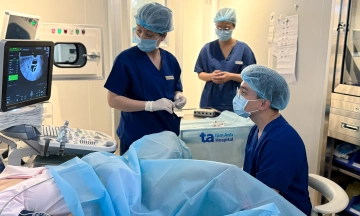
A doctor consults a patient experiencing neck pain. Illustration: Tam Anh General Hospital |
In many cases, neck pain when bowing the head can be alleviated with home remedies before medical intervention is necessary. Taking a warm bath or applying a hot compress with a towel or heating pad helps relax neck muscles, promotes blood circulation, and reduces pain.
When working, it is advisable to keep your back and neck straight and avoid prolonged bowing. Incorporate regular breaks and exercises to stretch the neck and shoulder area, and manage stress to reduce neck stiffness.
If these measures do not relieve neck pain when bowing the head, you should visit a specialized hospital for examination, diagnosis, and treatment. Seek immediate medical attention if neck pain persists, worsens, becomes severe, or is accompanied by numbness, weakness, tingling, or a burning sensation radiating down the shoulders, arms, or legs, as well as urinary dysfunction or loss of balance.
Depending on the condition, the doctor will conduct a clinical examination and may order tests such as cervical spine X-rays or magnetic resonance imaging (MRI) to visualize soft tissues and discs, enabling an accurate diagnosis and effective treatment.
Master of Science, Doctor Hoang Doan Trang
Department of Musculoskeletal Medicine
Tam Anh General Hospital Hanoi
| Readers can send questions about musculoskeletal conditions here for doctors to answer. |