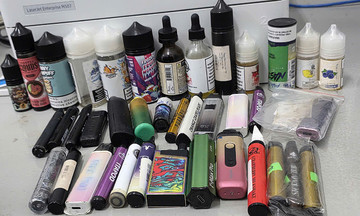
The World Health Organization (WHO) representative in Vietnam issued the recommendation on 24/11. This comes as the draft Revised Investment Law, currently under review by the National Assembly, has not yet included e-cigarettes and heated tobacco products in its list of banned investment and business sectors.
The United Nations health agency states that this omission creates a direct legal conflict. It effectively nullifies the ban on "manufacturing, trading, and importing" e-cigarettes and heated tobacco products, as stipulated in Resolution 173, which the National Assembly recently enacted and will become effective from 1/1/2025.
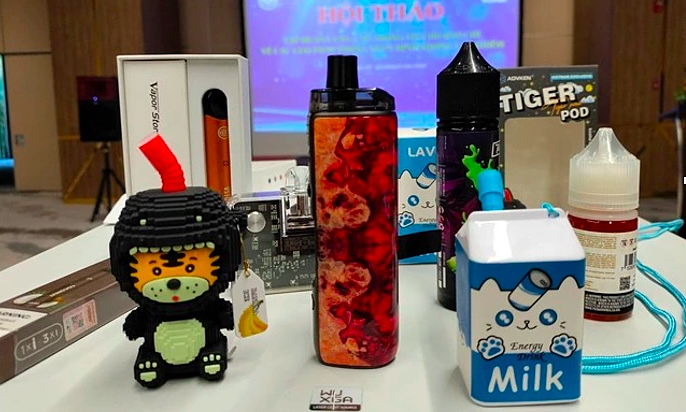 |
E-cigarettes are designed to be eye-catching, resembling toys or beverages. *Photo: Le Nga*
Doctor Angela Pratt, WHO Representative in Vietnam, emphasized that for the National Assembly's ban to be effective, the Revised Investment Law must immediately include these products in the prohibited list, without any exceptions. She views a comprehensive ban as a crucial step for Vietnam, vital for protecting public health and the future of younger generations.
E-cigarettes and heated tobacco products are new-generation items that function by heating a solution. This solution typically contains nicotine or flavorings dissolved in propylene glycol or glycerine. At least 60 chemical compounds have been identified in e-cigarette solutions, alongside numerous other harmful substances present in the vapor or smoke produced. These substances increase the risk of cancer, stroke, and other diseases among young people.
Initial control measures have proven effective. WHO cited data from the Poison Control Center at Bach Mai Hospital, which indicates that emergency cases linked to new-generation tobacco products decreased by almost 70% over the past 10 months compared to the period before the ban. Furthermore, advertising of these products through celebrities has largely stopped.
To maintain this effectiveness, WHO and the Ministry of Health jointly reject the proposal to permit production for export. Allowing "export but prohibiting domestic consumption" presents several risks. These include undermining the foundation for health protection, creating avenues for smuggling products back into the domestic market, and imposing a substantial burden on law enforcement efforts.
National Assembly deputy Nguyen Anh Tri, former Director of the National Institute of Hematology and Blood Transfusion, echoed this sentiment, warning: "If Resolution 173 implements a comprehensive ban, yet the Investment Law leaves this open, the policy will regress. Such a lack of legal synchronization creates loopholes for harmful products to infiltrate, complicating state management and threatening social order and security."
Tri pointed out that 42 countries worldwide currently ban e-cigarettes, and 24 prohibit heated tobacco products. Within the ASEAN region, five nations—Cambodia, Laos, Singapore, Thailand, and Vietnam—have enacted bans. No regional country accepts the "domestic ban, export production" model, deeming it an inhumane policy that creates a gray area for transnational crime.
Deputy Le Hoang Anh (Gia Lai) concurred, noting that e-cigarettes are becoming a perfect cover for drug criminals targeting young people. These devices are being exploited to conceal synthetic drugs, liquid cannabis, and hallucinogenic substances for which no effective treatment protocols exist. He argued that without an absolute ban on their sale, the state would indirectly facilitate drug crimes operating under the guise of legitimate commerce.
Health experts and lawmakers agree that the best international practice involves issuing a consistent, synchronized ban across all legal documents. This also means entirely abandoning the concept of producing such harmful items for export.
Le Nga