At a specialized hospital in Ho Chi Minh City, a patient's lung x-ray takes about one minute to complete, thanks to modern digital systems. The actual x-ray emission, a high-energy radiation beam that recreates internal body images, lasts only about 0,01 seconds. This includes the technician guiding the patient and capturing the image.
However, results are not sent immediately. The hospital's computer system holds records because health insurance (BHYT) regulations mandate a minimum of 6 minutes for each x-ray scan and 30 minutes for an ultrasound. Submitting data faster than these stipulated times leads to the hospital being deemed non-compliant and facing payment rejections.
A doctor with two decades of experience at the hospital described the "flexible countermeasures" adopted to address the issue of "doctors waiting for the clock to run out" while patients queue for x-rays. During the "dead time" between outpatient BHYT cases, doctors perform x-rays for emergency patients, inpatients, or those paying for services. These patient groups are not subject to the same strict time scrutiny by the assessment system as outpatient BHYT patients.
Additionally, the hospital employs a "delayed submission" strategy. While patients undergo continuous scans and receive immediate results, the hospital's management software temporarily holds the data. The system is programmed to automatically upload records to the BHYT assessment portal sequentially, ensuring compliance with the stipulated time between two consecutive cases.
"We still work as fast as possible to process patients, but we are forced to use technology and reorganize our procedures to ensure data aligns with regulations, preventing unfair payment rejections," the doctor stated.
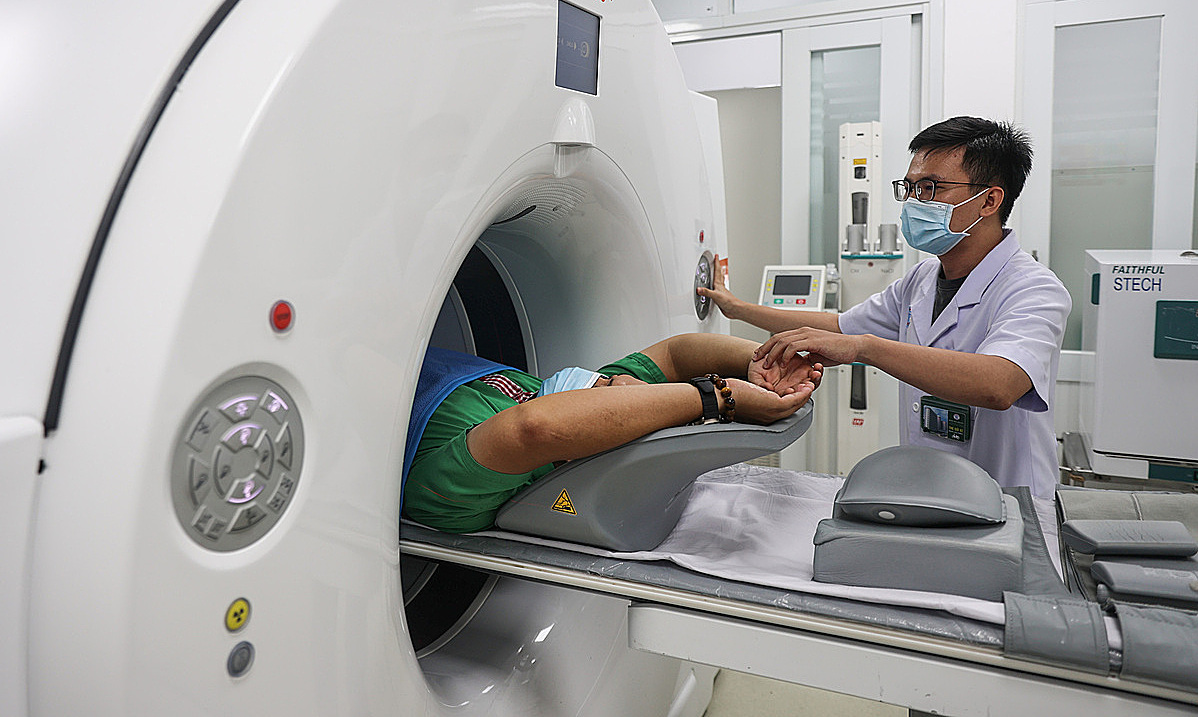 |
PET/CT scan for a patient at a hospital in Ho Chi Minh City. Photo: Quynh Tran.
On 4/2, a representative from Vietnam Social Security (VSS) clarified that they "did not arbitrarily impose the 6-minute regulation to hinder medical facilities." The assessment process is based entirely on legal normative documents, specifically Ministry of Health (MoH) Decisions 2775 and 2776 of 2025. These documents specify a standardized timeframe for musculoskeletal and lung x-rays of 6-12 minutes, and for stomach and colon x-rays of 20-30 minutes.
"Time assessment is a necessary checkpoint to ensure the quality of medical examination and treatment, preventing superficial work or exploitation of the BHYT fund," the VSS representative explained. VSS asserts that interpreting this as "doctors having to sit idle waiting for enough time" misrepresents the core intent. They have also recommended that the MoH review its professional guidelines to align with current practices.
Acknowledging these shortcomings are hindering hospitals, a leader from the MoH's Department of Medical Examination and Treatment Management stated that the "6 minutes or 30 minutes" norms were initially economic-technical standards developed to calculate service prices, based on outdated technology platforms.
"Applying economic norms as a rigid measure for professional assessment fundamentally misrepresents the process, as the time required for a technique largely depends on the doctor's skill and the complexity of each case," the Department's representative explained. A difficult case might take 20 minutes, while a straightforward one could be completed in one minute, which is common in medicine.
The MoH is working with the Society of Radiology and Nuclear Medicine to conduct a practical survey and draft a document proposing that the Ministry of Finance and VSS adjust the assessment rules. With health insurance examinations and treatments reaching a record of over 195 million visits in 2025, revising these outdated assessment mechanisms is crucial. This will ensure technology genuinely serves patients, rather than merely facilitating administrative compliance.
Le Phuong - Hong Chieu