


Mitchell Gaff, dressed in pajama bottoms, opened the door, invited the three officers inside, and eagerly agreed to sample various types of chewing gum, Susan recalled the meeting in 1/2024.
As Gaff began to try a new flavor, one of Susan's colleagues handed him a small plate.
"I remember watching him spit the first piece of gum into the dish and seeing the saliva, I could barely contain my excitement," Susan shared.
Thanks to this "gum marketing" ploy, Gaff unwittingly provided the three undercover officers with the DNA sample needed to confirm his connection to a 1984 rape and murder.
On 16/4, Gaff, 68, a convicted rapist, admitted to killing Judy Weaver and Susan Vesey in 1980 and 1984. These two cases, initially considered unrelated, had remained cold for many years.
DNA plays a pivotal role in solving cold cases by identifying perpetrators, as demonstrated in the Gaff case. Susan Vesey, a 21-year-old mother of two children, was murdered in 7/1980. In his confession, Gaff admitted he "tried random doors and found the victim's house unlocked." He then tied up, beat, raped, and strangled Vesey.
Four years later, Gaff attacked Judy Weaver, a 42-year-old mother, in her bedroom before setting her house on fire to destroy evidence. "Before leaving, I wrapped a cord around her neck, lit the corner of the bedsheet to conceal the crime and to kill her," Gaff stated, asserting he did not know either victim.
At the time of the murders, DNA analysis had not yet become a useful forensic tool. However, in Weaver's case, law enforcement showed foresight by contacting a laboratory to collect vaginal fluid samples, which helped them obtain evidence just hours after the victim's death. Weaver's boyfriend died in 1994, still considered the primary suspect in the case.
The advent of DNA analysis prompted law enforcement to re-examine the Weaver case in 2020. Forensic scientists at the Washington State Police reported that new software called STRmix helped identify profiles from small proportions of DNA. In the Weaver case, one of the ligatures found on her body contained a large amount of Weaver's own DNA, a small amount from her boyfriend, and a significantly smaller amount from an unidentified third person. They used STRmix to remove the DNA of Weaver and her boyfriend from the sample, narrowing the search to the mysterious individual. In 11/2023, they entered that DNA profile into the national criminal DNA database and found a match for Gaff.
Gaff's criminal history reveals a pattern of repeated offenses. In 11/1979, Gaff, armed with a gun and knife, attacked Jacalyn O'Brien, 29, in her home garage with the intent to rape. O'Brien fought back fiercely, causing him to flee. Gaff received a sentence of five years' probation and one year of community service. Gaff murdered Vesey months before his conviction in the O'Brien case, and he was on probation when he brutally raped two teenage sisters at their home in Everett, Washington, in 8/1984, less than three months after the Weaver murder.
During subsequent trials, Gaff confessed to attempting to attack up to 30 women and girls in a single day in the early 1980s, admitting to raping at least eight of them. Mental health experts diagnosed Gaff as a violent sexual predator. He was addicted to drugs and alcohol, "obsessed with thoughts of sex with strange women," and had rape fantasies since adolescence.
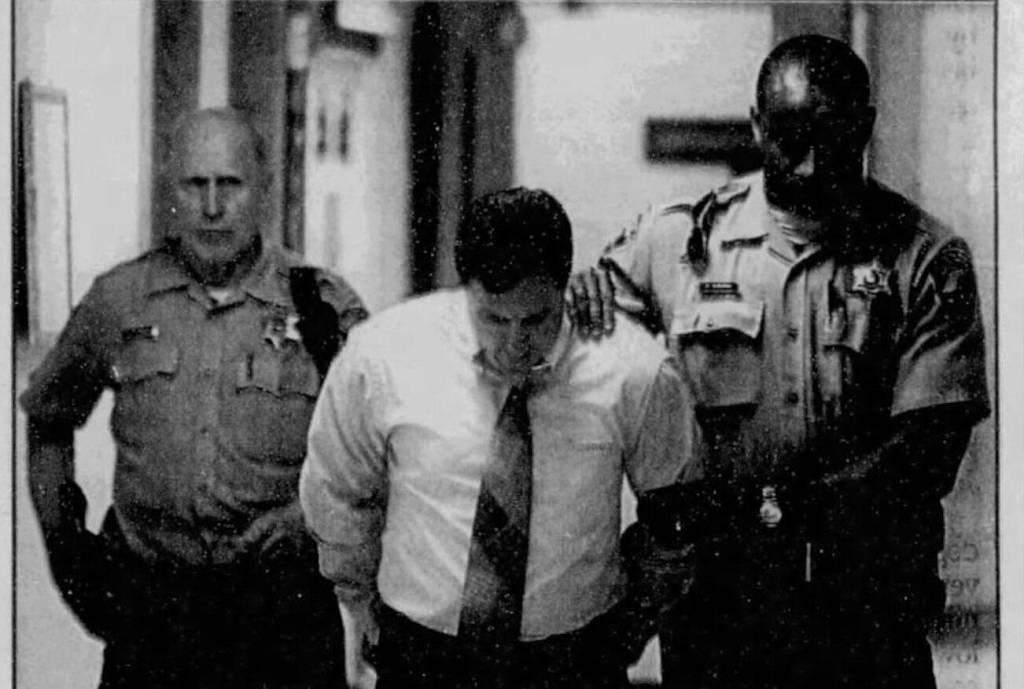 |
Mitchell Gaff escorted by police to court in 8/2000. Photo: The Herald |
The rape of the two sisters led to Gaff's conviction for 11 and a half years in 2/1985; he was released in 10/1994. His DNA was entered into the national criminal database, which nearly 40 years later yielded a match when cross-referenced.
After the initial match, police required an additional DNA sample for confirmation. Officer Susan explained that police often tail suspects and collect discarded cigarette butts or leftover drinks for samples. They had monitored Gaff for some time, but he rarely left his house except for a nearby grocery store. This led an officer to devise the "gum marketing" scheme.
The DNA extracted from Gaff's chewing gum matched the DNA found in vaginal fluid, on the neck and wrist ligatures, and on clothing cut from Weaver's body. Linking Gaff to the Vesey murder took more time. Months after the expert matched Gaff's DNA to the Weaver murder, Vesey's husband, Ken, informed police that his brother, who had been considered a suspect in Vesey's killing, had died.
According to records, Ken was 23 when he discovered his wife's body on the bedroom floor, while their 15-week-old child lay safely on the adjacent bed. Officer Susan, who took over the investigation of unresolved murders in 2022, had never heard of the Vesey case. She called Ken back for further details. During their conversation, Susan noticed "striking similarities" between the two cases. She sent several pieces of evidence from the Vesey crime scene for testing. A section of white cord cut from the victim's body was confirmed to contain Gaff's DNA.
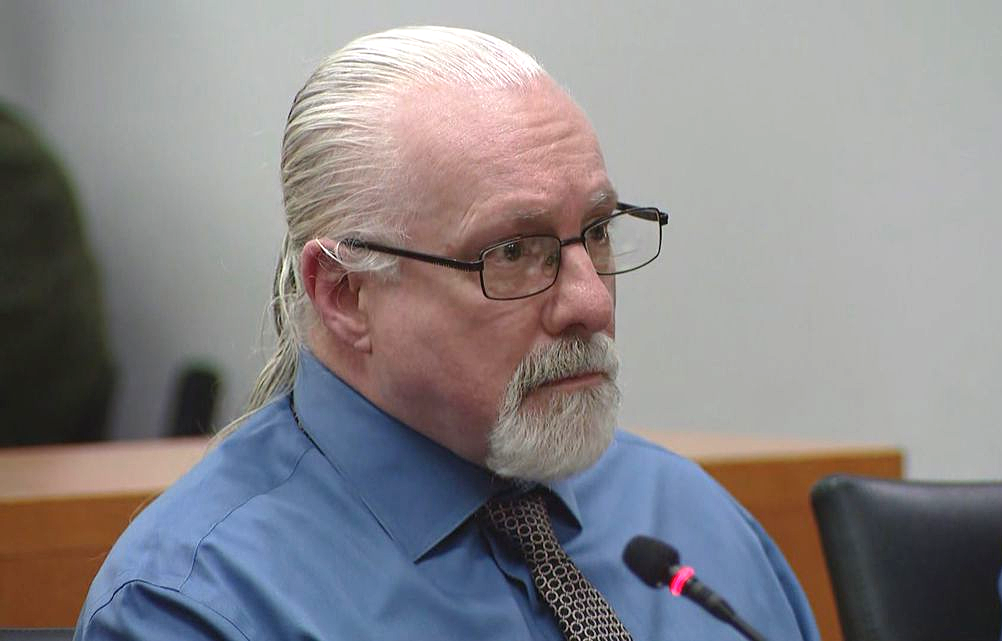 |
Mitchell Gaff at his sentencing on 13/5/2026. Photo: King5 |
On 13/5, the judge sentenced Gaff to life imprisonment with a minimum term of 50 years. For the Weaver and Vesey cases to be closed, "science just needed to catch up," Susan said.
TUE ANH (according to CNN, USA Today)




