The trial of former Deputy Minister of Labor, Invalids and Social Affairs Nguyen Ba Hoan, in a case involving harassment of labor export businesses, has concluded after three days of proceedings. The court deliberated for four days, with the verdict expected on the afternoon of 24/8.
In addition to nine former officials indicted for receiving bribes, the case involves several business owners and employees on trial for violating accounting regulations, causing serious consequences. Among these, Hoang Long company, chaired by Nghiem Quoc Hung, is accused of causing the most damage, totaling 241 billion dong, by concealing 1.200 billion dong in revenue.
Defending Hung, the lawyer did not dispute the charges but sought to present a comprehensive picture of the "hardships" faced by labor export companies to explain the alleged offenses.
Low profits persist due to "humanitarian spirit" for workers
The lawyer cited current regulations, which permit businesses to collect one month's salary from workers for 12 months of work; for a three-year contract, they can collect three months' salary. The service fee paid to brokers must not exceed one-half of this amount.
For example, the lawyer explained, for a worker earning 25 million dong per month in the Taiwan market, a three-year contract allows for a service fee of no more than 75 million dong, to be split between the company and the foreign broker. However, "that's what the law says", but in reality, foreign brokers consistently demand up to 100 million dong for a three-year contract. If the company disagrees, the broker refuses to sign the labor supply contract, meaning no workers can be sent.
Consequently, the lawyer stated, Hoang Long company informs workers upfront, allowing them to research and choose independently. Even when workers agree, after deducting brokerage service fees, "the company only receives about 25 million dong." Further subtracting income taxes, operational costs, employee commissions, airfare, visa fees, and language training for workers, the actual profit "is negligible", amounting to only 200 USD per contract.
From this amount, businesses still need to cover management costs for their overseas representatives to ensure workers' legal rights throughout the contract period, such as in cases of unexpected accidents, illness, or death. "This means the profit is even lower," the lawyer added.
The lawyer argued that foreign brokerage service fees are not the only expenses businesses incur. Specifically in this case, they also had to pay "inconvenient-to-mention" expenses, such as bribes to "grease the wheels" and expedite licenses at the Ministry of Labor, Invalids and Social Affairs.
"I do not want to specify details, as it would displease some defendants in this case," the lawyer stated, adding that these expenses increased costs for workers and were also amounts the company had to keep off the books.
Continuing with the Taiwan market example, the lawyer stated that despite lower-than-expected profits, defendant Hung continued operations "with the purpose of providing employment and life-changing opportunities for many manual laborers" because he "genuinely cared for the workers." "Part of it is also due to the humanitarian purpose mentioned," the lawyer concluded in his defense.
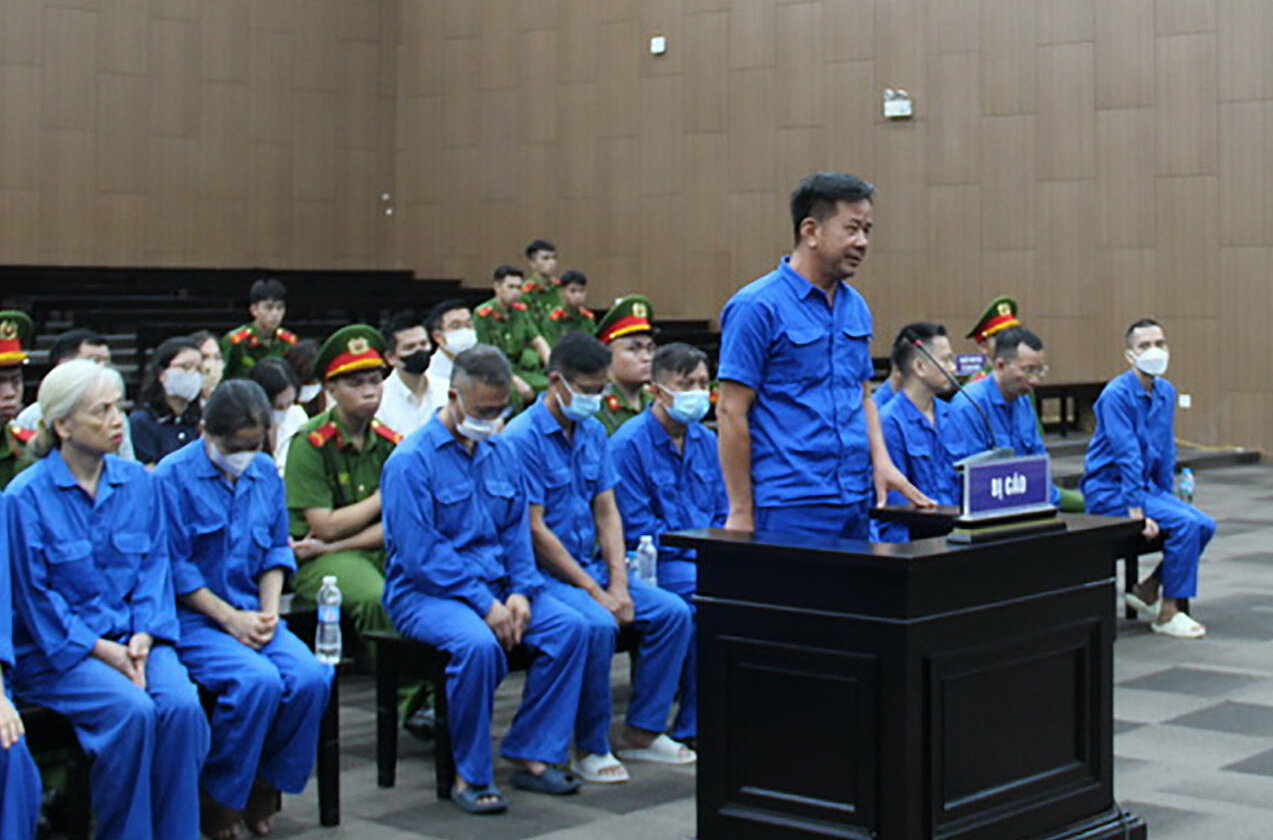 |
Defendant Nghiem Quoc Hung, Chairman of the Board and General Director of Hoang Long Company. Photo: Danh Lam |
While not denying accounting irregularities, the defense counsel asserted that the client's offenses were not for tax evasion, but rather due to poor management, existing barriers, and practical circumstances.
In addition to seeking leniency for his client, the lawyer proposed amending legal regulations to align with current realities. "If not amended, labor export businesses will be unable to find labor markets, and any company that tries to operate will inevitably err," the lawyer stated.
Thanh Lam