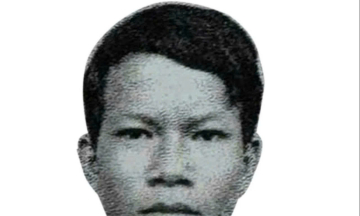
In july 1993, three masked men stormed the Atlas Caravans rental company headquarters in Hull, Yorkshire, on payday. Two carried guns, while the third wielded a baseball bat.
They intended to steal 250,000 British pounds (equivalent to 23 billion VND today) earmarked for employee salaries, but arrived too late to get the full amount. Ultimately, the gang made off with 38,000 British pounds.
Employees present were forced to lie on the floor, threatened with being shot in the head if they did not comply. One person sustained a head injury from shattered glass after a robber fired a gun through a window.
Following the incident, police found a stolen car abandoned near the scene. Inside the vehicle were some fingerprints, but none matched existing database records. Investigators described the crime scene as "surprisingly clean", making it difficult for investigators.
A fragment of a black sock, comprising only the toe and a section of the leg, was also recovered. Investigators believed it might have been used as a mask by one of the robbers. With no blood, saliva, or suitable hair follicles for DNA analysis using the technology available at the time, police did not discard the sock fragment. Instead, they used a specialized forensic adhesive roller to collect skin flakes from the fabric's surface. Microscopic examination revealed 25 tiny fragments identified as dandruff.
This clue was almost useless 33 years ago. DNA analysis technology in 1993 could not generate a reliable genetic profile from such a small amount of biological material. However, instead of giving up, investigators preserved the adhesive tape containing the dandruff flakes on a clean acetate sheet, waiting for another opportunity.
In some dandruff flakes, nucleated cells containing DNA were still present, although the genetic material may have partially degraded as the cells matured. Forensic research published in 1998 demonstrated that DNA from dandruff could be used to create a genetic profile; under appropriate conditions, even one flake could provide enough material for analysis. Low copy number DNA analysis, developed in the same year, allowed genetic profiles to be generated from as few as 15-20 cells, such as the dandruff flakes in this case, which previous methods could not handle.
By 2003, British police began to explore whether new technology could help solve cold cases. The dandruff flakes collected from the mask in 1993 were sent to scientist Jonathan Whitaker's laboratory in Birmingham in july 2003. From these minute samples, Whitaker extracted a DNA profile and cross-referenced it with approximately two million profiles in the UK's national database. The result matched Andrew Pearson, then 29 years old, who had numerous prior convictions and an existing DNA profile in the system.
After Pearson's arrest, police took a buccal swab from his inner cheek for comparative analysis. The profile obtained matched the profile from the dandruff flakes on the mask. At the trial in november 2004, scientist Jonathan Whitaker presented the matching results, showing that the dandruff sample either belonged to Pearson or another person with an identical DNA profile. The probability of a randomly selected person in the UK having such a DNA profile was about one in a billion. This was compelling scientific evidence, but Pearson offered alternative explanations. He claimed he might have sat in the getaway car and left his DNA on the back seat, or that he might have been given the sock fragment to wipe his head, or simply touched it without participating in the robbery.
The jury rejected these explanations. After 75 minutes of deliberation, they found Pearson guilty of robbery. He was sentenced to 12 years in prison for robbery and an additional three years for firearms possession, totaling 15 years in prison.
Pearson, a roofer at the time, had previously worked as a seasonal employee at Atlas Caravans, the company that was robbed. He had 76 previous convictions dating back to the 1970s, including theft, robbery, and assault. Despite this, for many years, Pearson seemingly did not believe he would be caught for the 1993 robbery. He even lived in a mobile home in a residential area just a five-minute drive from the robbed company headquarters, enjoying 11 quiet years, convinced he had escaped justice.
After Pearson's conviction, the case was not fully closed. Police continued to search for the two accomplices. Fingerprint analysis helped them identify a print on the stolen car that might belong to a notorious armed robber who had operated in Liverpool. This individual was later convicted in a large-scale drug importation case and received an 11-year prison sentence, but denied involvement in the robbery with Pearson. Investigators suspected this person was one of the gunmen, but lacked sufficient evidence to prove it. The identity of the third robber also remains undetermined.
The case garnered such attention that after the trial, a Head & Shoulders anti-dandruff shampoo advertisement in a British newspaper reused the article about the trial, accompanied by the slogan: "Don't get caught by dandruff."
Hai Thu (According to Crime Magazine)