This information is detailed in a draft amendment to Circular 62/2024/TT-BCA, which establishes national technical standards for road traffic safety and security monitoring systems and traffic command centers.
The draft proposes comprehensive artificial intelligence (AI) integration, requiring AI cameras and devices to achieve a license plate recognition accuracy of at least 93% during daylight hours. They must also be capable of automatically analyzing violations and enabling smart searches by license plate, vehicle color, and type.
The proposed standards also impose stricter data storage requirements. Camera data must be stored for a minimum of 60 days, with violation data retained for up to three years for enforcement, investigation, and tracing purposes. Furthermore, all devices must undergo conformity assessment and quality inspection upon import.
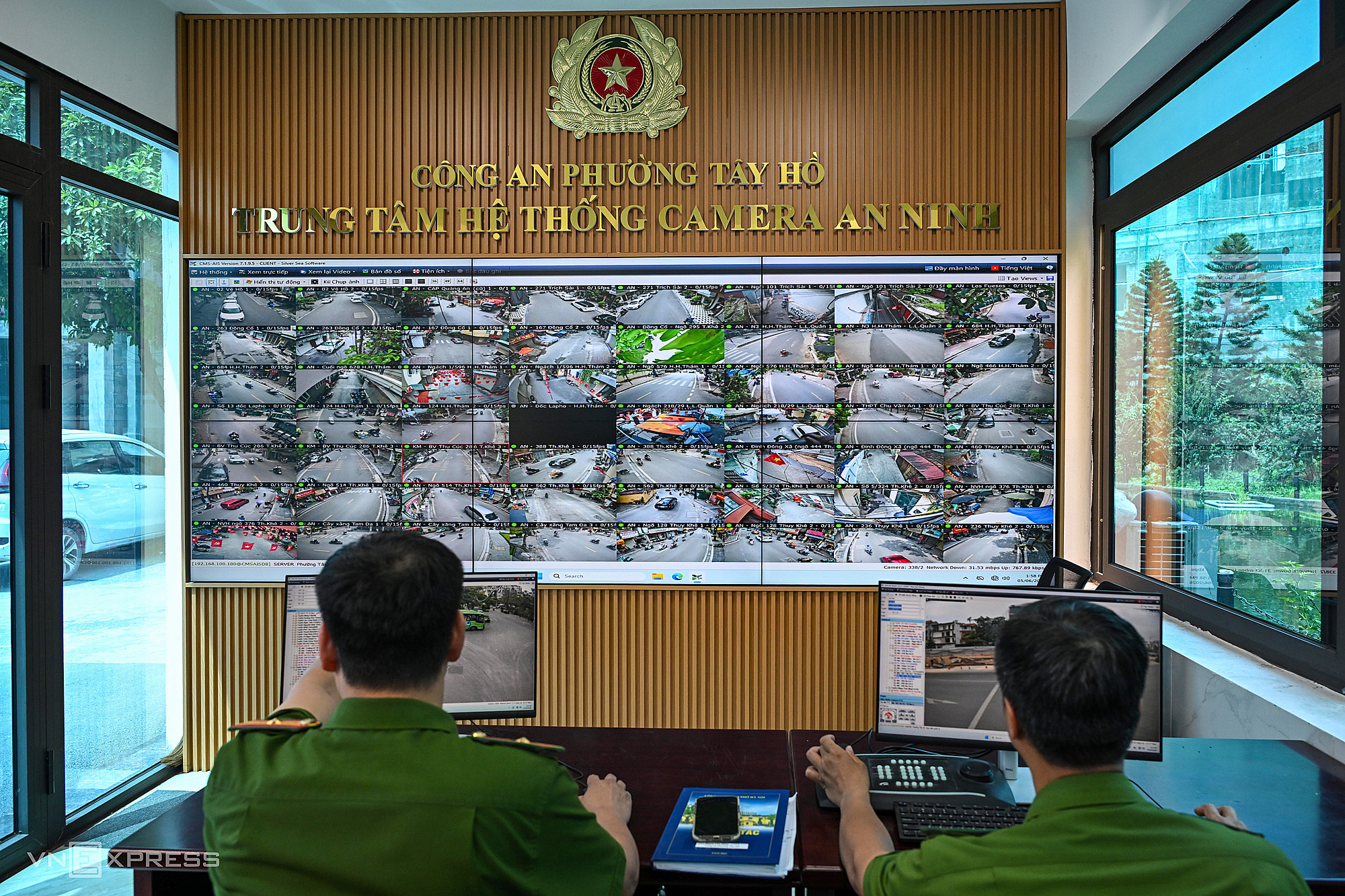 |
The security camera center system at Tay Ho Ward Police, Hanoi. *Photo: Giang Huy*
This upgrade aims to establish an intelligent platform for traffic monitoring, transitioning from manual to automated and smart surveillance. The system will also support real-time traffic management, predicting congestion and accidents.
AI cameras are expected to significantly improve the efficiency of "cold" penalties by automatically detecting, recording, and processing violations. This automation will reduce human dependence, thereby increasing transparency and accuracy in enforcement.
The standards also envision innovations for Traffic Command Centers, enabling traffic police to enhance their real-time command and operational capabilities. The regulations clearly define the centers' functions in detecting and processing violations, addressing accidents, and mitigating congestion.
Most current traffic cameras cannot automatically process "cold" penalties
According to the Ministry of Public Security, while provinces and cities nationwide have implemented smart operation centers and surveillance camera systems, there is currently no interconnectivity between these centers, nor a central "brain" for nationwide monitoring.
Currently, most invested camera systems primarily collect and display images for situational monitoring. However, their capacity for analysis and automatic violation detection remains limited. The majority of camera networks have been developed through fragmented investment phases, resulting in a small number of units, inconsistent configurations, and a low percentage of cameras equipped with AI features.
Furthermore, the integration of AI for server-side image analysis to automatically detect violations – such as not wearing a helmet, running red lights, driving in the wrong lane, backing up on highways, driving against traffic, changing lanes without signaling, or violating traffic signs and road markings – is either not yet implemented or remains very limited. This continued reliance on manual human review significantly reduces overall efficiency.
Many provinces and cities currently only have cameras installed at a few main intersections, offering a narrow field of observation. Furthermore, numerous new national highways and expressways still lack modern surveillance systems.