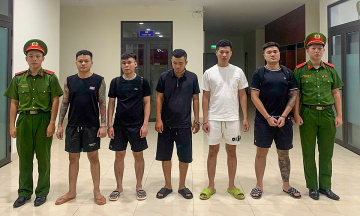
On 14/7, the Hanoi People's Court entered its third day of trial for Pham Vu Khiem, director of Herbitech Technology Company Limited, and his accomplices. They stand accused of producing over 13 million fake nutritional products, primarily targeting children, along with violations of accounting regulations and money laundering.
Previously, prosecutors recommended a sentence of 23-26 years in prison for the three charges. Khiem and his defense lawyers argued that the forensic methods and the basis for determining "counterfeit goods" used by the procedural authorities were inappropriate.
The defendant claimed that the manufacturing process made some ingredients difficult to detect in forensic results, rather than them being omitted. Lawyers also contended that many ingredients found to be deficient were merely coloring agents, flavorings, or sweeteners, which do not determine the product's use value or primary function.
 |
A representative of the Hanoi People's Procuracy at the court. Photo: Pham Du |
'Each ingredient is tied to consumer trust'
During the rebuttal in court, the representative of the Hanoi People's Procuracy reiterated that Herbitech's products are counterfeit goods as stipulated in Decree 98/2020.
Addressing the view of some lawyers that products are only considered counterfeit if the content of the main active ingredient falls below 70%, the prosecution asserted that this interpretation "misrepresents or deliberately distorts the spirit of Decree 98 to justify criminal behavior".
Citing point b, clause 7, article 3 of Decree 98, the prosecutor stated that counterfeit goods are those where at least one basic quality indicator, technical characteristic, or main quantity achieves 70% or less compared to the declared level.
According to the prosecution, violating just one of these conditions regarding quality indicators or technical characteristics is sufficient legal grounds to conclude that a product is counterfeit.
"Lawyers and the defendant cannot argue that only when the content of the main active ingredient is below 70% is it considered counterfeit, while other ingredients and quality indicators can be reduced by any amount", the prosecutor stated.
The prosecution emphasized that health protection foods are products directly related to human health. Each ingredient listed on the label is not just formal information but also a basis for consumers to choose the product.
According to the prosecution, when a business intentionally reduces content, removes, or replaces raw materials, it essentially creates a product different from what was authorized for circulation by competent authorities.
Promoting a multi-ingredient formula to attract customers but then arbitrarily reducing ingredients during production to cut costs is an act of profiteering.
"The manufacturer benefits from the entire formula when advertising and selling, but then refuses to take responsibility for that very formula during production. The law does not protect such a business practice", the prosecutor rebutted.
Regarding the forensic results, the prosecution affirmed that the assessment was conducted in coordination with the Institute of Criminal Science (Ministry of Public Security) and the National Institute for Food Safety and Hygiene Testing (Ministry of Health), utilizing modern equipment and adhering to professional procedures.
For the 59 batches of goods for which no samples remained, the prosecution stated that extracted data showed these batches had formulas and quantities identical to those already identified as counterfeit.
>> List of 67 counterfeit product lines from Herbitech
 |
Defendant Khiem (blue shirt) at the trial opened on 2/7. Photo: Danh Lam |
Prosecutors: Fraud spanned 35 tax declaration periods
Another point of contention was the prosecution's indictment for violating accounting regulations instead of tax evasion, as suggested by some lawyers.
According to the prosecution, these two charges infringe upon two distinct legal interests: tax evasion infringes upon tax administration activities, while violating accounting regulations infringes upon the honesty and accuracy of a business's financial information.
The prosecution determined that Herbitech intentionally established and maintained two accounting systems: one for tax declarations and another to track actual revenue for which no invoices were issued.
"This was not a mere professional error or isolated off-the-books transaction, but an organized, intentional act infringing upon the state's accounting operations", the prosecutor stated.
According to the prosecution, this behavior occurred continuously for 7 years, across 35 tax declaration periods. The prosecution also questioned defense lawyers as to why the defendants had numerous opportunities to file supplementary declarations during that time but failed to do so.
Maintaining these discrepancies for an extended period, according to the prosecution, indicates that this was not an administrative tax error but an intentional act infringing upon the accounting system to conceal the true nature of business operations.
>> Details of proposed sentences for 19 defendants
Thanh Lam