One late March evening, as they passed an ice cream stall, Phuong Anh tugged at her mother's hand, pleading for a treat. Her mother, Mac Thi Nga, 38, from Kinh Mon, Hai Phong, felt a wave of distress. "Refusing makes me feel guilty because my child already sacrifices so much, but I can't agree because even a little sugar in an ice cream cone could send her to the hospital", Nga said. "This emotional struggle has been constant for me for seven years, ever since my child was diagnosed with this rare disease."
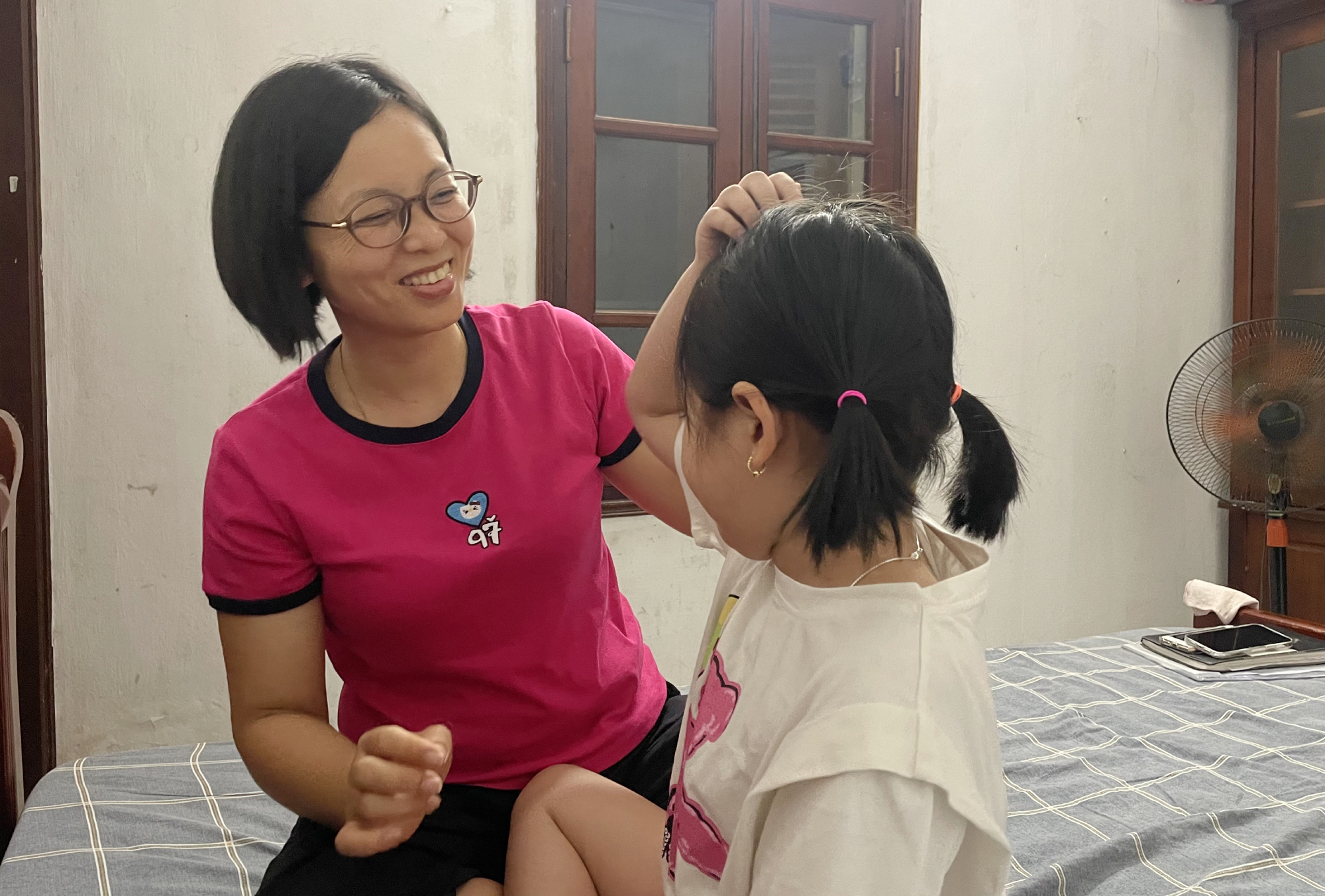 |
Mac Thi Nga, 38, and her 7-year-old daughter Phuong Anh in their rented room near National Children's Hospital, Ha Noi, on the evening of 26/3. Photo: Phan Duong |
Mac Thi Nga, 38, and her 7-year-old daughter Phuong Anh in their rented room near National Children's Hospital, Ha Noi, on the evening of 26/3. Photo: Phan Duong
The shock of day 21
Nga gave birth to Phuong Anh just before Tet in 2019. From her very first attempts to nurse, Nga noticed her daughter's weak sucking reflex and irregular breathing. A mother's intuition suggested something was wrong, prompting her to ask doctors for a check-up.
Screening results revealed that the baby had hypertrophic cardiomyopathy. Phuong Anh underwent multiple hospital transfers and various tests. On day 21, test results from abroad confirmed she had infantile-onset Pompe disease, a rare condition.
Pompe is an extremely rare genetic disorder, affecting only 1/40,000 to 1/300,000 live births worldwide. The disease results from a mutation in the alpha glucosidase (GAA) gene, causing glycogen to accumulate, which thickens heart muscle, weakens limb muscles, and enlarges the tongue. According to data from the Department of Endocrinology - Metabolism - Genetics at National Children's Hospital, from 2014 to 2021, the hospital identified only 52 child patients with Pompe. Among them, only 25 children had the ability and conditions to pursue the lifelong enzyme replacement therapy regimen.
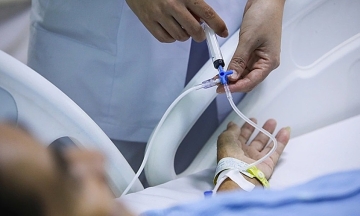
On day 34 of her life, Phuong Anh received her first intravenous enzyme replacement dose.
For the first three months, Nga fell into depression, denying the reality. "When the doctors informed us, my husband and I denied it: 'No way our child has such a strange disease'", she recounted. Taking her child for infusions, the mother walked as if in a trance. It was only when she saw other young patients with deformed chests and limp limbs that she fully grasped the situation.
The family's anchor at that time was the team of doctors and nurses at National Children's Hospital. They expedited procedures for the baby's treatment, presenting evidence of other child patients who were growing up. "The world has developed medicine; if you consistently bring your child for infusions, she will get better", the doctor's words uplifted the mother.
A 14-day cycle and a half-billion Vietnam dong bill
Since then, the family's time is no longer measured in months and years but in treatment cycles. Every 14 days, Phuong Anh must go to the hospital for enzyme infusions. The dosage increases with her weight. At her current weight of 27 kg, each infusion costs approximately 250 million Vietnam dong.
Nga admits she found "a silver lining in misfortune", as Pompe is one of the few rare diseases with specific treatments available. From 2019, the disease was included in the health insurance list, covering 100% of costs for children under six years old. In 2025, Phuong Anh received more than 4.5 billion Vietnam dong in insurance payments. However, upon turning seven, the insurance "shield" changed, forcing the family to seek sponsorship from pharmaceutical companies.
"My husband and I earn just over ten million Vietnam dong. If the sponsorship stops, our child's path to life will also be cut off", said Nguyen Van Du, 38, Phuong Anh's father.
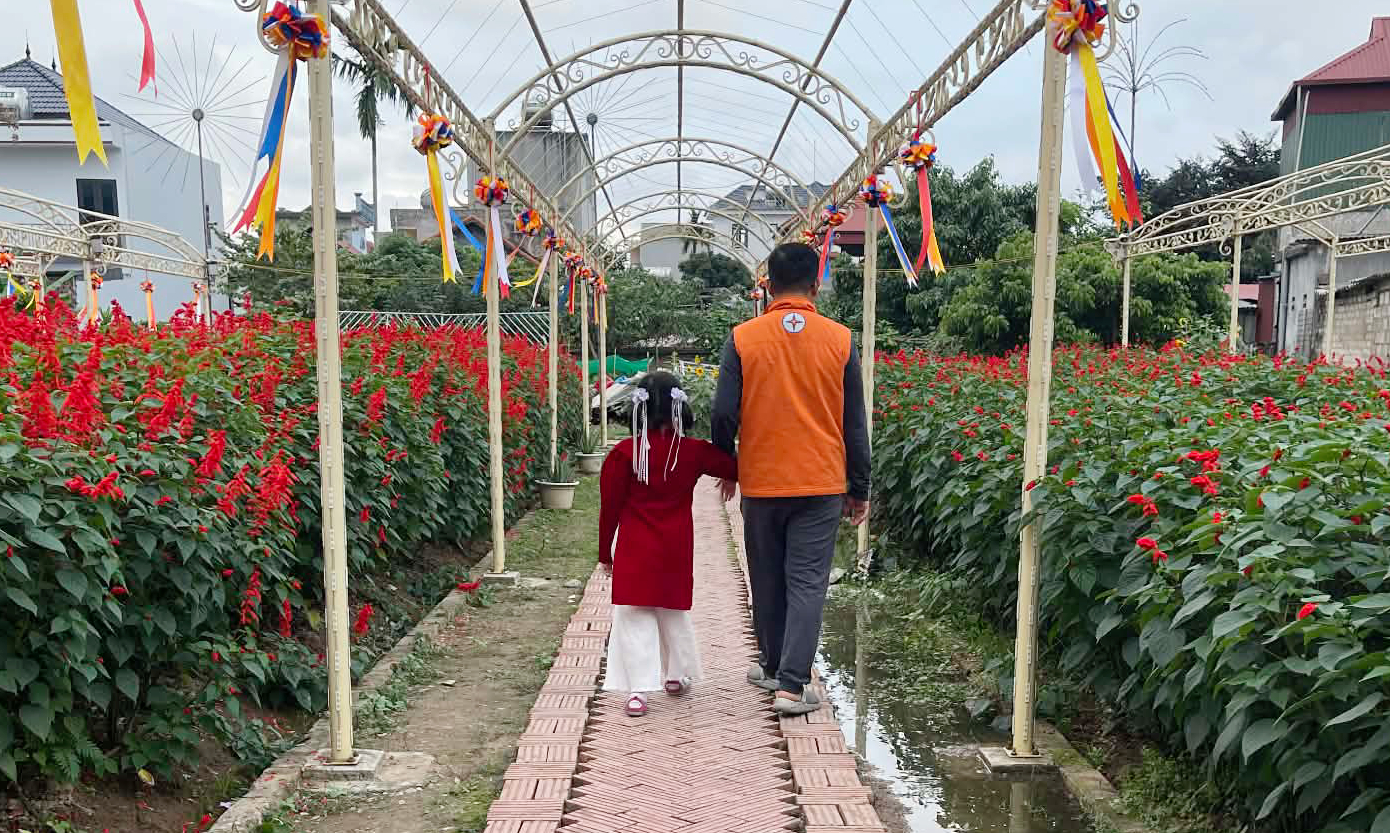 |
Du takes his daughter Phuong Anh out to play, early 2026. Photo: Family provided |
Du takes his daughter Phuong Anh out to play, early 2026. Photo: Family provided
Caring for a child with Pompe demands discipline. Nga resigned from her telecommunications job and taught herself nursing skills, from chest physiotherapy to measuring breathing rates. In their small rented room, an oxygen tank, a nebulizer, and leg braces occupy all living space.
Phuong Anh's meals are also a "battle". Sugar is strictly forbidden, and starches are heavily restricted. She is allowed only half a bowl of rice, supplemented with meat and unsweetened milk. One day, her mother cooked a delicious meal, and the girl secretly scooped more, but her mother shook her head. Sweet fruits like bananas and apples must also be avoided.
A child's instinct sometimes overrides the fear of illness. Once, a visitor gave them a few packs of sugary milk. A few hours later, Nga found four empty cartons scattered in a corner of the house. Seeing this, the mother's heart ached. "It was the first time my child discovered that sweet milk was easier to drink than plain milk. For a child with Pompe disease, there aren't many opportunities to experiment with such risks", she said.
The journey of integration
All financial burdens fall on the husband, who works as an electrician. Toiling to earn a living during the day, Du takes over bathing and feeding their child in the evening to allow his wife to rest. "In the evenings, I often invite her for a walk. Seeing our child tentatively ride her bike, all fatigue melts away", Du said.
Currently, Phuong Anh attends first grade in an inclusive program. Due to muscle weakness, her limbs move with difficulty. Every recess, Nga is at school to help her child go to the restroom and drink milk. Afternoons after school are filled with rehabilitation sessions that extend late into the evening.
Last week, due to traffic, Nga arrived a few minutes late to pick her up. As she arrived, she saw her daughter tentatively walking alone along the roadside amidst traffic. "In that moment, my eyes welled up, and I wondered why so many adults saw a disabled child walking alone, but no one stopped her or led her to the guard's room", she said.
This was not the first time the family felt "left behind". On many occasions, the couple had heard comments like, "If she's like that, why bother sending her to school and wasting money?" or "Treating her costs so much; it would be a shame if she doesn't survive."
"I hope that with medical advancements, society's understanding of rare diseases will improve", the mother said.
Supporting child patients with rare diseases and difficult circumstances is an activity within the Rays of Hope program, implemented by the Hope Foundation. Every contribution from the community sends another ray of light to the nation's future generation. Readers can join the program here:
Program name: Ten cua ban - Benh hiem Mat troi Hy vong
Program ID: 22966
Phan Duong