For over 10 years, comedian Matsubara Tanishi has intentionally lived in apartments most people avoid. These include properties where murders occurred, individuals died by suicide, or an elderly man passed away and was only discovered two years later.
"I once thought I might be haunted", he said.
In Japan, these apartments are known as "jiko bukken" (incident properties) and are generally considered unlucky. However, with rising rental prices, many are now seeing them as a cost-saving solution. The rent or sale price for "jiko bukken" is typically 10-50% lower than market rates.
In March this year, studio apartment rents in central Tokyo increased by 13% compared to the same period, marking the 22nd consecutive month of rises. Niki Hidenori, owner of a Kobe-based brokerage specializing in "jiko bukken", stated that current renters are becoming more pragmatic. "They are more concerned with price and view the issue practically", Niki said.
A recent survey indicated that most Japanese are willing to consider this type of housing if the price is reasonable.
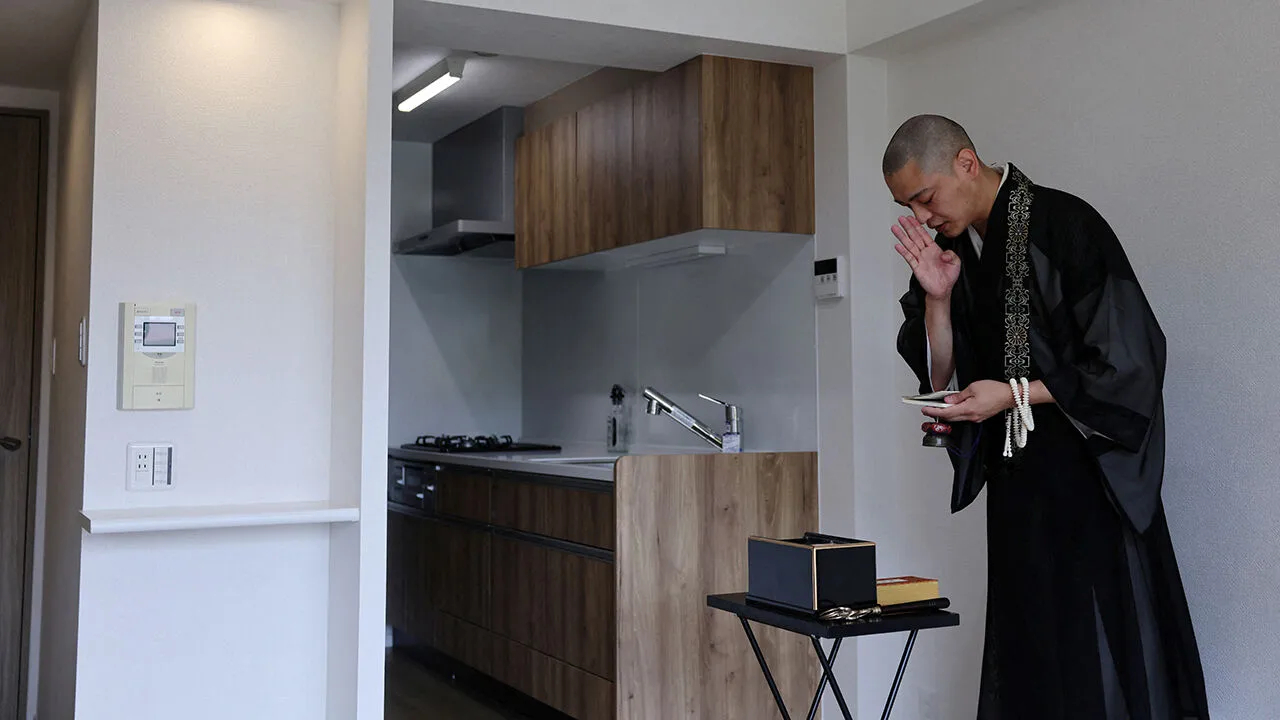 |
A monk performs a ritual in a jiko bukken apartment. *Photo: Reuters*
The interest in "jiko bukken" has created a market for associated services. Monks are invited to perform purification rites, offering peace of mind to residents. Kachimode, a company in Tokyo, uses thermal cameras and other devices to inspect apartments. If no anomalies are detected, the company issues a certificate stating the home is "not haunted".
Additionally, investor Oshima Teru operates a website that maps "jiko bukken" nationwide, marking them with a flame icon and describing the incidents. Kobayashi Yoko, a domestic worker in Tokyo, said she often finds reasons to decline work if a client's home appears on this map.
Japan's aging population is contributing to an increasing number of "jiko bukken". In 2025, Japan recorded over 20,000 cases of "kodokushi" (lonely deaths): individuals who died alone and were discovered at least eight days later.
In 2021, the government issued new guidelines stating that landlords are not required to disclose cases of lonely deaths, except for those involving severe decomposition. The regulation specifies that after three years, many deaths do not need to be disclosed to new buyers or renters. This allows investors to purchase properties at discounted prices and resell them close to market value after this period.
As for Matsubara, after more than a decade living in "jiko bukken", he reported never encountering strange phenomena. Nevertheless, the actor experienced prolonged sleepwalking due to the psychological stress of residing in spaces associated with tragedies.
Ryua, a young woman renting a "jiko bukken" in Tokyo, stated she feels completely at peace. "Every time my friends learn this is a home where someone died, they get worried and quickly ask to leave", she recounted.
Bao Nhien (According to Economist)