Chef Vu Nhat Thong from Eric Vu Cooking Class explains that the ends of spring rolls typically have less filling. This results in a larger surface area contacting the cooking oil, creating a heat concentration effect that causes these sections to cook and burn faster.
Additionally, if the spring rolls are wrapped loosely, moisture from the filling can leak out. When exposed to high temperatures, sugars rapidly caramelize, while proteins undergo the Maillard reaction, leading to localized darkening of the wrapper.
Furthermore, once the water at the ends has evaporated completely, the temperature in these areas spikes from 100 degrees C to 160-180 degrees C. The wrapper then puffs up, creating air pockets that accumulate heat, causing scorching.
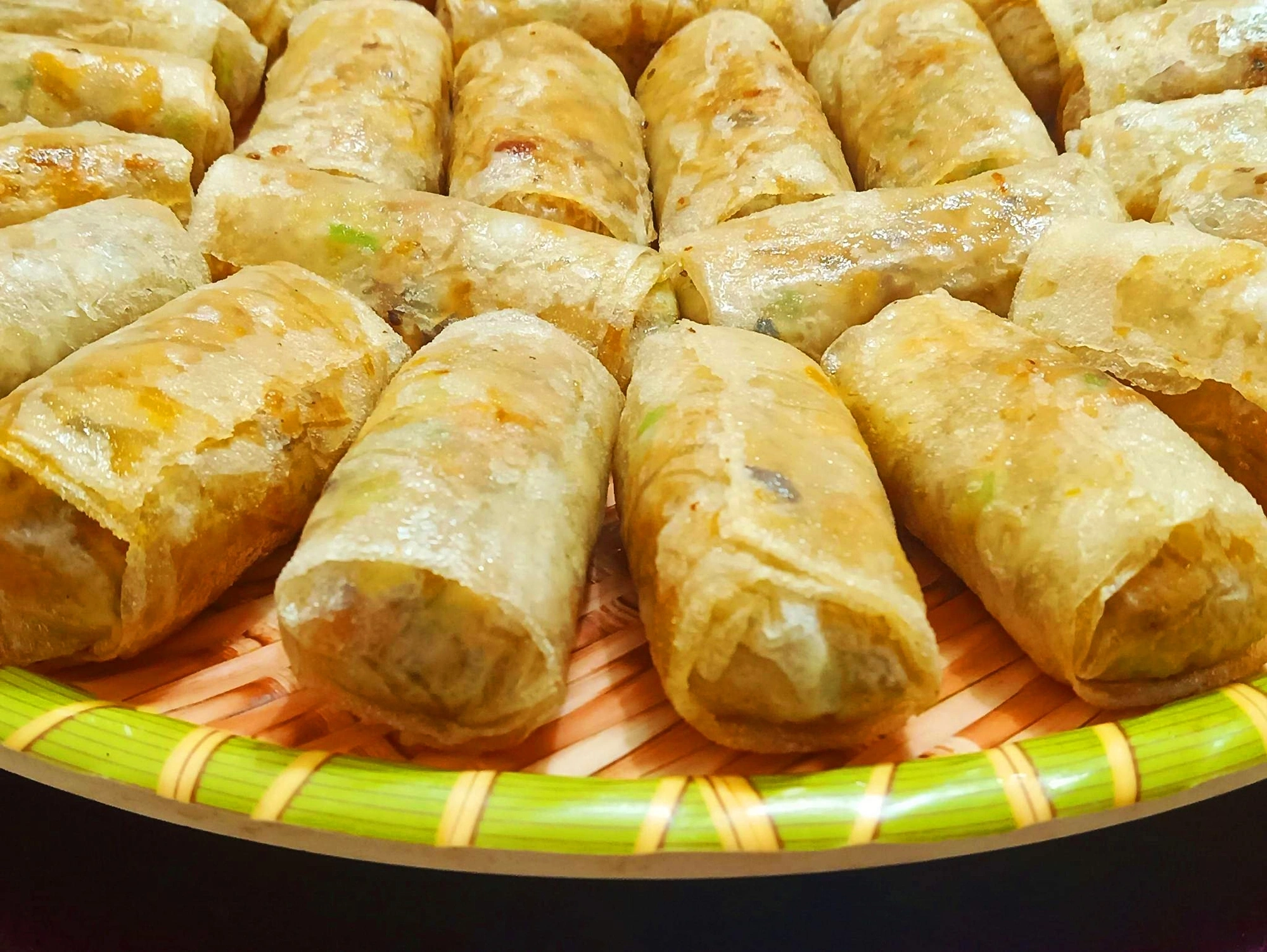 |
Achieving uniformly golden and glossy fried spring rolls is a result of many secrets, from ingredients and wrapping to frying techniques. *Photo: Quynh Vu* |
To ensure uniformly golden and long-lasting crispy fried spring rolls, home cooks should pay attention to every step, from preparing the filling to the frying technique:
Filling Preparation
The cook should saute the filling over high heat to evaporate excess moisture. Allow it to cool completely before wrapping, and add 1% tapioca starch to absorb any remaining dampness.
Wrapping Technique
When wrapping, fold the edges to create double thickness at both ends of the roll, pressing firmly to prevent leakage.
Before frying, the spring rolls should be chilled for 30 minutes to set their shape, then left at room temperature for 10-15 minutes. A thin layer of tapioca starch can be lightly dusted on the outside to create a protective barrier, reducing thermal shock and preventing filling leakage.
Using a Fat and Oil Blend
Experts recommend using a blend of 70% pork fat and 30% vegetable oil. Pork fat has a high smoke point, helps maintain crispiness longer, and adds a richer flavor, while vegetable oil aids in quick heat transfer, balancing the overall effect.
Frying Technique
When placing spring rolls into the pan, do not submerge them immediately. Instead, continuously dip and lift them for the first 30 seconds to ensure even heat contact across the entire surface.
Next, apply a two-stage frying method: the first stage at 160 degrees C for 3-4 minutes, then remove and let cool; the second stage at 170 degrees C helps the wrapper become perfectly crispy, allows moisture to escape gradually, and prevents the rolls from breaking apart.
Bao Nhien