Culinary expert Eric Vu, founder of Eric Cooking Class, states that freshwater snails such as buou snails, da snails, and lac snails often carry the roundworm parasite Angiostrongylus cantonensis (rat lungworm). When this parasite enters the human body, it can cause meningitis.
According to food safety studies, parasites in snails are completely destroyed when the snail meat reaches a temperature of 70-75 degrees Celsius and is maintained for a specific period. Therefore, maintaining the water at a rolling boil is essential to ensure food hygiene and safety.
Snail meat's main components are muscle protein and collagen. When the temperature exceeds 75-80 degrees Celsius for an extended period, the protein fibers contract strongly, expelling internal water. This dehydration causes the snail meat to become firm and chewy. Therefore, extending the boiling time does not make snails tastier; instead, it diminishes their natural crisp and sweet texture.
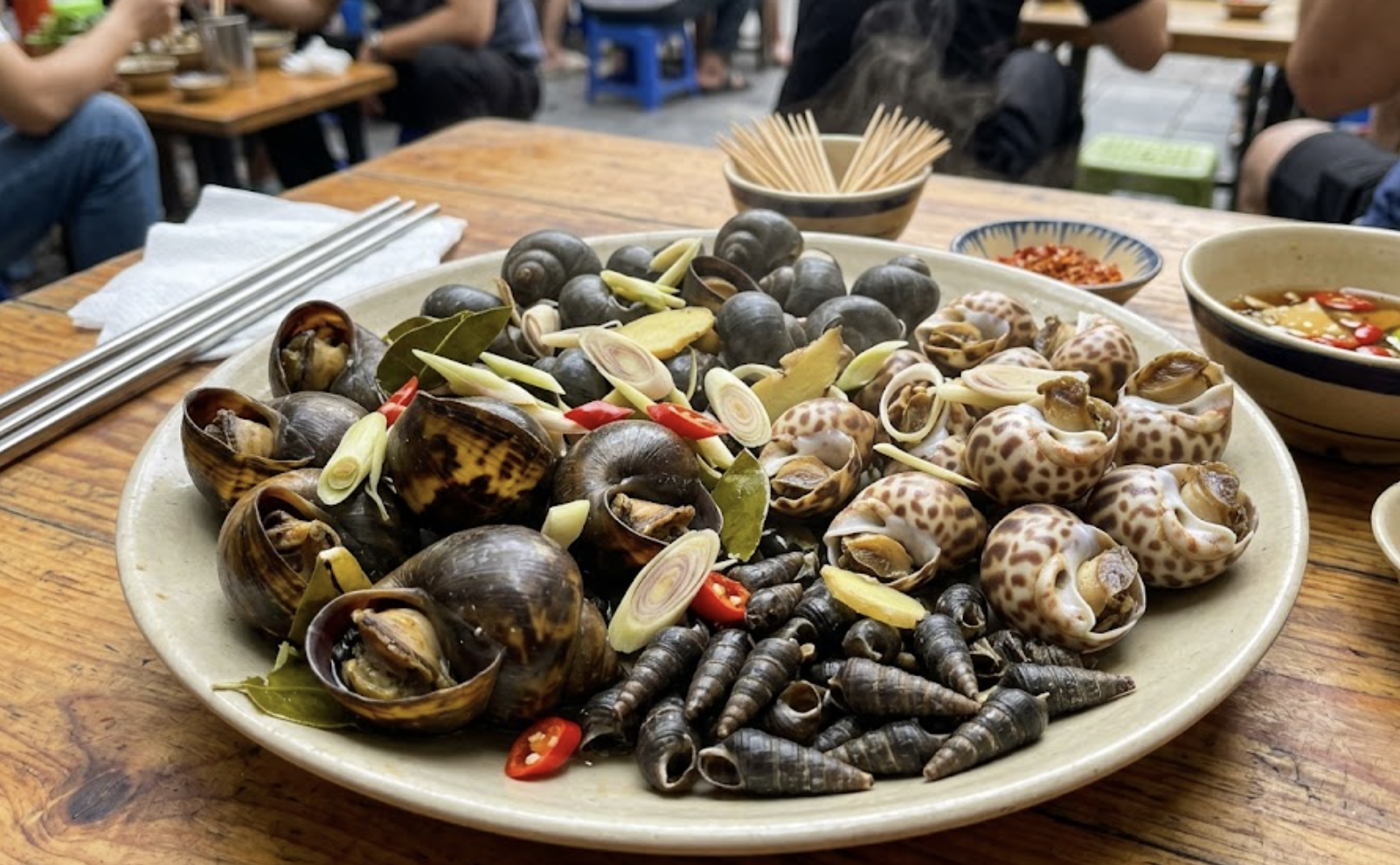 |
Each snail type has a different boiling time. |
To ensure snails are cooked evenly, safely, and remain tender, the boiling time must be adjusted according to their size and shell thickness. The following times are calculated from the moment the water boils and one kg of snails are added to the pot:
- Huong snails, mo snails, gao snails (thin shells, small meat): 5-7 minutes.
- Mong tay snails, len snails: 4-6 minutes.
- Buou snails, lac snails, da snails (thick shells, large meat): 10-15 minutes.
- Giac snails, tu va snails (large size 300-500 gr/snail): 20-30 minutes.
Note that if you time from the second boil, the duration shortens to about 2 minutes for small snails, 4 minutes for medium snails, and longer for larger snail types. Furthermore, when boiling a large batch (2 kg or more), add 2-3 minutes to compensate for the heat reduction when a significant amount of snails is added to the pot.
Signs that snails are cooked include their operculum (lid) detaching and the meat protruding. Remove the pot from the heat immediately upon seeing the operculum detach to prevent overcooking.
Tips for cleaning and enhancing flavor
Cleaning mud and dirt: Before cooking, soak snails in rice water mixed with a few chili slices for 1-2 hours. Compounds from the chili cause mild irritation, prompting the snails to open their mouths and release all dirt and sand.
Eliminating fishy odor: During the boiling process, add crushed lemongrass, kaffir lime leaves, and ginger. The essential oils containing citral and limonene compounds in lemongrass and kaffir lime will mask the muddy smell and the snails' characteristic fishy odor.
Controlling water quantity: Use only a very small amount of water at the bottom of the pot and cover it tightly so the snails cook primarily by steam. Submerging them in too much water will dissolve the snails' natural sweetness.
For perfect boiled snails, avoid adding them to water that has not yet boiled, as this will result in uneven cooking and insufficient temperature to immediately kill parasites.
Also, avoid boiling excessively large batches, as heat distribution will be uneven, leading to snails at the bottom cooking while those on top remain raw. During boiling, avoid opening the pot lid frequently to prevent heat loss, which prolongs cooking time and makes the snail meat tough and chewy.
Bao Nhien