The outdoor unit's primary function is to dissipate heat absorbed by the air conditioner from indoors to the outside environment. Its casing and components are designed to withstand harsh weather conditions. However, attempts to cover the outdoor unit can be detrimental if users make one of three common mistakes.
**Completely enclosing the unit**
Many covers are marketed for sun and rain protection, leading users to fully enclose their outdoor units year-round. This practice obstructs air intake and exhaust, preventing heat from escaping and forcing the compressor to overwork. Prolonged overexertion can damage the compressor, incurring significant replacement costs. Users should only employ covers for dust protection during extended periods of non-use, such as in winter, and never when the unit is operating.
**Installing an overly low or enclosed cover**
While outdoor units can operate in the shade, many households install covers that are too low or fully enclose the unit with metal sheeting. When the fan expels hot air, it hits the obstruction, circulates, and is drawn back into the unit. This forces the outdoor unit to operate with hotter air, reducing heat dissipation efficiency and increasing electricity consumption. The general rule is that a cover should only provide overhead sun protection. Standard installation requires a minimum distance of 20 cm from the wall and 60-70 cm of clear space in front of the fan.
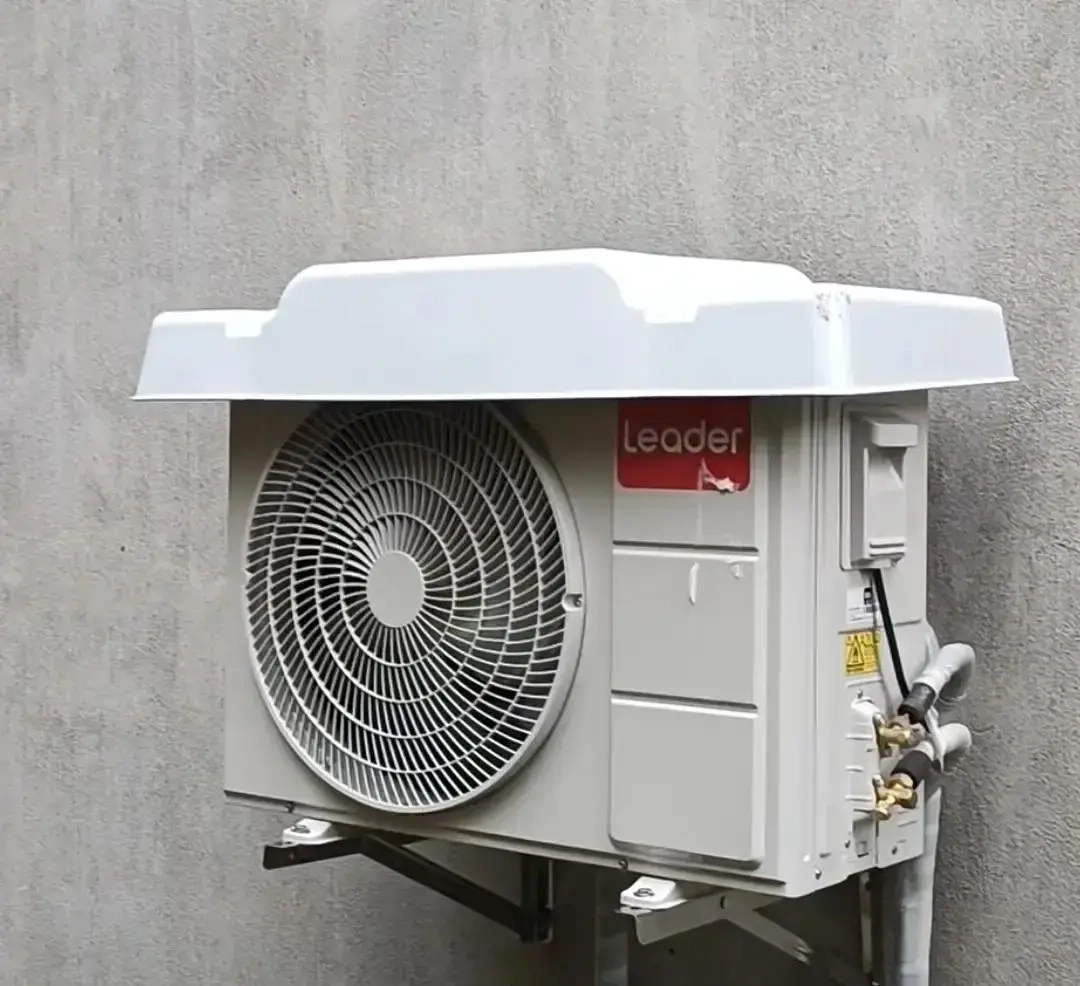 |
It is permissible to shade the air conditioner's outdoor unit, but airflow must not be blocked. *Photo: Aboluowang* |
**Blocking side panels for sun protection**
Households with outdoor units facing west or located on rooftops often use tarps or metal sheets to cover the side panels closely, aiming to create shade and prevent overheating. This practice restricts airflow through the heat exchanger. The proper approach is to establish a distant barrier for shade while maintaining ample open space around the unit. Air conditioner manufacturer Carrier recommends placing outdoor units in well-ventilated areas, clear of plants, debris, or other obstructions. Obstructed airflow from dirt and debris is more damaging than direct sunlight. Leaves, trash, and dust accumulating on the condenser coil reduce airflow. Users must keep the area around the outdoor unit clean, avoiding potted plants or climbing vines near the machine. When cleaning, disconnect power and use a soft brush or a low-pressure water hose, avoiding high-pressure jets that can bend the delicate aluminum fins.
Furthermore, spraying water directly onto a running outdoor unit to rapidly cool it can cause electrical short circuits. Nguyen Duc Loi, a former lecturer at Hanoi University of Science and Technology, suggests that users can install specialized misting systems for the condenser unit to lower the ambient air temperature to 30-35 degrees C, thereby enhancing efficiency. However, such systems require careful control of water volume and placement to prevent scale buildup.