The timing of adding salt to scrambled eggs has long been a subject of debate. Many people fear that adding salt to raw eggs will thin the egg whites, making the dish chewy and tough after cooking. Conversely, some believe that salting from the beginning helps the eggs absorb flavor and become richer. Recently, experts have provided a consensus answer that challenges the traditional view.
Food journalist J. Kenji Lopez-Alt of The New York Times asserts that salt does not make egg proteins tougher. He explains that if salt is added to eggs about 15 minutes before cooking, the seasoning has time to dissolve and distribute evenly. This process helps eggs retain more water, yielding a soft and moist product.
Tests by the culinary science website Serious Eats and the food magazine Bon Appetit (US) also yielded similar results, with batches of eggs salted early tending to be softer, fluffier, and richer in flavor. Major egg producers in the US, including Happy Egg, Vital Farms, and Pete & Gerry's, support this view. They note that adding salt immediately when whisking raw eggs helps break down the egg white structure, creating a uniform mixture. While taste tests did not show a significant difference in flavor, adding salt to raw eggs is recommended for the best texture.
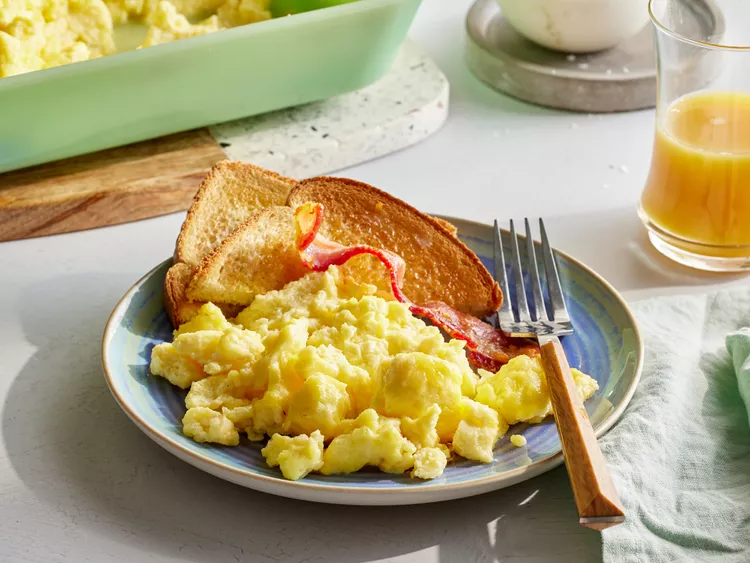 |
Photo: Allrecipes |
From a food science perspective, American researcher Harold McGee explains that most proteins in eggs carry a negative charge. When salt is added, the ions interact with the charged regions of the proteins, reducing the repulsive forces between them. This allows proteins to link together earlier during heating without forming an overly tight network that would expel water. This process acts as a buffer, contributing to a tender final egg dish.
While salt timing has a certain effect, experts emphasize that temperature is the decisive factor for the quality of scrambled eggs. Harold McGee points out that temperature control is key when cooking eggs. Excessive heat causes proteins to coagulate quickly, shrink, and expel water, resulting in dry, rubbery egg pieces. Conversely, moderate heat allows coagulation to occur slowly, creating soft, moist egg curds.
Bao Nhien (According to Allrecipes)