Home cooks often favor pressure cookers for their ability to tenderize food quickly. However, according to chef Vu Nhat Thong from Eric Cooking Class, this convenience often comes at the cost of quality, preventing dishes from achieving the rich flavor of traditional slow-cooking methods.
Physically, pressure cookers operate by increasing pressure to raise the boiling point of water. Under normal conditions, water boils at 100 degrees C, but within a pressure cooker's sealed environment, the temperature can reach 121 degrees C. This elevated heat helps collagen, the protein responsible for tough meat, break down faster.
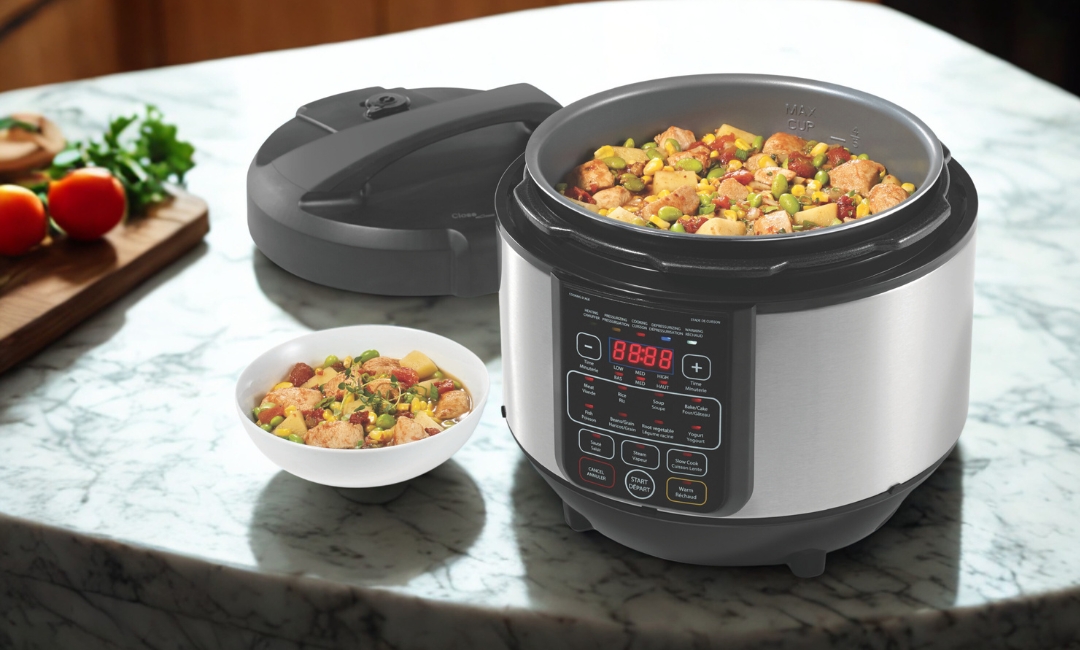 |
Photo: Starfrit |
However, chef Vu Nhat Thong noted that a pressure cooker only shortens cooking time; it does not guarantee better flavor. Many braised and stewed dishes achieve their distinct taste through a slow cooking process, which a pressure cooker struggles to replicate.
The appealing brown color and characteristic aroma of braised and stewed dishes largely depend on the Maillard reaction. This chemical reaction primarily occurs at 140-165 degrees C on the dry surface of food. In the steam-saturated environment of a pressure cooker, this reaction is almost nonexistent, often resulting in pale dishes that lack an attractive, glossy brown coating.
Additionally, aromatic compounds from ingredients like onions, garlic, ginger, and lemongrass are highly volatile and heat-sensitive. When heated to around 121 degrees C in a high-pressure environment, many of these fragrance molecules decompose before they can fully meld into the broth. Conversely, simmering slowly over a longer period allows essential oils and aromatic compounds to release gradually, creating a more layered flavor. Food science studies using gas chromatography also show that stews cooked in conventional pots retain significantly higher amounts of aromatic compounds compared to those made in pressure cookers.
Many people inadvertently diminish flavor further by choosing the quick release method for pressure cookers. During quick release, the strong burst of steam carries not only water vapor but also many essential oils and aromatic compounds from ingredients like onions, garlic, lemongrass, and ginger. The aroma spreading throughout the kitchen indicates that a portion of the flavor has escaped the pot. Therefore, for stews, chefs often recommend natural pressure release, allowing steam to condense gradually and return aromatic molecules to the broth instead of letting them escape.
Despite these drawbacks, Thong affirmed that pressure cookers remain highly effective tools in many situations, such as cooking tough beans, tenderizing tendons and bones, or when home cooks need to save time.
To balance speed and flavor, the chef suggests a combined approach: pressure cook ingredients for about 20 minutes to achieve 70% tenderness, then transfer them to a regular pot, add seasonings, and simmer for 30-45 minutes. This method shortens cooking time by approximately two-thirds while allowing sufficient conditions for flavor compounds to meld, resulting in tender food with a rich, deeply aromatic broth.
For broths, high pressure can sometimes be an advantage. Under intense heat and pressure, the vigorous agitation of the liquid emulsifies fat, bone marrow, and protein into the water, creating a milky, rich broth. This technique is ideal for preparing Japanese Tonkotsu Ramen but is not suitable if one desires a clear, light, and naturally sweet Vietnamese beef pho broth.
Bao Nhien