In Vietnamese spiritual culture, the rooster is an indispensable offering on the ceremonial tray. However, many young families today question whether it can be replaced by other meats or cut into smaller pieces for convenience.
Tran Thi Kim Hoa, a Master of Vietnamese Studies, explains this issue from a cultural and spiritual perspective.
Symbol of the sun
Originating from the rice civilization, before clocks existed, people relied on the rooster's crow to tell time. A rooster's morning crow signals dawn, calls the sun to awaken, and dispels darkness. "In spiritual belief, the rooster embodies Yang energy, symbolizing life and vitality. Offering a rooster on New Year's Eve carries the meaning of 'calling in the new day,' praying for a smooth year, and warding off evil spirits," Ms. Hoa explained.
Therefore, an offering rooster differs from a rooster for consumption. A rooster for eating only needs to be delicious, but an offering rooster serves as a "language" to communicate with deities and ancestors, thus demanding solemnity. The selection criteria for an offering rooster are often strict: a bright red comb, yellow legs, a full breast, and it must not have mated, to symbolize purity and reverence.
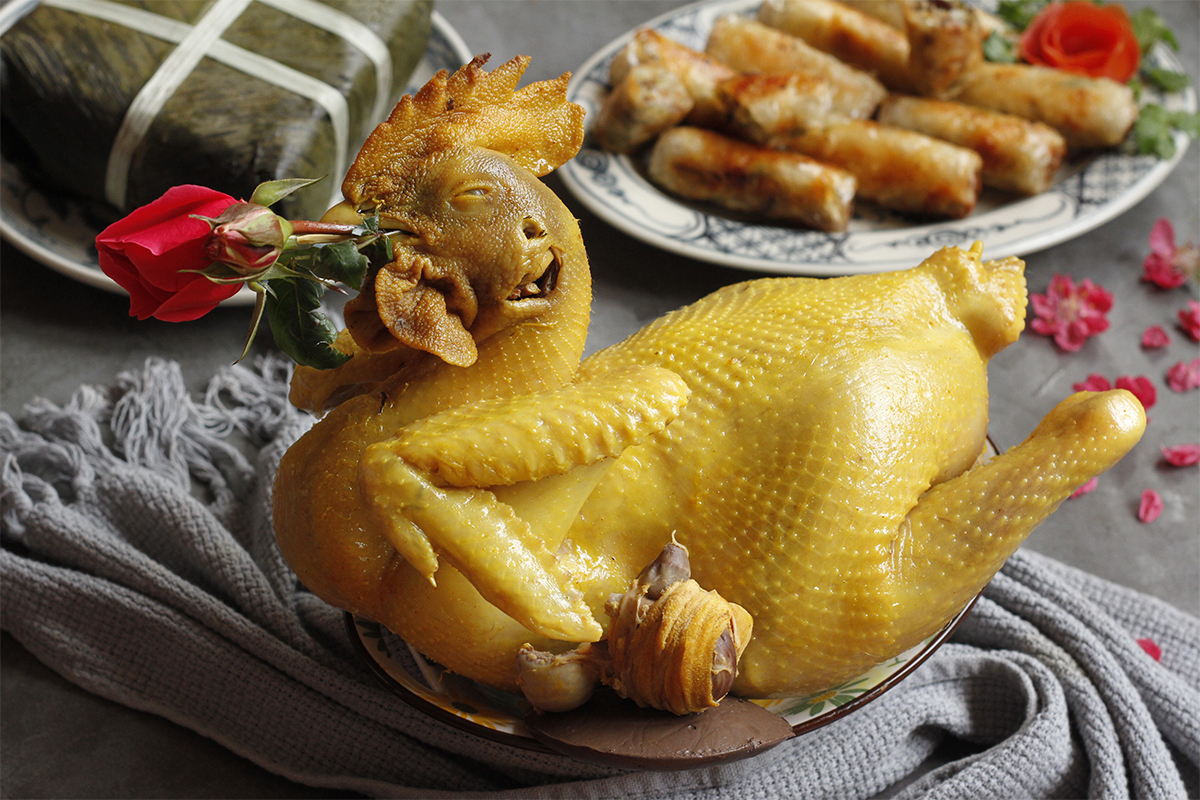 |
Illustration: Bui Thuy
Why should it be offered whole?
Regarding its presentation, experts recommend offering the rooster whole, especially for major ceremonies, for two reasons:
Completeness: A whole rooster symbolizes completeness, ensuring "smooth sailing from start to finish."
Aesthetics: Skillfully boiled roosters are often tied in a "fairy wing" style (head held high, wings folded as if in flight). Notably, the rooster's beak often holds a red rose. According to folk beliefs, the vibrant red color symbolizes good fortune and luck; the image of a rooster holding a flower signifies "bringing good news" (bao hy) to the household on the first day of the new year.
Which way should the rooster face?
Regarding the rooster's placement direction, experts highlight differences across various rituals to avoid taboos:
New Year's Eve offering (outdoors): The rooster should face the street. Folk belief holds that this is when the new "Quan Hanh Khien" (celestial official overseeing the year) passes by, and the rooster facing outward serves to "call the sun," welcome vitality, bid farewell to the old year's officials, and greet the new year's officials.
Ancestor offering (indoors): The rooster should face the ancestral altar (in a position of bowing to ancestors) to show respect and filial piety. Households should avoid placing the rooster facing the main door, as it is believed that this position makes the rooster "leave," taking good fortune out of the house.
When can a rooster be offered in pieces?
Cutting a rooster into pieces is acceptable in certain cases: for everyday savory offerings (not major ceremonies or New Year's Eve), when offering a hen, or when the offering tray is too full to arrange a whole rooster.
However, Ms. Hoa noted that regardless of the presentation method, the core element remains meticulousness. If cut into pieces, the plate of rooster should be arranged neatly and generously, avoiding disarray. The essence of the offering lies in sincerity, and the harmony of descendants is the most important factor for ancestors to witness.
Bao Nhien