Da Nang city leaders have moved to accelerate the development of the city's free trade zone (FTZ) by directing the specific exploitation of an 11 million cubic meter earth mine. The decision, made during a meeting chaired by Nguyen Manh Hung on 21/4, focuses on resolving a critical overlap affecting FTZ number 4, a key component of Da Nang's economic strategy.
The primary concern revolves around FTZ number 4, where 83,34 hectares of the planned zone overlap with the substantial earth mine in Ba Na commune. During the meeting with the Management Board of Hi-Tech Park and Industrial Zones, the Department of Agriculture and Environment initially proposed a plan to exploit the mine over two to three years for public investment, with site handover occurring afterward. However, Vu Quang Hung, Head of the Management Board, argued against this approach. He highlighted that such a timeline could delay progress and reduce opportunities to attract investors during the FTZ pilot phase, which extends until 2028. He also pointed out that fully excavating the earth and then having to transport it back for leveling would result in wasted resources.
In response, Chairman Nguyen Manh Hung mandated that the earth mine not be commercially auctioned. Instead, he prioritized its exploitation solely for public investment under a special mechanism. The extraction must strictly align with the free trade zone's master plan, with earth taken only to the necessary ground elevation. This ensures the immediate handover of a clear site to investors. Da Nang City People's Committee vice chairman Tran Nam Hung will directly oversee the completion of a specific plan for an early report.
FTZ number 4, spanning 559 hectares, is one of seven planned locations for the Da Nang Free Trade Zone. The project, proposed by Thanh Binh Phu My Investment Joint Stock Company, is expected to deploy phase one across 335 hectares before 9/2026. The remaining portion will proceed after site clearance is completed.
Beyond the FTZ project, Da Nang is developing 10 new industrial zones. However, these initiatives face difficulties due to a lack of topographic data required for 1/2000 sub-zone planning. Some projects, like the Dien Tien industrial zone, currently possess only about 20% of the necessary data, which is impacting the progress of investor attraction.
Recognizing these challenges, Chairman Hung instructed units not to wait for data from various departments and sectors. Instead, they must proactively measure and update information to meet daily progress requirements. He emphasized that both industrial zones and the free trade zone are new growth drivers for Da Nang. Therefore, all procedural and coordination obstacles must be decisively resolved for projects to be implemented swiftly.
City leaders also highlighted limitations in coordination among departments and sectors. They primarily communicated through written documents, lacking direct engagement, which prolonged processing times for various issues.
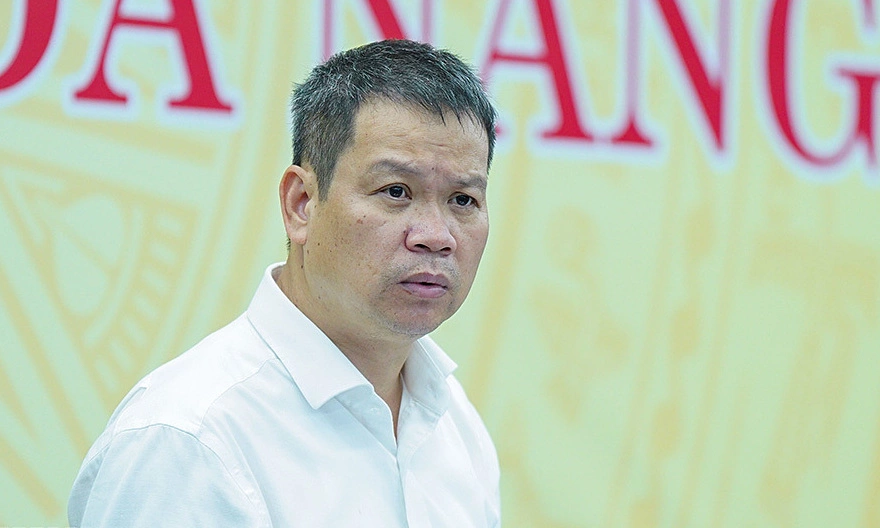 |
Da Nang City People's Committee chairman Nguyen Manh Hung at the working session on the afternoon of 21/4. Photo: Nguyen Dong |
Nguyen Dong