On the afternoon of 26/5, Inspection Team 10 of the Politburo held a conference to approve the draft second inspection report of the Politburo regarding the Standing Committee of the Hanoi Party Committee.
General Secretary and President To Lam affirmed that in recent times, the capital's appearance has undergone significant changes. Streets are more spacious, clean, and orderly. The city's efforts have yielded tangible results that residents can perceive and measure daily.
He commended Hanoi for confidently setting an average economic growth target of 11% or more for the 2026-2030 period. This is a challenging figure, significantly higher than the national average. However, to transform this goal into reality, Hanoi cannot continue with the old growth model, relying on inertia or pre-existing advantages.
The General Secretary and President urged the city to reform institutions and the business investment environment, resolve outstanding projects, and foster science, technology, and innovation. Specifically, Hanoi needs to increase labor productivity, develop the digital and data economies, and strongly promote the private economic sector.
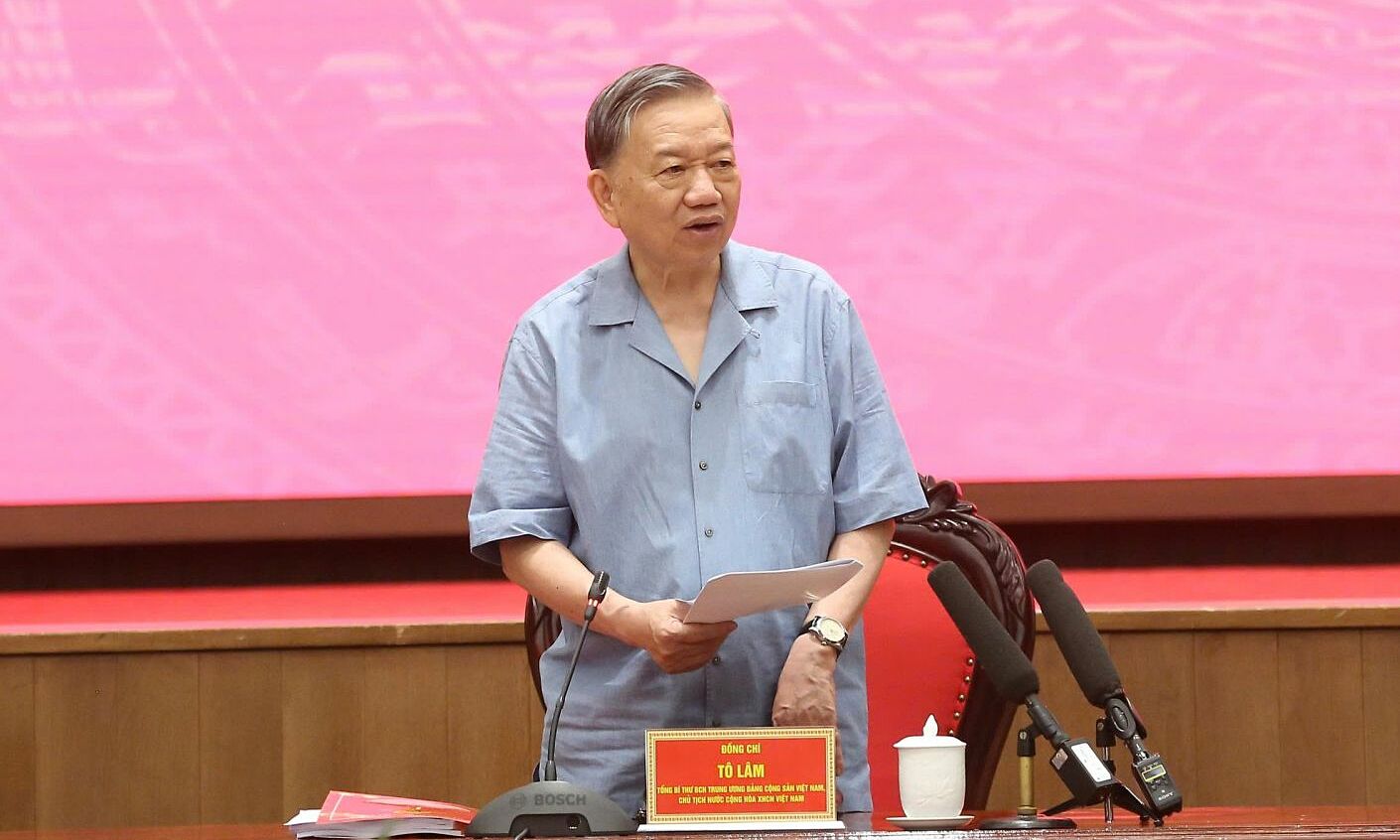 |
General Secretary and President To Lam chaired the working session between the Politburo's Inspection Team and the Standing Committee of the Hanoi Party Committee on the afternoon of 26/5. Photo: Hoang Phong
He also called for accelerating major projects and ensuring effective compensation and site clearance, coupled with building public consensus. Alongside developing large urban areas, Hanoi must invest in social housing, rental housing, or implement housing policies to serve the majority.
The General Secretary and President also proposed that the city continue to concretize the policy of building socialist commune and ward models with specific criteria and standards. The capital must truly be a model for urban infrastructure, social governance, and people's lives—a desirable place to live and visit for all Vietnamese citizens, thereby replicating the model in eligible localities.
General Secretary and President To Lam also noted that the people place great trust and expectation in Hanoi's breakthroughs. The ultimate goal of the two-tier government model is not merely a mechanical reduction of personnel or streamlining of the administrative apparatus. The greater objective is to build a government closer to the people, more responsive to practical demands, ensuring high transparency and optimal governance efficiency.
Hanoi must lead in building a modern, data-driven, and digitally operated urban governance model, minimizing the "ask-give" mechanism, reducing administrative intermediaries, and cutting down on formalistic meetings.
The General Secretary and President urged the city to innovate its cadre evaluation and classification, linking it with their placement, utilization, training, planning, and screening. "We cannot set very high development requirements yet be content with a cadre team lacking ambition, innovation, afraid of responsibility, and working half-heartedly," he stated.