At 19h, the air quality index (AQI) at the monitoring station near the gate of Hanoi University of Science and Technology on Giai Phong street registered 168. The Khuat Duy Tien park station recorded 167, and the 556 Nguyen Van Cu station showed 159. These figures all fall into the unhealthy range, posing potential health impacts for the general public and more serious risks for sensitive groups.
Air quality began to deteriorate around noon and worsened throughout the afternoon. Beyond Hanoi, some monitoring stations in Thai Nguyen and Hung Yen also reported similar pollution levels.
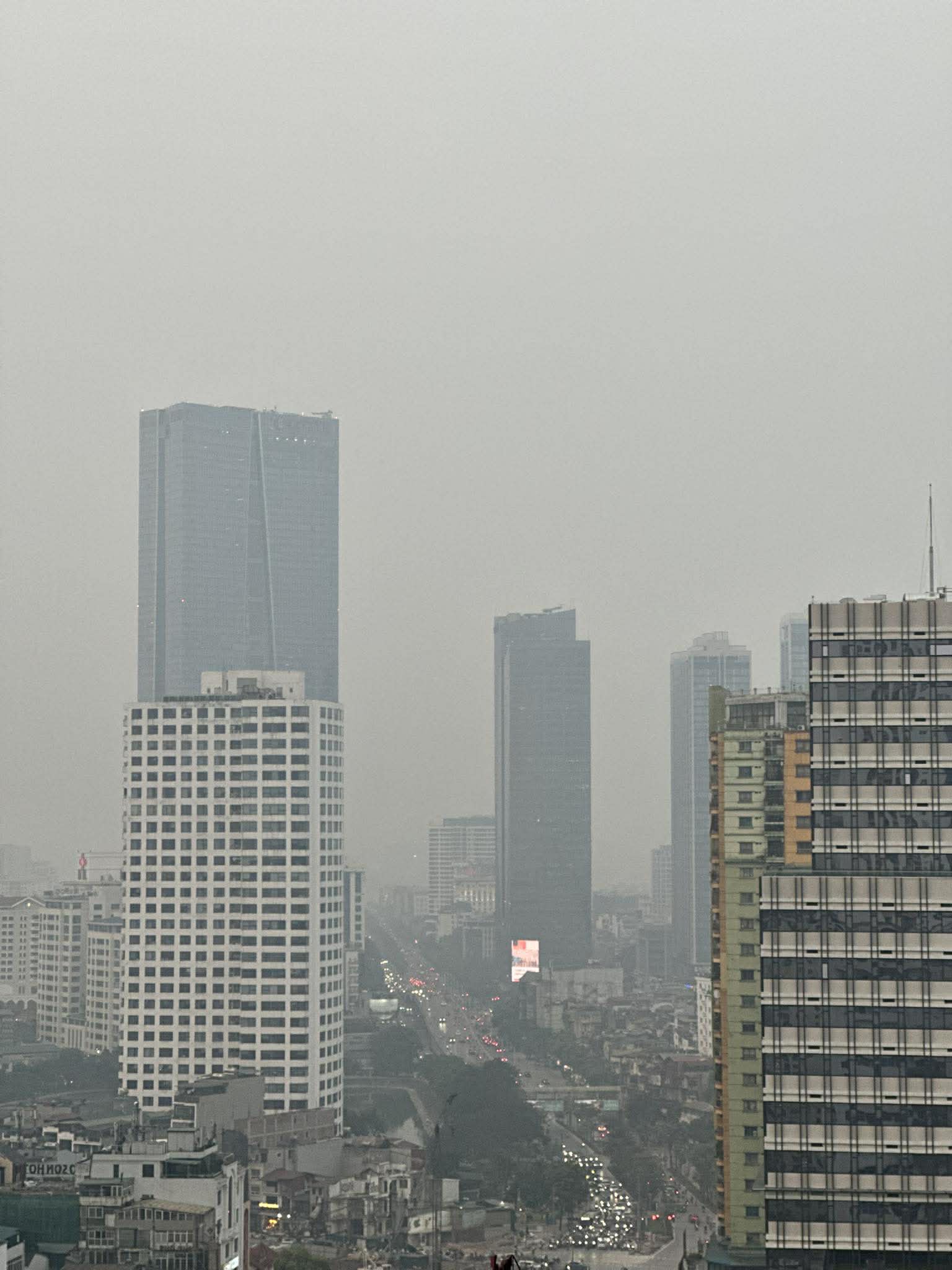 |
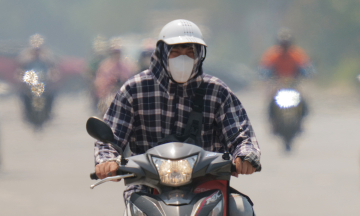
Air pollution in Hanoi on the afternoon of 6/4. *Photo: Xuan Hoa*.
According to the IQAir monitoring system, Hanoi topped the list of the world's most polluted cities at this time, with an overall AQI of 196. This was higher than Kuwait City (Kuwait) and Shanghai (Trung Quoc), both at 155. Many inner-city locations in Hanoi recorded very unhealthy levels, including Ho Tay at 251, Vo Chi Cong at 222, and Hang Trong at 224.
Meteorological agencies noted that weather conditions on 6/4 were unfavorable for pollutant dispersal. Peak temperatures commonly reached 33-35 degrees C, with some areas exceeding 35 degrees. The absence of rain at night meant the air lacked a mechanism to wash away fine dust.
Weak south to southeast winds, blowing at level 2-3, further reduced the ability to disperse pollutants from traffic and construction activities. Nighttime temperatures remained at 26-28 degrees C, resulting in a small day-night temperature difference that limited atmospheric convection. These factors facilitated the accumulation of fine dust and toxic gases near ground level.
Late last year, when Hanoi's air quality remained unhealthy for several days, the Ministry of Agriculture and Environment urged ministries and sectors to implement urgent measures in Hanoi and its surrounding areas. The Ministry of Industry and Trade was asked to strictly control emissions from thermal power plants, steel, chemical, and fertilizer factories, and to reduce their capacity when pollution indices surpassed 200.
The Ministry of Construction required construction sites to enhance shielding, wash vehicles, and use misting to suppress dust. It even suggested temporarily halting activities that generate significant dust. Local authorities were instructed to reroute traffic and control material transport vehicles to alleviate congestion.
Police forces were tasked with increasing enforcement against unshielded material transport vehicles, expired vehicles emitting black smoke, and illegal waste burning. The Ministry of Health provided guidance to residents on protecting their health, particularly for sensitive groups, while the Ministry of Education and Training advised educational institutions to limit outdoor activities when air quality was poor.
Gia Chinh