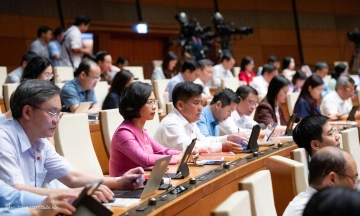
The National Assembly Standing Committee's specialized oversight delegation on the implementation of social insurance policies and laws for the 2021-2026 period held its first session on 3/7. During the meeting, Chu Manh Sinh, Deputy General Director of Vietnam Social Insurance, advocated for comprehensive monitoring and surveying across all types of enterprises to address the persistent issue of social insurance debt.
Chu Manh Sinh highlighted that outstanding debt, late payments, and evasion of social insurance contributions occur most frequently in the private sector. This situation directly impacts employees' rights, complicating the resolution of their benefit claims. He urged the delegation to conduct a thorough survey to develop effective remedies.
 |
Deputy General Director of Vietnam Social Insurance Chu Manh Sinh. |
Le Nhat Thanh, a full-time delegate to the Ethnic Council, suggested that the oversight delegation visit localities with many foreign direct investment (FDI) enterprises; areas with concentrations of informal workers, mountainous provinces, and ethnic minority regions. This approach aims to provide a comprehensive reflection of the current social insurance landscape. He also proposed specific criteria for selecting these localities to ensure they represent the overall national situation, including areas with varying social insurance participation rates, from high to low.
Concluding the session, Vice Chairwoman of the National Assembly Nguyen Thi Thanh emphasized the broad scope and complexity of this oversight topic, noting its direct impact on the rights of tens of millions of workers. She stressed the importance of ensuring regional representation and considering socioeconomic development conditions when selecting areas. Prioritizing localities with large numbers of participants, such as Ha Noi, TP HCM, and the mountainous or Central Highlands regions, would offer a comprehensive perspective.
The severity of the problem was underscored by TP HCM Social Insurance, which reported in late 2025 that over 17,700 enterprises were in debt for employees' social insurance. Many of these businesses owed tens of billions of dong in late payments, reflecting the complex nature of ongoing violations of insurance obligations.
The current Social Insurance Law mandates that employers who delay or evade social insurance and health insurance payments must settle the full outstanding amount. Additionally, they are required to pay an extra sum calculated at 0,03% per day on the overdue amount and the number of days delayed or evaded. Beyond financial penalties, violating enterprises face administrative sanctions and are ineligible for emulation titles or awards. Employers found evading insurance contributions may also face criminal prosecution.
Son Ha