As of the morning of 3/7, the National Steering Committee for Civil Defense reported that authorities had informed, inspected, and guided 56,240 vessels with over 2,491,840 workers about the typhoon's developments and track. This allowed them to proactively steer clear of dangerous areas.
Thunderstorms and whirlwinds, a distant effect of the typhoon, caused a Quang Ninh fishing boat to sink at 1h28 today while returning from fishing grounds to Co To Island. Six of the seven fishermen were rescued, but one remains missing.
In response to the typhoon, in addition to Quang Ninh and Ninh Binh proactively prohibiting sea activities, twelve other coastal provinces and cities have issued directives: Hai Phong, Hung Yen, Thanh Hoa, Nghe An, Ha Tinh, Quang Tri, Hue, Da Nang, Quang Ngai, Gia Lai, Dak Lak, and Khanh Hoa have instructed communes, wards, and departments to prepare for the typhoon's impact.
This morning, the National Steering Committee for Civil Defense issued an urgent dispatch, requiring eleven provinces and cities in the Northeast region and Thanh Hoa to promptly inspect vessels, proactively prohibit sea activities, ensure the safety of fisheries, tourism, and coastal infrastructure, and prepare search and rescue forces.
Inland, the Steering Committee has requested a review of areas at risk of deep flooding, flash floods, and landslides to facilitate proactive resident evacuation. Other measures include reinforcing homes, structures, and dikes, trimming trees, ensuring the safety of power grids and telecommunications, and proactively draining water and harvesting agricultural products to minimize damage.
 |
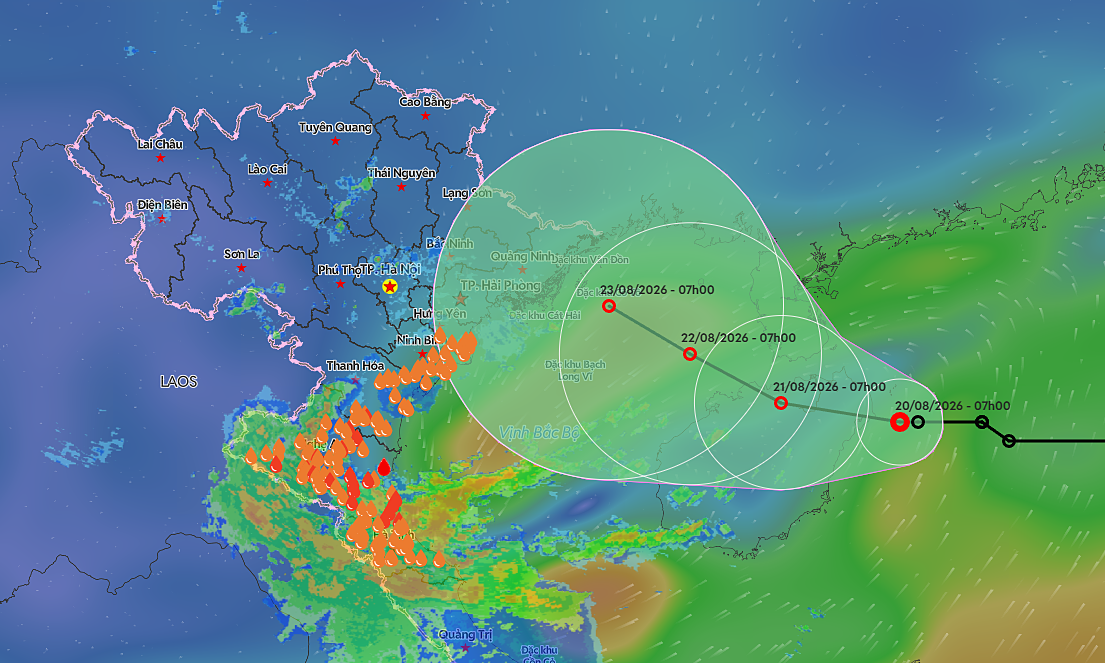
Forecast track and impact zone of typhoon Maysak, noon 3/7. *Photo: Disaster Monitoring System* |
The National Center for Hydro-Meteorological Forecasting announced that at 10h today, the eye of typhoon Maysak was over the southern sea, about 90 km from Hainan Island (China). The maximum wind speed reached 88 km/h, force 8-9, gusting to force 11. The typhoon is changing direction to west-northwest, moving slowly at about 5 km/h.
Compared to yesterday's forecast, the typhoon's track is likely to shift further to the northeast. This means it will not approach Quang Ninh's border but will enter the southern part of Hainan Island, proceed into the northern Gulf of Tonkin, then head more towards the southern part of Guangxi province (China). The typhoon's speed has slowed, from about 10-15 km/h in the morning bulletin to about 5 km/h.
The forecast indicates that by 10h tomorrow, the typhoon's eye will be in the northern Gulf of Tonkin, about 170 km from Mong Cai (Quang Ninh), maintaining force 8-9 intensity, gusting to force 11. By 5/7, the typhoon will enter the southern part of Guangxi province (China) with force 8 intensity, then weaken into a tropical depression, and later a low-pressure area by 6/7.
International forecasting centers have differing assessments of the typhoon's intensity as it enters the Gulf of Tonkin. Japan forecasts the typhoon to gradually weaken after passing Hainan Island, reducing to about 65 km/h as it approaches Quang Ninh's waters. The Hong Kong Observatory believes conditions in the gulf could help the typhoon maintain or strengthen to about 85 km/h before making landfall.
 |
Satellite image of typhoon Maysak at 11h on 3/7. *Photo: NCHMF* |
The National Center for Hydro-Meteorological Forecasting predicts that the typhoon will directly affect Northern Vietnam. From the night of 3/7 to the end of 5/7, the Northeast region and Thanh Hoa will experience rainfall of 100-200 mm; specifically, the Northeast region will see 150-250 mm, with some localized areas exceeding 350 mm.
From the afternoon of 4/7, coastal areas of Quang Ninh, Hai Phong, and Hung Yen are likely to experience strong winds of force 6, with areas near the typhoon's eye seeing force 7-8, gusting to force 9-10. Sea waves of 2-3 m combined with a storm surge of 0,2-0,4 m could cause localized flooding at river mouths, tidal flats, and low-lying coastal areas.
Due to the rain, from 4/7 to 7/7, rivers in the Northeast region are likely to experience a flood event. Upstream water levels could rise 3-6 m, while downstream levels could increase 2-4 m. Flood peaks on the Lo River, upper Thai Binh River, and rivers in Quang Ninh, Lang Son, Cao Bang, Bac Ninh are likely to reach alarm levels 1-2, with some rivers exceeding alarm level 2.
Gia Chinh
See detailed 7-day weather forecast here.