At the seminar "Building socialist communes and wards in the new development era - theoretical and practical issues" on 21/5, Professor Nguyen Xuan Thang, Chairman of the Central Theoretical Council, stated that establishing socialist communes and wards is a foundational step for the nation to enter a new development phase. This aligns with the global trend of shifting from traditional administrative management to modern community governance, prioritizing citizens and quality of life.
He emphasized that contemporary socialist communes and wards do not signify a return to old models of egalitarianism, subsidies, or traditional management. Instead, they aim to build civilized, modern grassroots communities capable of self-governance and adaptation to the digital age. Examples include Singapore's experience with smart city models integrating digital public services and citizen satisfaction, and Japan's local self-governing communities addressing an aging population.
"The model of socialist communes and wards should aspire to ten values: democracy, rule of law, discipline, safety, green living, digital integration, openness, humanity, development, and happiness," Professor Thang said. He elaborated that democracy must form the bedrock of social trust and grassroots community strength. The rule of law not only ensures effective state management but also consolidates social equity, protecting human and civil rights. Discipline is essential for stable community operations and for building social trust from the grassroots level.
He argued that socialist communes and wards should be places where people feel secure, trusting, and protected in their daily lives. They should also embody a development model that is environmentally responsible, efficiently uses resources, and creates high-quality living spaces for residents.
These communities also require strong capabilities in applying digital technology and artificial intelligence to governance and social development. They need to be broadly connected, flexibly adaptive, and continuously innovative. People are positioned at the center of development, with a focus on social welfare, support for vulnerable individuals, community cohesion, and the preservation of positive values.
"A developing socialist commune or ward must be a place that ignites aspirations for advancement, a spirit of innovation, and the self-development capacity of its people and social community," Professor Nguyen Xuan Thang stated, underscoring that these should be places where residents desire to live, feel connected, and find happiness in their daily lives.
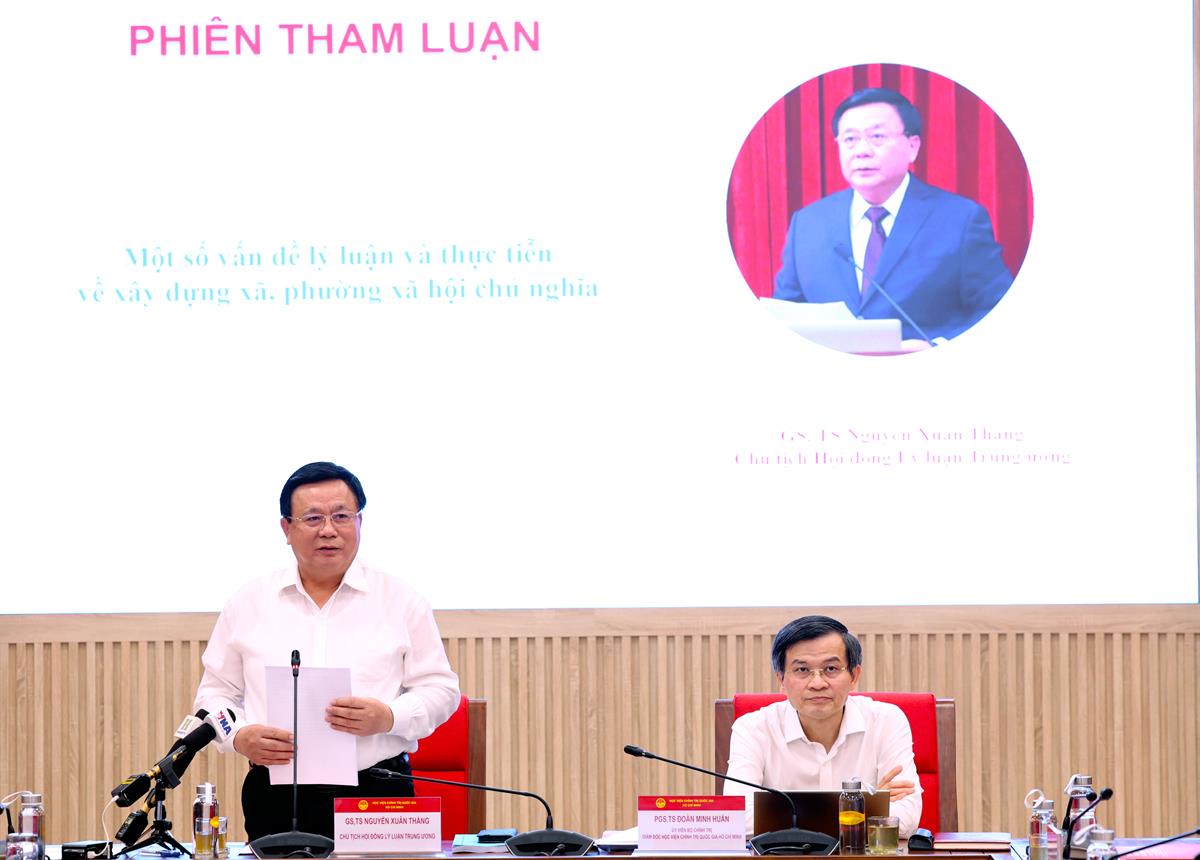 |
Professor Nguyen Xuan Thang, Chairman of the Central Theoretical Council (standing), and Associate Professor Doan Minh Huan, Director of the Ho Chi Minh National Academy of Politics. Photo: HCMA
Socialist commune and ward model: from pilot to widespread adoption
At the seminar, Associate Professor Doan Minh Huan, Director of the Ho Chi Minh National Academy of Politics, suggested that Vietnam's initiative to build socialist communes and wards should be viewed as a step towards integrating socialist values into grassroots life.
He noted that piloting the model at the commune and ward level is a practical approach because this is the closest administrative tier to the people, where the effectiveness of policies can be directly tested. Residents are both beneficiaries and active participants in operating and validating the model.
Associate Professor Doan Minh Huan asserted that the socialist model cannot be implemented uniformly nationwide. It requires a phased approach, moving from pilot programs to broader replication, adapting to diverse development conditions across urban and rural areas, lowlands and highlands, and considering local cultural and ethnic characteristics.
He explained that Vietnam is in a transitional period towards socialism, so the construction of socialist communes and wards should not strive for perfection. With the goal of building a prosperous society, the current phase should focus on forming a large middle class and gradually improving the quality of life for citizens before pursuing higher objectives. The effective operation of many socialist communes and wards will provide a basis for exploring the expansion of the model on a larger scale.
Regarding criteria, Associate Professor Doan Minh Huan stressed that socialist communes and wards must adhere to the fundamental attributes of socialism, characterized by eight features, primarily encompassing "prosperous people, strong nation, democracy, justice, and civilization." The common thread is a human-centered approach, creating conditions for people's holistic development and ensuring a life of abundance, freedom, and happiness.
He also cautioned against conflating the criteria for socialist communes and wards with those for new rural areas or civilized urban areas. The socialist commune and ward model cannot exist in isolation; it must be integrated into the overall development of provinces, cities, and the entire country. Similarly, economic development requires a synchronized ecosystem, not just confinement within a single commune or ward.
Furthermore, the socialist commune and ward model must ensure its capacity for self-development through intrinsic capabilities, supported by the State, and with citizens playing a primary role. Residents are not merely recipients of achievements but also directly participate in organizing, implementing, and operating the model.
The Director of the Ho Chi Minh National Academy of Politics also proposed establishing a common framework of criteria for the socialist commune and ward model nationwide. This would prevent disparate implementations across different localities while still allowing room for local innovation and flexibility.
Vu Tuan