According to the project on developing the national population database, e-identification, and e-authentication application, approved by the prime minister on 26/5, VNeID is set to play a central role in the national digital ecosystem.
By 2028, all citizens will receive social welfare and support via VNeID. The application will undergo a comprehensive upgrade, integrating 50% of essential digital utilities for citizen and business transactions. All Vietnamese citizens will be issued electronic identification accounts; all citizen and organizational documents will also be integrated into the app.
All mobile subscribers will register and verify their information on VNeID. The government aims for 80% of eligible citizens to be issued digital signature certificates for online public services.
By 2030, 70% of citizens will use cashless payment services on VNeID. All citizens with a level two VNeID account, if desired, will have their payment account and e-wallet information integrated into the application.
The government also aims for 70% of utilities and services on VNeID to integrate artificial intelligence to personalize and enhance user experience.
The vision for 2045 is for all utilities and services on VNeID to integrate artificial intelligence; all citizens will be able to use the application for cashless payments, essential bill payments, and daily digital services.
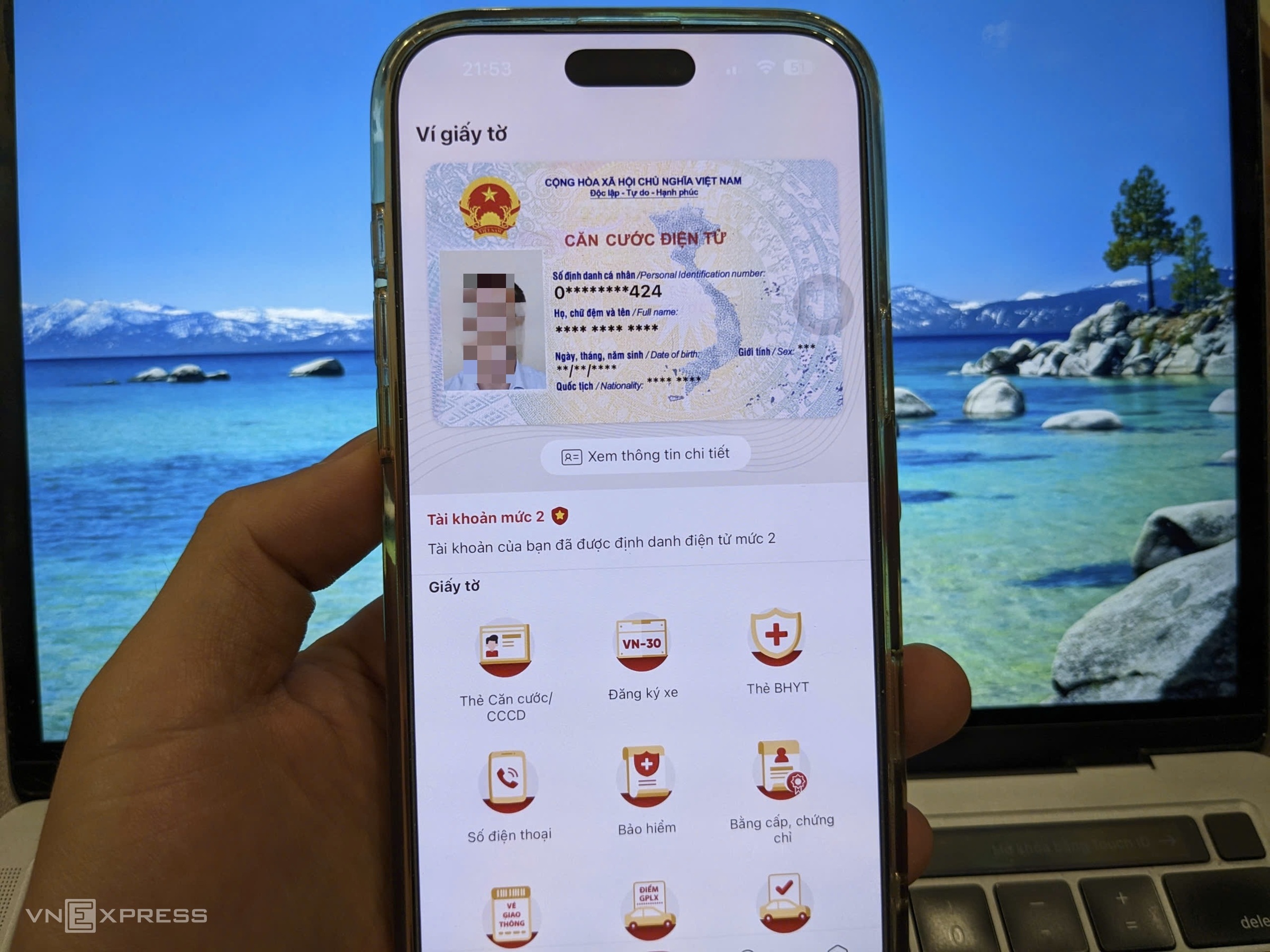 |
VNeID application, 5/2026. *Photo: Viet Tuan* |
To achieve these goals, the prime minister assigned the Ministry of Public Security to lead, in coordination with the Ministry of Justice and the Ministry of Science and Technology, in reviewing and proposing amendments to regulations related to electronic identification, electronic transactions, digital utility integration, cashless payments, and personal data protection.
The Ministry of Public Security was also tasked with advising the government to submit to the National Assembly the issuance of the Law on Electronic Identification and Authentication, along with guiding documents, to clarify the scope, legal value, usage conditions, and legal responsibilities when using VNeID in administrative, civil, commercial, and other electronic transactions.
By the end of 2025, the country had over 65 million activated VNeID accounts, with 6 groups of documents integrated into the application, including 18,7 million driver's licenses and 7 million vehicle registrations.
Currently, VNeID has integrated many types of documents, such as: ID cards, health insurance cards, driver's licenses, passports, residence information, social insurance, tax information, marital status, degrees, certificates, academic records, transport tickets, and dependent information.
Citizens can use VNeID to present documents when performing services, replacing physical papers, and can also proactively update and integrate additional necessary documents into the application.
Vu Tuan