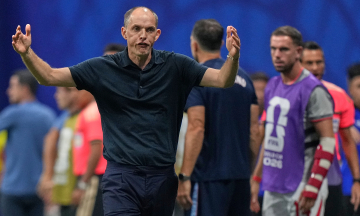
Referee Daniel Siebert's officiating in the Champions League final on 30/5 faced mixed opinions. Specifically, four incidents sparked debate: Leandro Trossard's handball in the build-up to Kai Havertz's opening goal, two handballs by Bukayo Saka in Arsenal's penalty area in the 16th minute, Cristhian Mosquera's foul on Khvitcha Kvaratskhelia in the 62nd minute which resulted in a penalty but saw the Spanish defender avoid a second yellow card, and Nuno Mendes's challenge on Noni Madueke in the 101st minute, which could have led to a penalty.
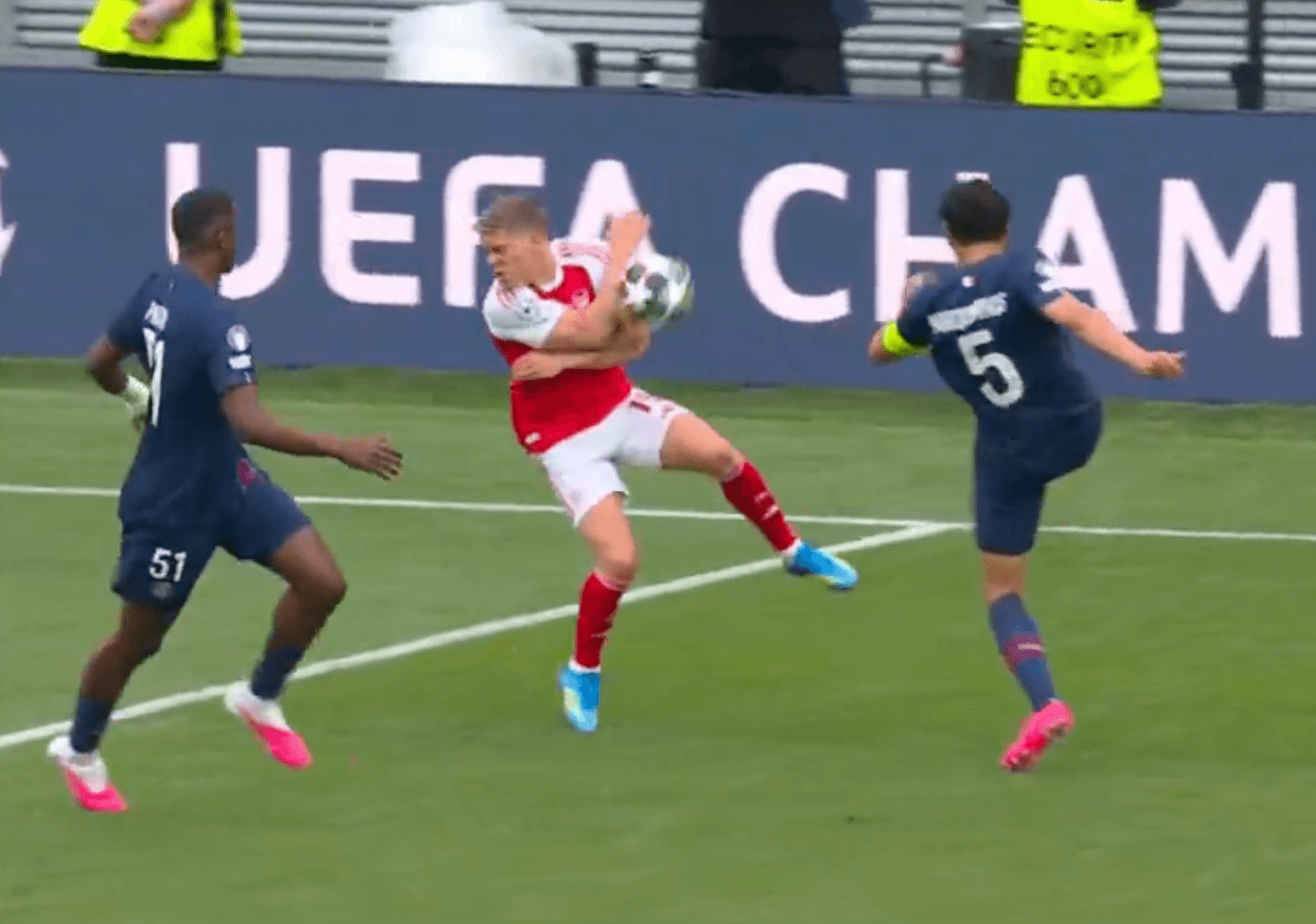 |
The incident where the ball struck Trossard's arm, which was close to his body, before the subsequent attack led to Havertz's opening goal in the 2025-2026 Champions League final on 30/5 at Puskas Arena, Budapest, Hungary. Photo: TNT Sports
- Why wasn't Trossard penalized for handball in the incident leading to Havertz's goal?
In the play leading to Arsenal's opening goal, the ball was driven towards Trossard and appeared to strike his upper arm. The attack then continued upfield before Havertz scored against PSG. However, there was a valid reason for the video assistant referee (VAR) not to overturn the on-field referee's decision to allow the goal. Trossard's arm was tucked close to his body at the time, meaning it did not make his body unnaturally larger. Additionally, the forward showed no intentional act of playing the ball with his hand.
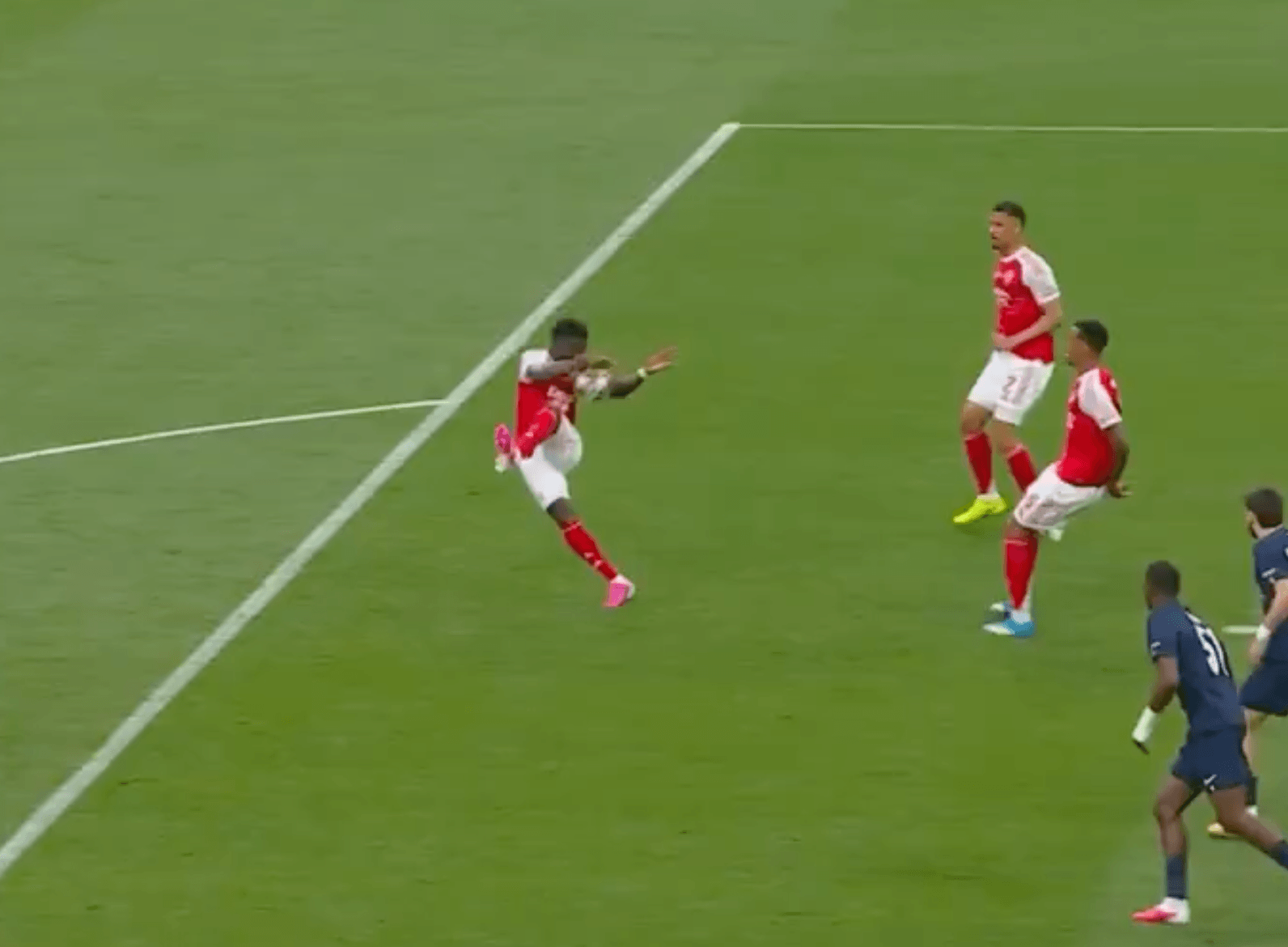 |
The incident where the ball accidentally hit the ground and then struck Saka's hand twice in Arsenal's penalty area in the 2025-2026 Champions League final on 30/5 at Puskas Arena, Budapest, Hungary. Photo: TNT Sports
- Why were two handballs in Arsenal's penalty area by Saka after a PSG corner not penalized?
This situation is quite similar to Joao Neves's incident in the Champions League semifinal second leg against Bayern Munich. A handball in the penalty area does not automatically result in a penalty; it depends on whether the incident directly prevented a dangerous attacking situation. In this play, Saka was clearly trying to track back and cover but miskicked the ball. The ball bounced off the ground and accidentally struck his hand. This occurred immediately after the ball had hit another part of Saka's body (his chest) and clearly changed direction. This handball was entirely passive, and he did not prevent a clear scoring opportunity for the opponent. Therefore, there was no basis for a penalty.
 |
The incident where Arsenal's Mosquera fouled PSG's Kvaratskhelia in the penalty area, leading to a penalty in the 2025-2026 Champions League final on 30/5 at Puskas Arena, Budapest, Hungary. Photo: AFP
- What are the criteria for issuing a second yellow card in the penalty area? And why was Mosquera – who had already received one yellow card – not sent off after fouling Kvaratskhelia, which led to a penalty?
The laws applied in the penalty area have recently undergone significant changes. In this play, Mosquera actively challenged for the ball, and he was not the last defender. The resulting penalty was correct because his challenge did not win the ball; it was clumsy and careless, rather than intentionally malicious. Under current rules, even if a foul occurs, the referee is not obligated to issue a yellow card. Conversely, if Mosquera had prevented a clear goal-scoring opportunity or had no intention of playing the ball – such as deliberately pulling Kvaratskhelia's shirt – he would certainly have received a caution.
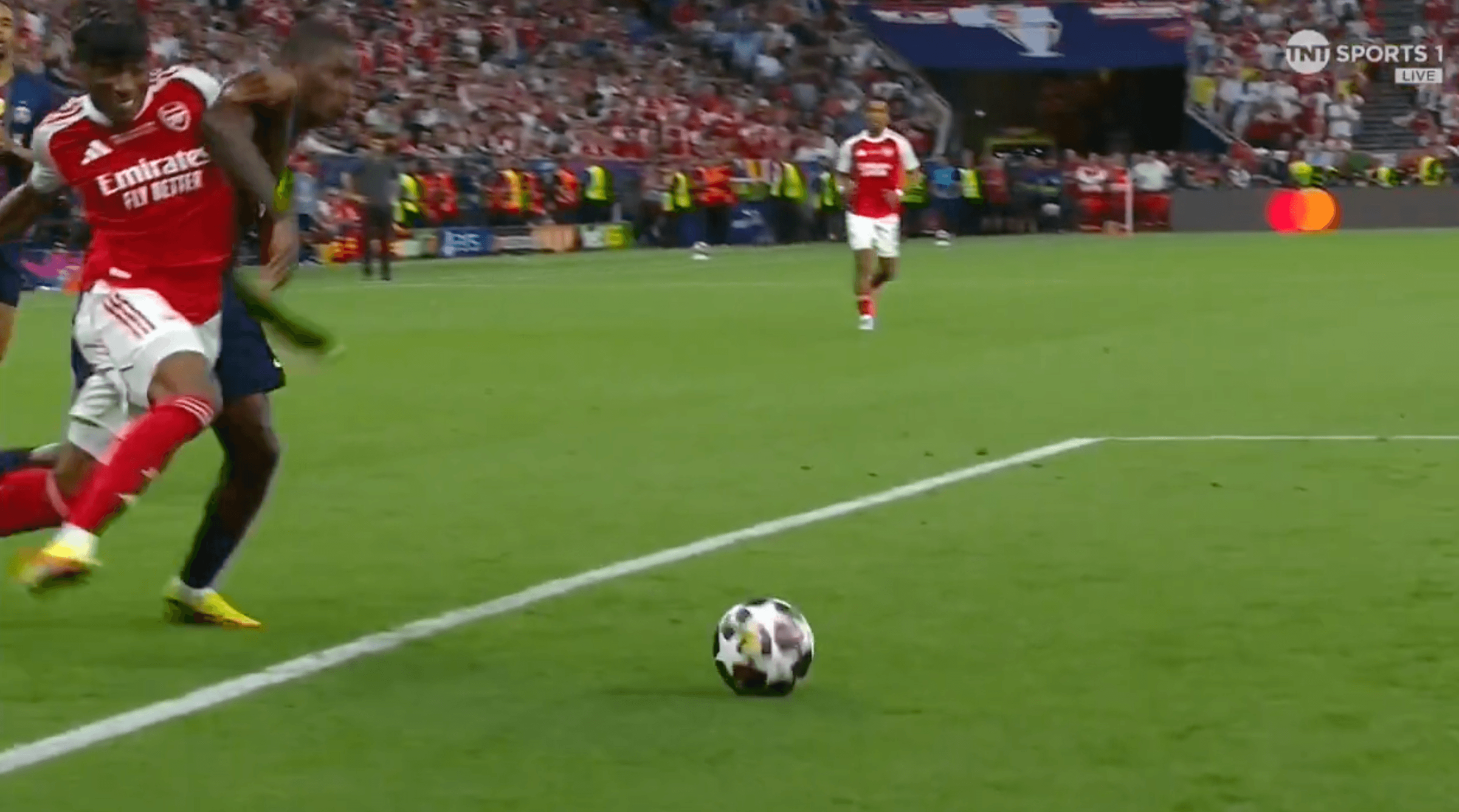 |
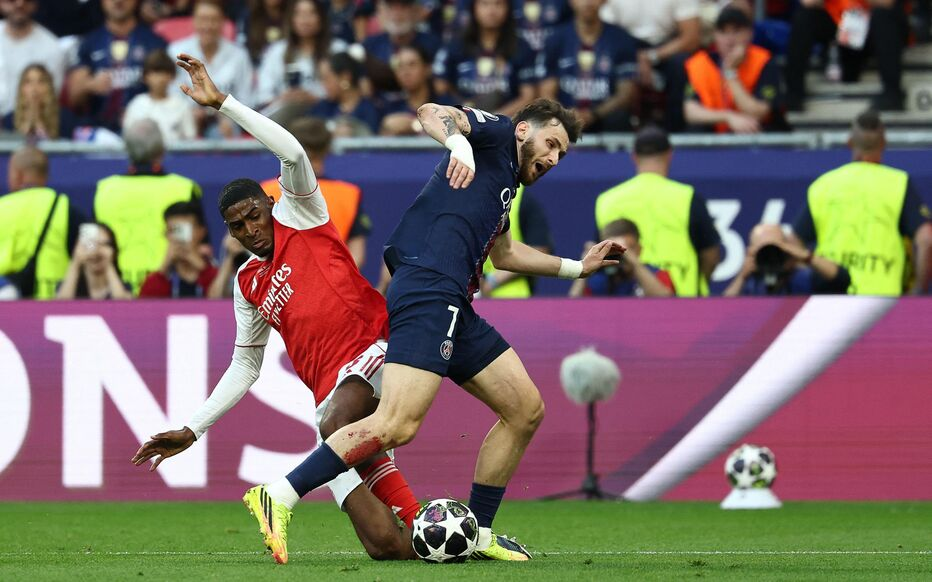
A close-up slow-motion replay of the collision between Madueke and Mendes in the 2025-2026 Champions League final on 30/5 at Puskas Arena, Budapest, Hungary. Photo: TNT Sports
- Was there a foul by Mendes on Madueke in the first period of extra time?
Here, the story lies in the referee's subjective perception. I had the feeling that Madueke gained an advantage over Mendes because he actively used his arm to block his opponent. I saw this as a subtle one-on-one challenge between two players, and the Arsenal forward actively feigned a fall. He deliberately sought a penalty even though he hadn't truly bypassed his marker. There was no specific reason for him to fall in that manner, and the referee's decision to wave away the penalty appeal was entirely reasonable.
Hoang Thong (according to L’Equipe)