Tuchel faced criticism for his allegedly overly cautious playing style, which led to England's comeback loss in Atlanta on 15/7. However, the German coach argues the issue was not the tactical formation, but England players' inability to control the ball under pressure.
"At that moment, I felt no tactical system in the world could help the team," Sky Sport quoted Tuchel on 16/7. "We played too passively and were not aggressive enough in challenges. The team couldn't stop players from the second line entering the penalty area, and the opponent's crosses were high quality. I haven't reviewed the data, but it felt like immediately after their equalizer, the game completely changed. Our ball possession dropped sharply, we almost stopped winning challenges, which forced us to retreat deeper. That was never the plan."
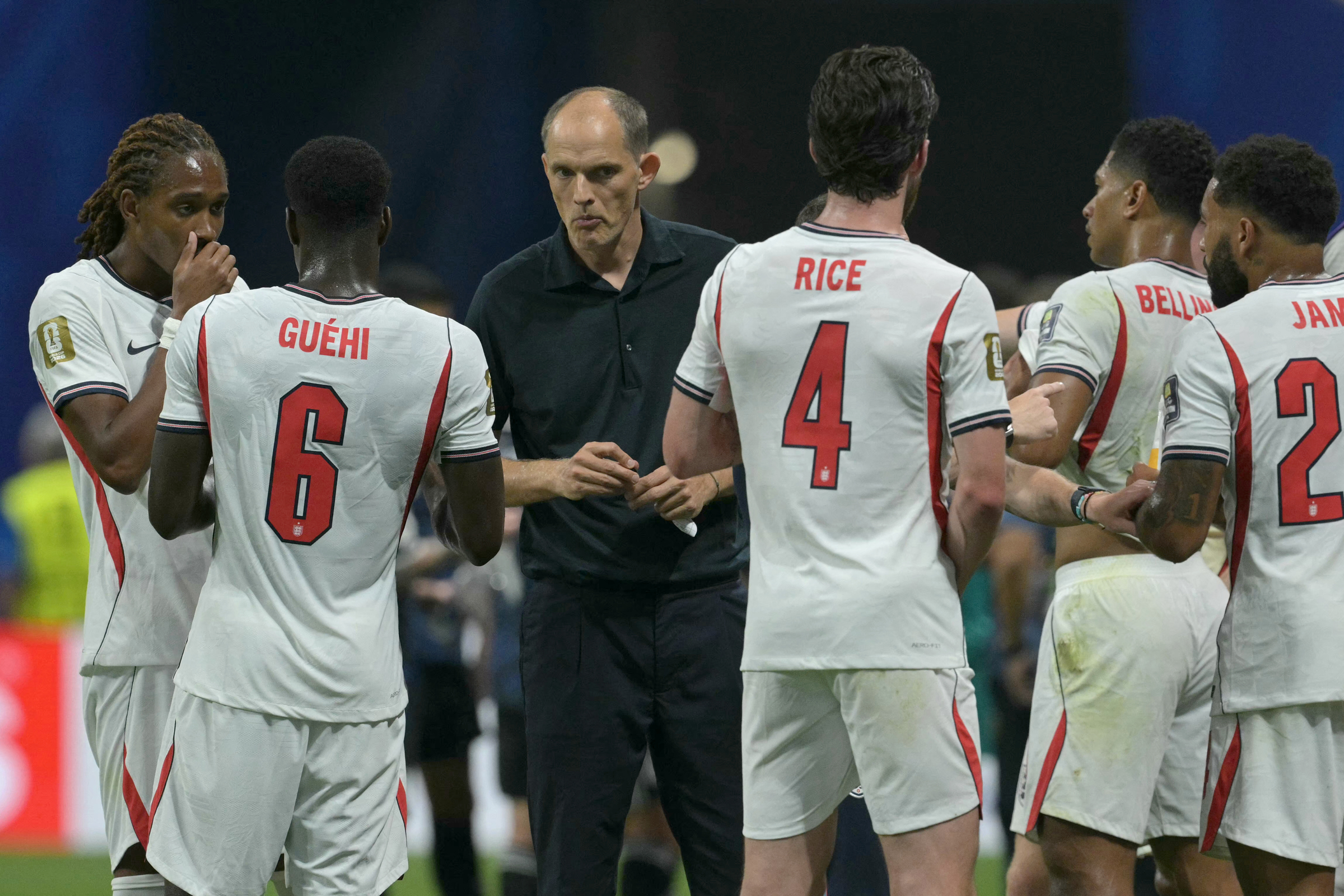 |
Coach Thomas Tuchel (in black) talks with an England player during the 1-2 loss to Argentina in the 2026 World Cup semi-final at Atlanta, US on 15/7/2026. *Photo: AFP*
According to Tuchel, England could not prevent Argentinian midfielders from exploiting space between the lines and consistently lost possession.
"You need to regain ball possession. If you cannot do that, you cannot break the pressure and you cannot regain control of the game," he analyzed. "I think ball control plays a crucial role. Perhaps it is not in the English football DNA, unlike how it exists in the football DNA of Spain, Argentina, or Brazil – where players always want to hold the ball and dictate the game."
Tuchel's statement also sparked debate about squad selection. Midfielder Kobbie Mainoo, who handles the ball well in tight spaces, did not play a minute in the tournament. Meanwhile, Phil Foden or Cole Palmer – two of England's most technical and impactful players – were not even on the World Cup squad list.
Tuchel also defended his decision to switch to a three-center-back formation after Anthony Gordon's goal gave England the lead. Tuchel brought in defenders Ezri Konsa, Dan Burn, Nico O'Reilly, which led to "the Three Lions" facing immense pressure in the final 15 minutes and conceding two goals.
"We switched to a five-man defense not to play more passively, but to be more proactive," he explained. "The goal was to press faster with the wing-backs and limit space between defenders. We asked players to step up and play more aggressively within the system, but ultimately the team still struggled."
Heat map shows England gradually losing ground due to adjustments after leading Argentina 1-0. *Graphic: X / @bogachev_al*
Beyond tactical factors, Tuchel also cites physical condition as a significant influence on England's performance. "The Three Lions" traveled a total of 23,118 km in five weeks – the most among World Cup teams – and had to play in hot weather, at high altitude, and some matches with a man down. "I think we had physical problems throughout the tournament. Playing in the heat, at high altitude, or with a man down all took a heavy toll on the team," he said.
Tuchel's contract to coach England runs until Euro 2028, with a clause for departure if they disappoint at the 2026 World Cup. According to UK newspaper Sportmail, the Football Association (FA) is reportedly still confident in the German coach, despite debates surrounding tactical decisions in the loss to Argentina.
Tuchel believes England can win a major title under him. "I am 100% committed," the 52-year-old coach emphasized. "The team still has much to improve, and I am ready to do that. I believe we can control the ball better and show our qualities more clearly. I see that in training and at the World Cup. The team still has a higher level to conquer, and if we do, we can win a major title."
Main events of England 1-2 Argentina match.
Is 'English football DNA' truly the issue?
The concept of "English football DNA" was introduced by the Football Association (FA) in 2014 as a long-term development strategy for national teams, from youth to senior men's.
The program is built on five pillars: identity, playing style, player development, coaching, and support systems. The goal is to train players with good technical skills, modern tactical thinking, strong physical foundations, and stable competitive mentality.
This model encourages ball-possession play, tactical adaptability, consistency in coaching methods, and the application of sports science, psychology, data analysis, and nutrition in training.
However, Tuchel's assessment also sparked debate. Sky Sports News reporter Rob Dorsett suggests the German coach has a point in identifying England's weakness in maintaining ball possession under pressure. Still, his invocation of "English football DNA" raises questions about the effectiveness of the football development program the FA has implemented since 2014.
The "English football DNA" program was designed to shape a unified playing style for England's national teams, from youth to senior level, aiming to develop players with better technical skills, tactical understanding, and adaptability. Therefore, if the ability to control the ball under pressure remains a team limitation after more than a decade, it may indicate the program has not achieved its goals. Conversely, if the training system has been effective, the problem might lie in how Tuchel assessed the reasons for the defeat.
Hong Duy (according to Sky Sports)