According to Carragher, for a club with Arsenal's rich history, possessing only two European titles in nearly 140 years is a significant shortfall. This is especially true given the many excellent generations of players and coaches the club has had. Those two rare titles are the UEFA Cup Winners' Cup in 1994 and the Inter-Cities Fairs Cup in 1970, a precursor to today's Europa League.
Therefore, today's final against PSG in Budapest is not just about securing a trophy, but also an opportunity for Mikel Arteta's squad to become pioneers – the first team in club history to lift the Champions League trophy.
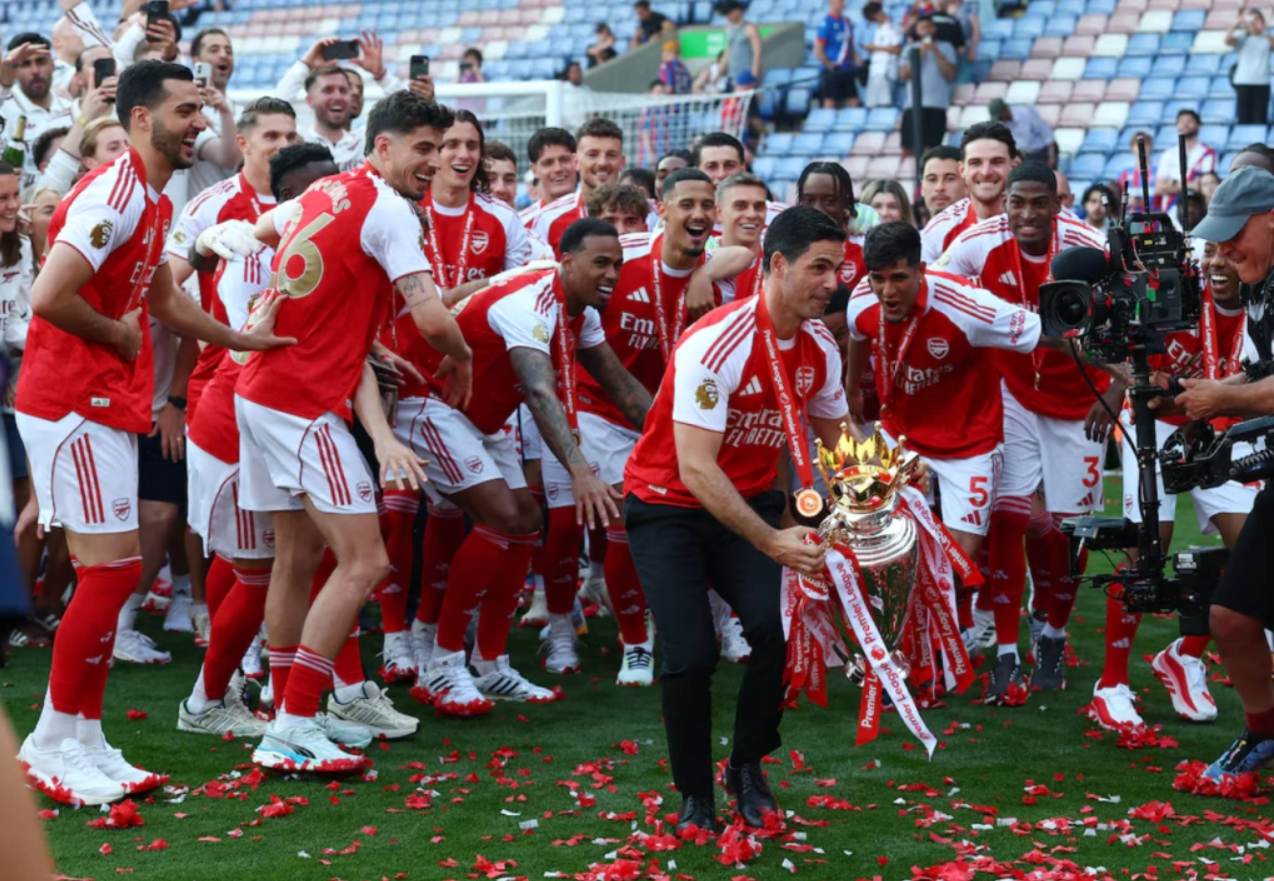 |
Coach Mikel Arteta and Arsenal players celebrate the Premier League championship at Selhurst Park, London, England on 24/5. Photo: Reuters |
Coach Mikel Arteta and Arsenal players celebrate the Premier League championship at Selhurst Park, London, England on 24/5. Photo: Reuters
Arsenal's history includes many special milestones. These include Charlie George's goal at Wembley in 1971, which helped the London team defeat Liverpool 2-1 in the 1971 FA Cup final, completing a domestic double. Another highlight was the unbeaten 2003-2004 season under legendary coach Arsene Wenger. However, Carragher notes that despite their historical and emotional significance, these achievements are primarily domestic.
"When compared to European powerhouses like Real Madrid, Barca, Bayern Munich, or Liverpool, Arsenal still lacks a continental mark – the Champions League title, a trophy capable of shaping a club's global status and memory," the former English center-back stated. He highlighted a notable detail: even among those honored with statues outside Emirates Stadium, only Thierry Henry won the European Cup/Champions League, but not with Arsenal, rather with Barca.
Carragher argues that the Champions League can fundamentally alter how the world perceives a club, and that recognition is permanent. He cites examples: AC Milan is often remembered for its golden era of the late 1980s more than its recent decline; Juventus, despite being Italy's most decorated club, is most vividly recalled for Arrigo Sacchi's team; and Bayern Munich, while dominating the Bundesliga, derives its greatest value from its six European titles.
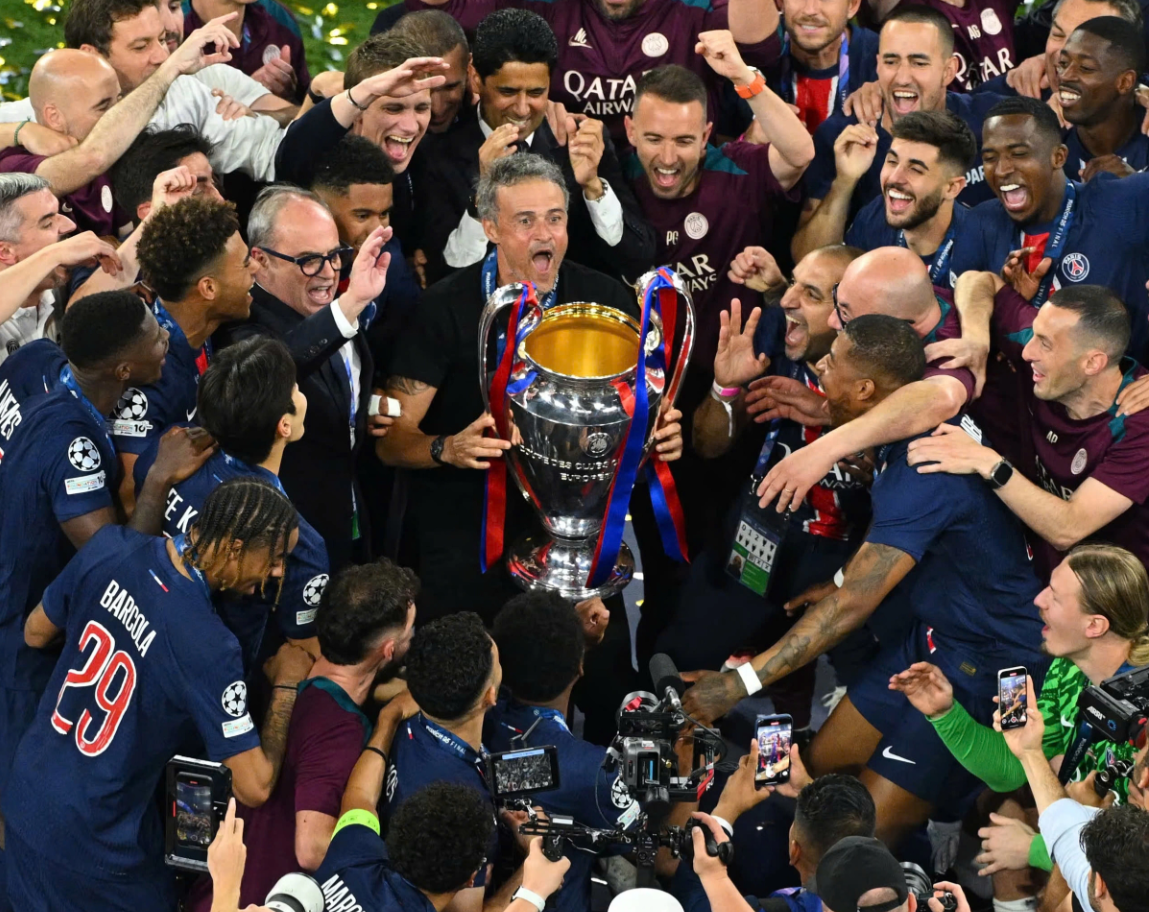 |
Coach Luis Enrique lifts the Champions League trophy for PSG after the final against Inter at Allianz Stadium, Munich, Germany on the evening of 31/5/2025. Photo: Reuters |
Coach Luis Enrique lifts the Champions League trophy for PSG after the final against Inter at Allianz Stadium, Munich, Germany on the evening of 31/5/2025. Photo: Reuters
Carragher then pointed to PSG as a prime example of a club's status transforming after winning a European title. Under coach Luis Enrique, the French team shed the perception of being a "big fish in a small pond" and emerged as one of Europe's most highly rated teams. He believes PSG is now considered one of Europe's strongest teams, and a continued victory would place them among history's greatest teams.
However, Carragher also cautioned Arsenal against trying to imitate PSG, emphasizing the importance of developing their own identity. In their semi-final clash last season, Arsenal created many difficulties for PSG using set pieces and long balls – tactics that could again be key in today's final at Puskas Stadium.
The former Liverpool legend also analyzed that Arsenal possesses a defense strong enough to protect a lead if they score first. This season, the "Gunners" have won all their Champions League matches when they opened the scoring. Conversely, PSG under Enrique is regarded as a modern attacking team, influenced by Pep Guardiola's philosophy and combined with the directness inspired by Jurgen Klopp's football.
Regarding their chances, Carragher rates PSG higher but asserts Arsenal is not outmatched. He believes the Champions League is often decided by the strongest team, and Arsenal, if they maintain consistent form, can make history. "If they win in Budapest today, the London team will solidify their position as England's top team and join Europe's footballing powerhouses," he wrote.
Hong Duy (via Telegraph)