This year marks the 70th anniversary of the Ballon d'Or award. To honor its first recipient, the late English forward Stanley Matthews, organizers moved the ceremony to London on 26/10.
London is also the hometown of Harry Kane, the striker who scored 61 goals in 51 matches for Bayern during the 2025-2026 season. Additionally, Arsenal, who recently ended a 22-year wait to win the Premier League and are preparing to face PSG in the Champions League final, are based there.
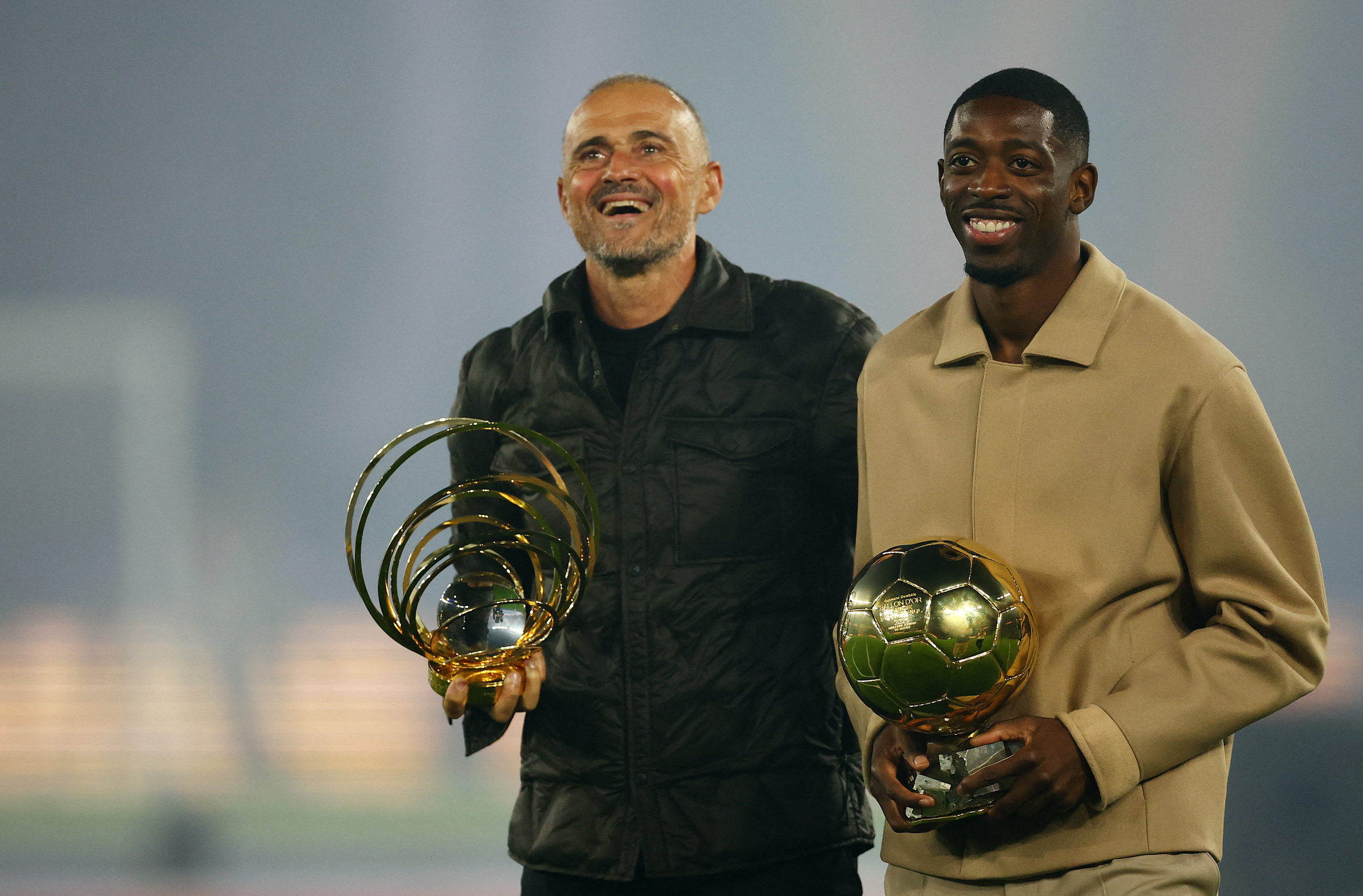 |
Forward Ousmane Dembele (right) shows off the Ballon d'Or, alongside coach Luis Enrique, after PSG's match against Auxerre at Parc des Princes, Paris, on 27/9. Photo: Reuters
From its inception in 1956 until 2009, the Ballon d'Or winners were always announced in Paris, the city where the organizing magazine, France Football, is headquartered.
From 2009 to 2025, a period during which the Ballon d'Or was combined with the FIFA World Player of the Year award, the ceremony took place at FIFA's headquarters in Zurich, Switzerland. From 2015 to 2025, once the partnership concluded, France Football organized the annual awards ceremony at the Chatelet Theater in Paris.
The Ballon d'Or ceremony aims to honor outstanding individuals, along with team categories, coaches, and social contributions. Besides the main awards for men and women, the event also includes many other categories: the best goalkeeper award (Yashin Trophy), the best young player (Kopa Trophy), the top goal scorer (Gerd Muller Trophy), the best coach (Johan Cruyff Trophy), the best club, and the Socrates Award for social contributions. Last year, organizers added three new categories for women's football: the Yashin, Gerd Muller, and Kopa awards.
Voters select the Ballon d'Or winner based on three criteria: individual performance, collective achievements, and fair play. The voting panel consists of 100 journalists from the top 100 FIFA-ranked nations (for men) and 50 journalists from the top 50 nations (for women). Each journalist selects 10 players from a shortlist of 30 nominees proposed by France Football, L'Equipe, and the Union of European Football Associations (UEFA), assigning points from 15 down to one. The player with the highest total points wins the award.
This year, in addition to club-level competitions, the 2026 World Cup will also play a significant role in the Ballon d'Or voting results.
By Thanh Quy (according to ESPN)