The event will take place at 11 PM on Thursday, 27/8, and will be broadcast on VnExpress.
The draw includes 29 teams that qualified directly and seven teams that advanced through the play-off round: Sabah, Bodo/Glimt, LASK, AEK, Fenerbahce, Viking, and Slovan Bratislava. This marks the third season the tournament operates under a new format, featuring a single league table with 36 clubs instead of the previous group stage.
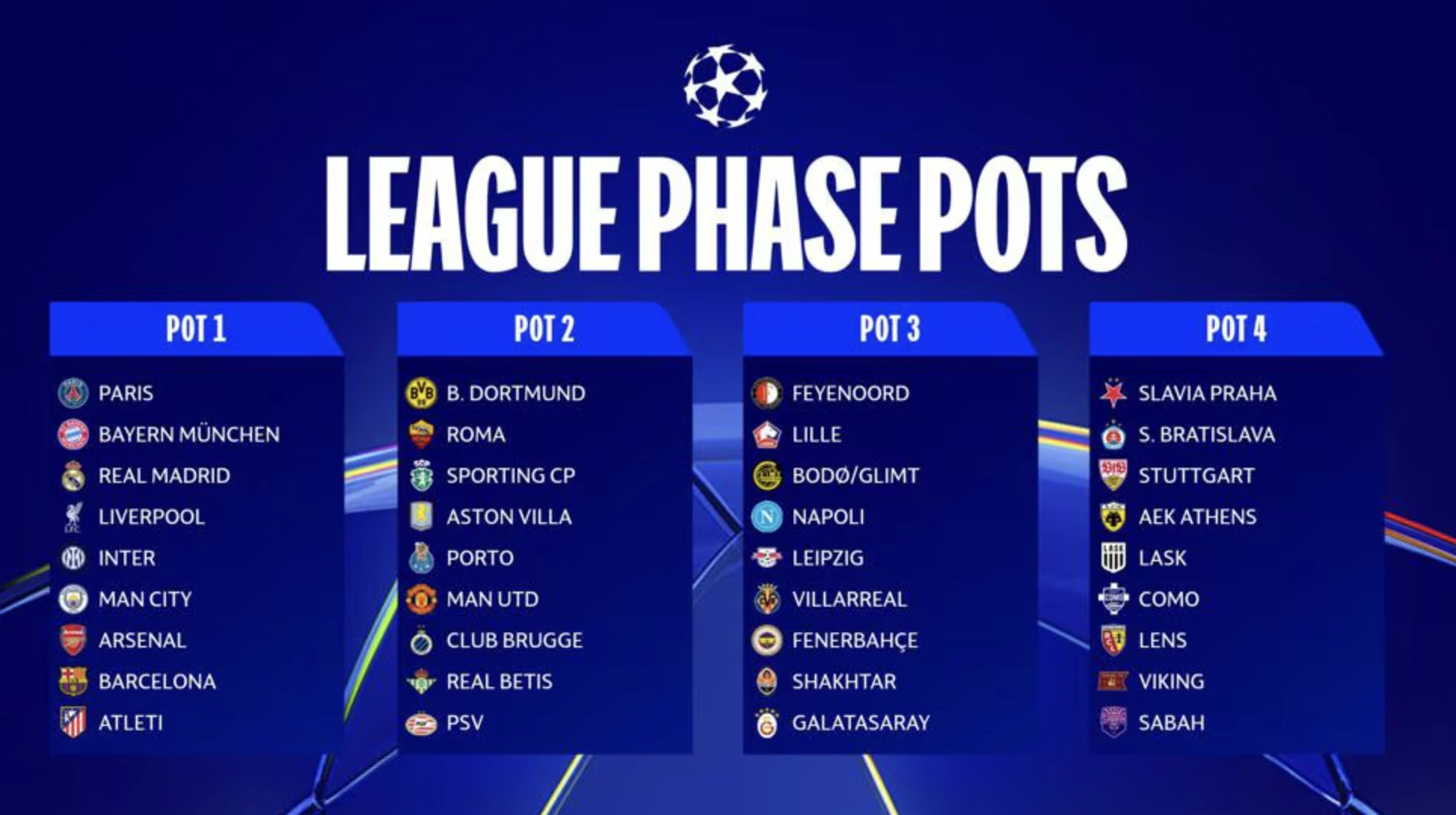 |
The four seeded pots before the Champions League 2026-2027 qualifying round draw. Photo: UEFA |
The draw begins with teams from pot one. Each club will sequentially have two opponents identified from each of the four pots, resulting in a total of eight opponents. In these eight matches, each team will play four games at home and four away. After completing pot one, the organizers will proceed with the remaining pots in order to finalize the schedule for all 36 clubs.
During the qualifying round, teams from the same country are not permitted to face each other. Each club can also only encounter a maximum of two opponents from any single other country.
Upon the conclusion of the qualifying round, the top eight teams will directly advance to the round of 16. Clubs ranked from 9th to 24th must compete in a play-off round for the remaining eight spots. The 12 teams ranked 25th and below will be eliminated from the Champions League and will not transfer to other European competitions.
The new format gives significant importance to the draw for participating teams. A favorable draw can provide top contenders with an easier path to the knock-out stage, while also creating opportunities for less-fancied teams to cause an upset.
The division of clubs into four seeded pots aims to create a relatively balanced schedule. However, even within each pot, some opponents are considered more challenging. In pot three, Napoli and Villarreal are names many teams might wish to avoid, while Como—making their Champions League debut—is assessed as capable of surprising despite being in pot four.
The reality of the initial seasons under this new format shows that renowned teams are not guaranteed progression. RB Leipzig, Napoli, Ajax, and Villarreal have faced early exits. Meanwhile, Man City, Inter Milan, and Juventus were previously eliminated in the knock-out play-off round after failing to secure a top 8 spot in the qualifying round.
Therefore, even at this draw stage, today's selections can significantly impact each team's chances of advancing deep into the Champions League.
 |
PSG celebrates winning the Champions League 2025-2026. Photo: AP |
UEFA has also unveiled the official ball for the new Champions League season. The ball's design draws inspiration from the dedicated training process behind players' success. Images of fog on the pitch during cold mornings are transformed into the primary pattern, symbolizing effort, ambition, and the drive for success. Against a white background, a metallic coating adds depth to the design. Streaks of fog weave through the iconic Champions League stars, reflecting light and creating striking color panels. The adidas and Champions League logos are rendered in pink, adding a highlight to the overall aesthetic.
Qualifying round matches will take place from September to late January 2027. The knock-out stage will commence with the play-off round in February, followed by the round of 16 in March, quarter-finals in April, and semi-finals in May.
The Champions League 2026-2027 final is scheduled for 5/6/2027, at the Metropolitano stadium in Madrid, Spain. This marks the second time Atletico's home ground will host the Champions League final, following 2019. PSG is the defending champion for the past two seasons.
Hong Duy