After crossing the finish line at Mizuho Stadium in Nagoya on the evening of 27/9, Wu Yanni bent over, gasping for breath, then continuously shed tears. The Chinese athlete finished the 100m hurdles final in 13,12 seconds, placing third behind home runners Mako Fukube and Hitomi Nakajima.
Fukube secured gold with 12,74 seconds, while Nakajima finished 0,04 seconds later. Another Chinese representative, defending champion Lin Yuwei, recorded 13,47 seconds, placing seventh.
The 13,12-second time was not close to Wu's personal best of 12,74 seconds, nor was it enough for her to achieve her goal of winning. However, the bronze medal held special significance, as it was her first time on an ASIAD podium after more than 1,000 days living with the memory of the Hangzhou final.
"Three years ago, Wu Yanni had no achievement. Three years later, Wu Yanni stands on the podium. For me, that is enough," she said through tears.
 |
Wu Yanni cried while draped in the Chinese flag after winning a bronze medal in the women's 100m hurdles with a time of 13,12 seconds at Mizuho Stadium, Nagoya, Japan, on the evening of 27/9. Photo: Xinhua
Wu entered the final still haunted by the fear of a false start. Her reaction time was 0,192 seconds, the slowest among the eight athletes. She left the blocks last and was still in last place after the first hurdle, before accelerating in the second half to overtake her rivals one by one.
Asked about her cautious start, Wu admitted she remained haunted by the incident three years prior. "Everyone can review it; I was the slowest starter," she said. "But I did not back down because of the shadow of that false start."
At the ASIAD Hangzhou final on 1/10/2023, Wu surged from the blocks before the signal. Both she and India's Jyothi Yarraji were flagged for a foul, but both protested the decision and were allowed to compete while officials reviewed the incident.
Wu finished second, but her result was later disqualified. Yarraji's time of 12,91 seconds was upheld, earning her a silver medal, while Japan's Yumi Tanaka took bronze. Teammate Lin Yuwei won gold with 12,74 seconds.
That failure was particularly devastating because Wu was one of the most prominent faces of the Chinese delegation at the home games. With her striking appearance, unique makeup style, and strong personality, media and fans dubbed her "China's 'track and field beauty'". Her significant appeal meant her every move, statement, and result were scrutinized.
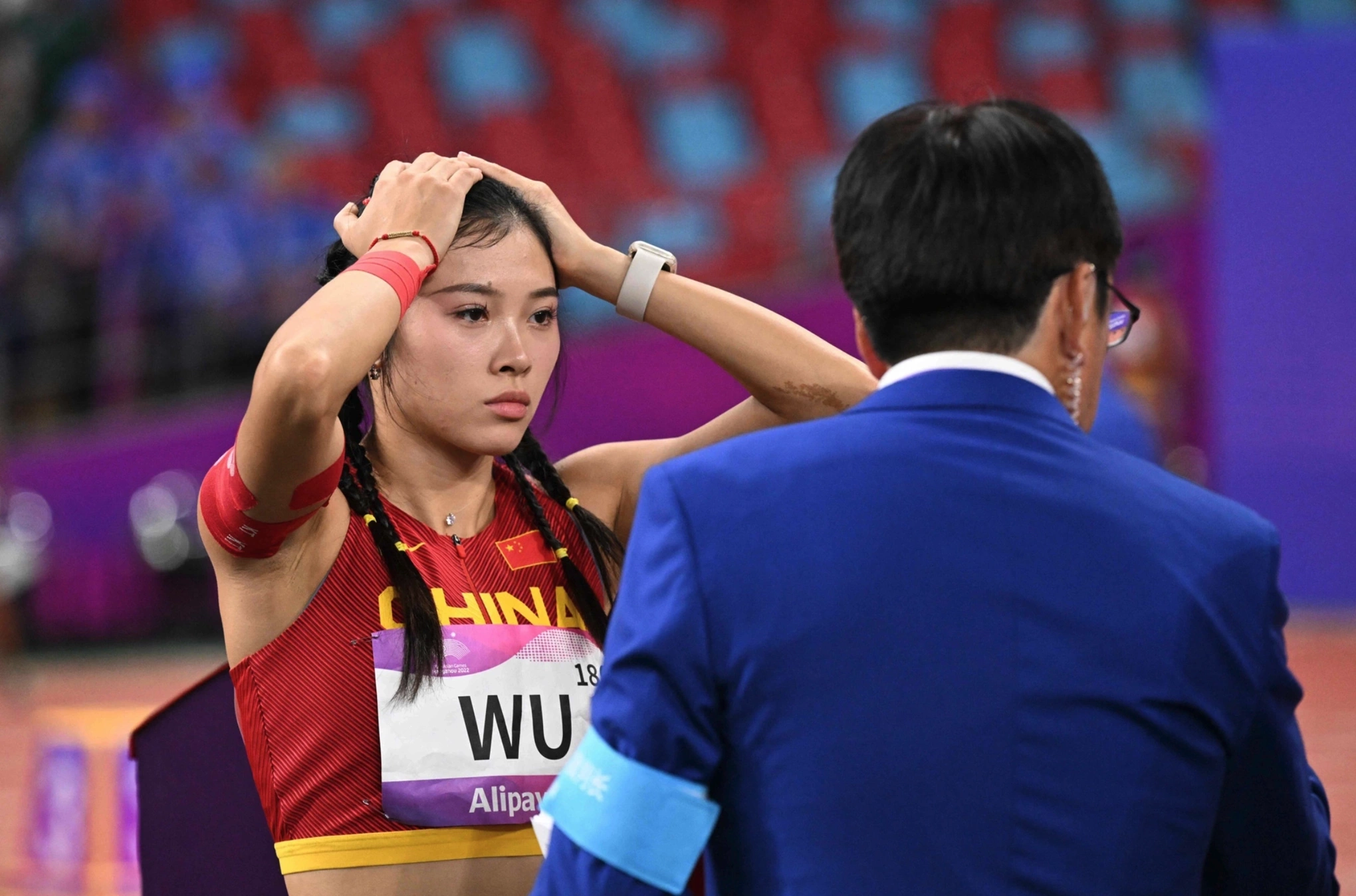 |
Wu Yanni argued with an official after being flagged for a false start in the women's 100m hurdles final at ASIAD Hangzhou, China, on 1/10/2023. Photo: VCG
Following the incident, Wu faced a wave of criticism on social media. Many not only questioned her technical error but also attacked her manner of arguing with the official. The athlete, born in 1997, stated she installed a timer application on her phone immediately after the Hangzhou night. By the final in Nagoya, that clock had run for more than 1,090 days.
"I always remind myself to grow from failure," Wu said. "Today, I defeated the Wu Yanni of three years ago. I give myself 100 points."
Wu's emotions also stemmed from physical challenges during her preparation. At 29, she admitted her recovery ability was not what it once was. Though she avoided serious injuries, Wu frequently experienced fasciitis, lower back muscle strain, and knee effusion. After each training session, her body reacted strongly and needed more time to recover.
These issues led Wu to reduce her competition schedule for the 2026 season. She dedicated more time to improving her speed between hurdles and her explosive power – two aspects she admitted were not superior to the Japanese athletes.
Before ASIAD, Wu's season-best time was 12,99 seconds, achieved when she won the Chinese championship in late June. She edged out Lin Yuwei by 0,01 seconds in a 0,7 m/s headwind. This result was 0,25 seconds slower than her personal best, while Fukube and Nakajima had both repeatedly run under 13 seconds.
Therefore, despite being expected to contend for gold, Wu proactively lowered her expectations. She stated her biggest priority was to finish the race, achieve an official result, and perform to the best of her physical ability. The bronze medal, therefore, was not her initial goal, but it offered psychological liberation.
"From the moment I put on the national flag, I did not want to take it off," Wu said. "Only my team, family, and those close to me know what I have been through."
Nagoya also marked Wu's third ASIAD, following Jakarta 2018 and Hangzhou 2023. A significant career breakthrough came at the 2023 World University Games in Chengdu, where Wu ran 12,76 seconds, winning a silver medal and qualifying for the Paris Olympics.
In June 2024, she lowered her personal best to 12,74 seconds. At the Paris Olympics that same year, Wu became the first Chinese athlete to run the 100m hurdles under 13 seconds at the Olympic Games, achieving 12,97 seconds in the heats. She later ran 12,98 seconds in the repechage but did not qualify for the semifinals.
In 2025, Wu won a bronze medal at the Asian Championships with 13,07 seconds and set a Chinese indoor 60m hurdles record of 8,01 seconds. These results kept her among the continent's top hurdlers, though she has not yet reached the medal rounds at global competitions.
 |
Wu still aims to break the Chinese record of 12,64 seconds, reach the Olympic final, and approach the Asian record. She affirmed she is not yet considering retirement, as she has many unfulfilled ambitions.
After the tearful interview in Nagoya, Wu regained her familiar cheerful demeanor and said she could finally "clock out". The athlete expressed a desire to eat her favorite foods, enjoy bread, drink juice, travel, and take photos after a long period of intense training.
Wu has not yet achieved her desired gold medal. However, from a last-place position after a cautious start, she surged to win bronze, putting an end to three years of haunting memories.