With the 2026 World Cup approximately six months away, FIFA president Gianni Infantino has once again suggested potential amendments related to football rules. These include adjusting the offside rule that former Arsenal head coach Arsene Wenger first developed in 2020.
Infantino believes that reviewing the offside rule can help achieve the goal of "making the game more attacking and exciting." Speaking at the WSS, held for the first time in Dubai, he stated, "We are reviewing the offside rule, which has evolved over the years and currently requires an attacker to be behind the defender, or level with him. Perhaps in the future, an attacker will have to be completely past the defender to be considered offside."
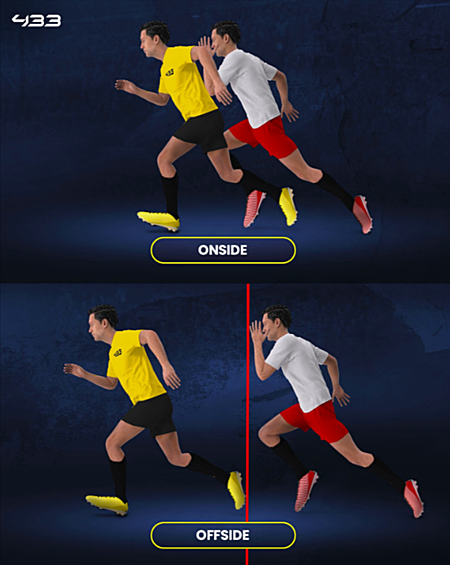 |
Illustration of the new method for determining offside. |
Arsene Wenger, in his role as FIFA's Chief of Global Football Development, first proposed changing the offside rule in 2020. His idea is to only deem an attacker offside when their entire body has completely passed the second-to-last defending player; any overlap would keep the player in an onside position. In contrast, the current rule states that an attacking player is offside if any part of their body that can play the ball extends beyond the second-to-last defender.
Wenger's idea, as of 10/2025, remains a draft for analysis by the International Football Association Board (IFAB). If approved, the new offside law will be forwarded to the Council for approval in 2/2026, before undergoing testing.
This initiative is part of a broader drive by FIFA, with 2025 serving as a testing year for several other innovations at FIFA tournaments. These include: the use of 'blue cards' for VAR reviews at the U20 World Cup and Arab Cup, referee-worn cameras at the FIFA Club World Cup, and an 8-second rule for goalkeepers. While some measures have been fully implemented, others are still experimental, all providing valuable data before the 2026 World Cup finals in North America.
Infantino reinforced his view by highlighting his team's consistent introduction of changes in refereeing in recent years, making football fairer. He noted, "We introduced VAR to bring transparency to matches, allowing referees to correct errors seen by millions of viewers at home and in stadiums. We then continued to improve VAR with increasingly advanced technology to help referees make more accurate decisions."
Compiled by Ha Phuong