Jordan, a West Asian nation, lies on the Dead Sea, bordering politically sensitive countries like Iraq, Israel, and Syria. While part of the Arab bloc, Jordan does not possess extensive oil reserves like many Gulf states. Tourism serves as Jordan's primary revenue source, drawing visitors to sites such as the red desert of Wadi Rum, the ancient city of Petra, the Dead Sea, and the Roman ruins of Jerash.
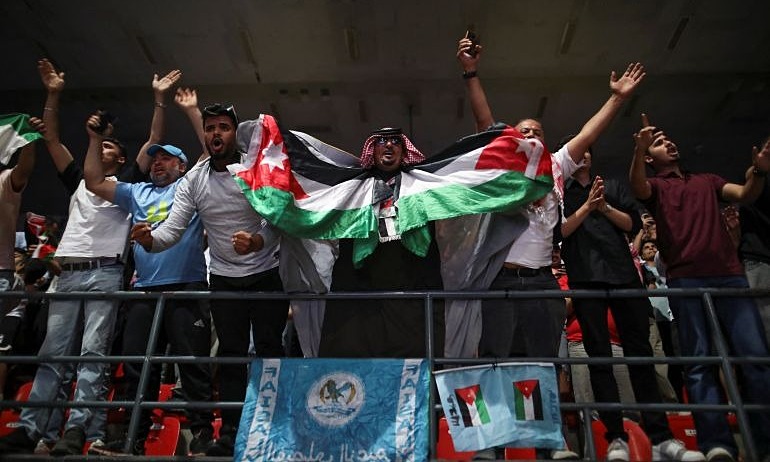 |
Jordanian fans celebrate a goal against Oman during a 2026 World Cup qualifier at Sultan Qaboos Stadium, Muscat, Oman, on the evening of 5/6/2025. Photo: Reuters
Jordan's GDP per capita historically doubled Vietnam's until around 2015. However, this gap has narrowed recently. In 2024, Vietnam surpassed Jordan for the first time, with a GDP per capita of 4,717 USD compared to Jordan's 4,618 USD, according to World Bank data.
In sports, Jordan primarily focuses on martial arts. All four of its Olympic medals, including one gold, have come from taekwondo and karate. Nevertheless, football remains the nation's most popular sport, despite the national team's fluctuating fortunes.
Jordan's FIFA ranking has ranged from a low of 152 in July 1999 to a high of 37 in August 2004. In November 2018, when Vietnam re-entered the world's top 100, Jordan was ranked 109th. Two months later, Vietnam eliminated Jordan in a penalty shootout during the 2019 Asian Cup round of 16.
Since then, Jordanian football has made significant progress, reaching the 2023 Asian Cup final, securing its first qualification for the 2026 World Cup finals, and making it to the FIFA Arab Cup final. In contrast, Vietnam exited the 2023 Asian Cup in the group stage and failed to advance to the third round of 2026 World Cup qualifiers.
Jordan benefits from several conditions conducive to football development, including regular competition against strong West Asian teams. The average height of adult males in Jordan is 1,75 m, notably taller than Vietnam's 1,69 m.
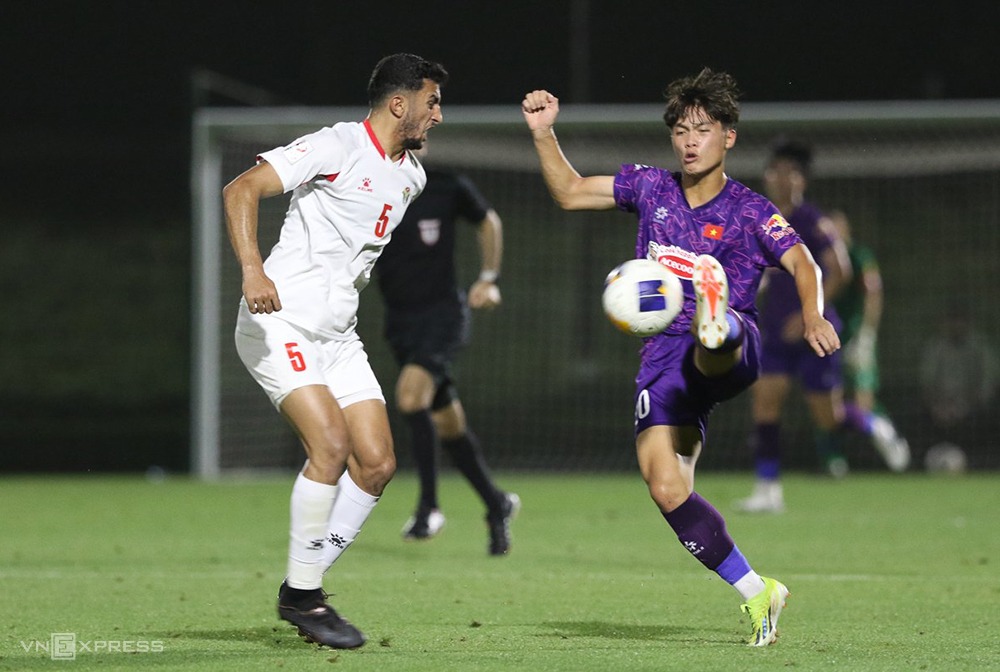 |
Nguyen Quoc Viet controls the ball during a U23 friendly between Vietnam and Jordan in Doha, Qatar, on the evening of 10/4/2024. Photo: Doan Huynh
At the U23 level, Jordan has consistently qualified for every U23 Asian Cup finals, while Vietnam missed the inaugural tournament in 2013. Jordan's best performance was a third-place finish in its first appearance. Vietnam has achieved a better result, reaching the final in 2018, where it lost to Uzbekistan in extra time.
Jordan qualified for this U23 Asian Cup impressively, winning all three matches against Turkmenistan, Taiwan, and Bhutan, scoring 19 goals and conceding only one.
Their most prominent player is left winger Odeh Fakhoury. At just 20 years old, Fakhoury has already secured a place on the national team and participated in the recent Arab Cup. He was also among the top scorers in the qualifiers, with 5 goals.
Additionally, Jordan's squad for the 2026 U23 Asian Cup includes two other national team players: center-back Ali Hajabi, who stands at 1,91 m, and forward Baker Kalbouneh. All 23 Jordanian players in the squad currently play domestically, similar to Vietnam.
Jordan also holds a favorable head-to-head record against Vietnam, with two wins and one draw. They defeated Vietnam 3-1 in the 2016 U23 Asian Cup group stage and drew 0-0 in the 2020 group stage. Their most recent encounter, a friendly on 10/4/2024, also ended 0-0, with Jordan winning the subsequent penalty shootout.
The two teams will meet again in their first match of the 2026 U23 Asian Cup finals, scheduled for 6:30 PM on Tuesday, 6/1, Hanoi time. This presents an opportunity for coach Kim Sang-sik's squad to secure their first victory against Jordan at this level.
Xuan Binh compiled