In first-half injury time at Miami Stadium, Norway led 1-0. Goalkeeper Orjan Nyland launched a long ball. Slow-motion replays showed the ball's trajectory abruptly changed, dropping earlier than expected near midfield. Elliot Anderson won possession, initiating a counter-attack by passing to Anthony Gordon. The Barcelona newcomer then assisted Jude Bellingham for the equalizer.
 |
Jude Bellingham (10) celebrates England's 1-1 equalizer in the World Cup quarter-final against Norway at Miami Stadium, Florida, USA on 11/7/2026. Photo: AP
Immediately after the goal, Norway's players and coaching staff protested. Coach Stale Solbakken approached referee Clement Turpin at halftime, while Nyland and Erling Haaland repeatedly pointed upwards, claiming the ball had touched a cable of the "spidercam" camera system.
The International Football Association Board (IFAB) Laws of the Game clearly stipulate this scenario. According to Law 9, if the ball touches an object above the field of play, such as a roof, cable, or suspended camera, the referee must stop the match immediately. Play then restarts with a dropped ball at the position where the ball touched the object, awarded to the team that last touched the ball.
In other words, if the ball had truly touched the spidercam cable after Nyland's kick, the referee should have blown the whistle immediately. England's counter-attack would not have occurred, meaning Bellingham's goal would not have stood.
This situation rarely appears in top-tier football. The spidercam is suspended by four cables stretched from the corners of the pitch, enabling aerial filming and diverse television angles. Although this system has been used for years in major tournaments, the ball seldom hits the cables during play.
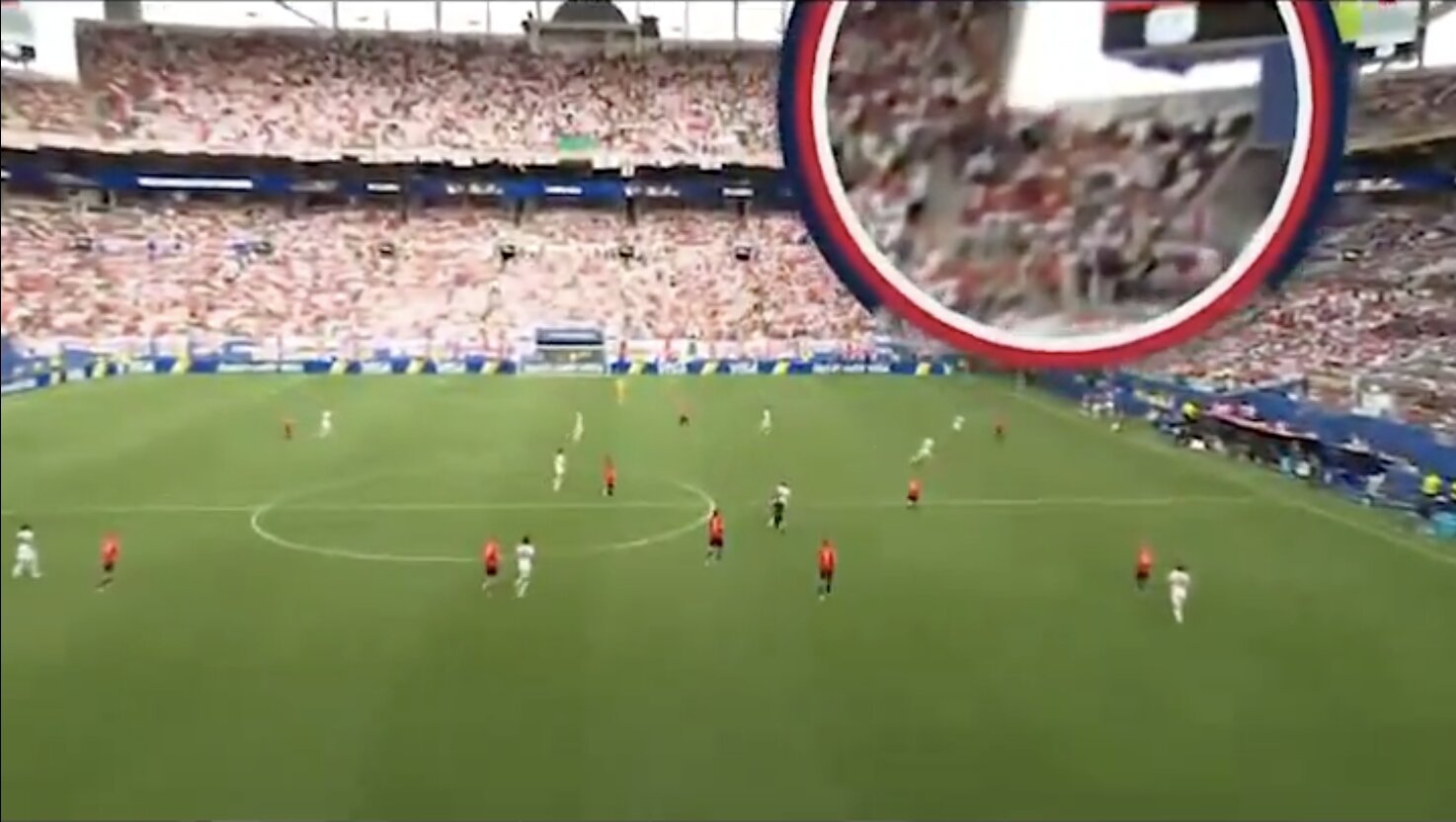 |
A FOX Sports camera angle indicated the ball touched a camera cable before England's attack and goal. Photo: screenshot
Television replays led many to believe there was contact. The ball's trajectory changed abruptly, from a long flight path to an almost direct drop near midfield. Norway's assistant coach Kent Bergersen suggested this contact caused the ball to fall early, allowing Anderson to intercept the ball and launch the attack.
NRK commentator Kristoffer Lokberg even labeled this "the biggest refereeing scandal in World Cup history". Expert Carl-Erik Torp also deemed it a "serious refereeing error".
According to former FIFA referee Mark Clattenburg, the video assistant referee (VAR) was fully entitled to review this situation. He explained that any incident occurring during the attacking phase leading to a goal falls within VAR's purview. If the ball had touched the camera or cable, the VAR team could recommend that the referee disallow the goal because the entire play should have ended prior to that.
However, FIFA offered a different explanation in a statement to the media. The VAR team did not determine that the ball had touched the spidercam. After the halftime break, FIFA stated they checked data from the ball's embedded sensor but found no "signal spike" indicating contact. This sensor is used to support semi-automated offside technology and other decisions at the World Cup 2026, such as Croatia's disallowed goal against Portugal in the round of 16.
This information failed to convince many fans, according to The Sun. The English newspaper cited numerous opinions questioning why television images clearly showed a change in the ball's trajectory, yet sensor data registered no contact. Some also suspected the sensor might not be sensitive enough to detect a light touch on the cable, or that the ball merely grazed the wire without generating sufficient force.
Nevertheless, under current rules, sensor data is not the sole decisive factor. The crucial aspect is whether the referee and VAR determine if the ball touched an object outside the field of play. According to FOX Sports' camera angle, the broadcaster asserted the ball had indeed struck a spidercam cable.
Hoang An (according to The Telegraph, NRK)