For Luciana Alvarengue, watching the 2022 World Cup final on television was a special experience. Argentina's squad featured not just one, but two former students who had sat in her classroom: Enzo Fernandez and Julian Alvarez.
"For me, they are always students, even when they are no longer in the classroom," she told Jonathan Wilson of the British newspaper The Guardian. "Seeing that moment, hearing my son exclaim, ‘Mom, your students are there!’… it felt truly wonderful."
 |
Julian Alvarez (right) and Enzo Fernandez when they played for Argentina's River Plate in 2020. Photo: Guardian |
In 2012, at 26 years old, Alvarengue began teaching at the school operated by River Plate Football Club. At that time, the school was located within the Monumental Stadium complex, meaning classes were canceled if River had a mid-week match. Today, the school has moved to a spacious, purpose-built facility just a few minutes' walk from the stadium. The main hall is dominated by six large portraits: Alvarez, Fernandez, Gonzalo Montiel, Exequiel Palacios, German Pezzella, and Guido Rodriguez – all former students who were part of Argentina's 2022 World Cup-winning squad.
This school is not exclusively for footballers but also for other athletes, as River manages teams across various sports, from hockey to chess. Alvarengue quickly realized that working here was completely different from any other place she had taught.
Many students lived in the club's boarding facility, far from their families, which led them to form deeper emotional bonds with their teachers. "Whenever they came to class, the boys would proactively kiss your cheek to greet you," she recalled. "’Hello teacher’, ‘Good morning teacher, I’m here for school’."
This was particularly true for Alvarez, a teenager from Calchin in Cordoba province, a 7-hour drive northwest of Buenos Aires. Living far from home, he needed more emotional support and often gave Alvarengue warm hugs. Alvarez was 12 years old when she started teaching him, while Fernandez was 11. She taught both of them until they were 14. They were in different grades and had contrasting personalities.
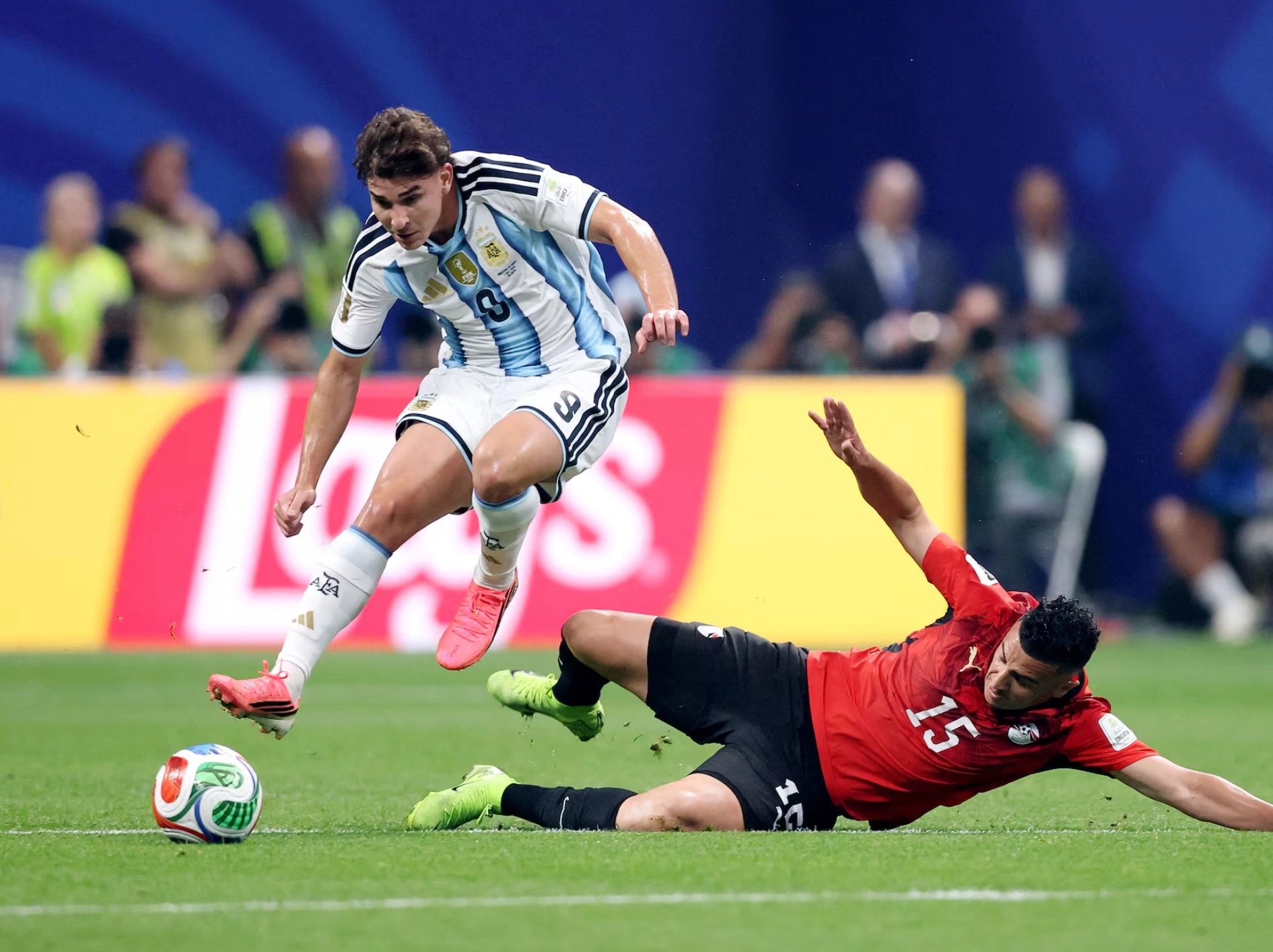 |
Julian Alvarez (left) vies for the ball with Karim Hafez during the Argentina – Egypt round of 16 match at the 2026 World Cup in Atlanta, Georgia, USA on 7/7/2026. Photo: Reuters |
"With math, students either love it or loathe it," Alvarengue said with a laugh. "There's no in-between. Alvarez was very good at math. Overall, he had a very serious approach to learning in class. Fernandez, however, was a bit more challenging. Some days, you could tell his mind was entirely on matches, or whether he would be selected for the starting lineup."
"Whenever he entered the classroom, Fernandez liked to make noise by tapping his pencil case on the desk," Alvarengue remembered. "I vividly recall walking in, looking to my left where Fernandez sat. He would lean against the wall, put his feet on another chair, and some days he would be like, ‘Today I'm just going to sit like this’. Alvarez was much calmer and more polite."
Alvarengue continued: "Fernandez was always thinking about football, like what he wanted to do on the field, who the next opponent was. He would constantly analyze the upcoming match, the situation, whether the team needed a tactical change, or if they had to travel far. In general, 100% of his mind was always on football."
"I couldn't start a lesson without asking Fernandez how his weekend match went. Conversely, Alvarez was more focused on his studies at school: ‘I’m at school, I need to study’. Yet, both were always positive leaders in the classroom. Talking to them was enjoyable, as it felt like conversing with adults rather than children," she concluded.
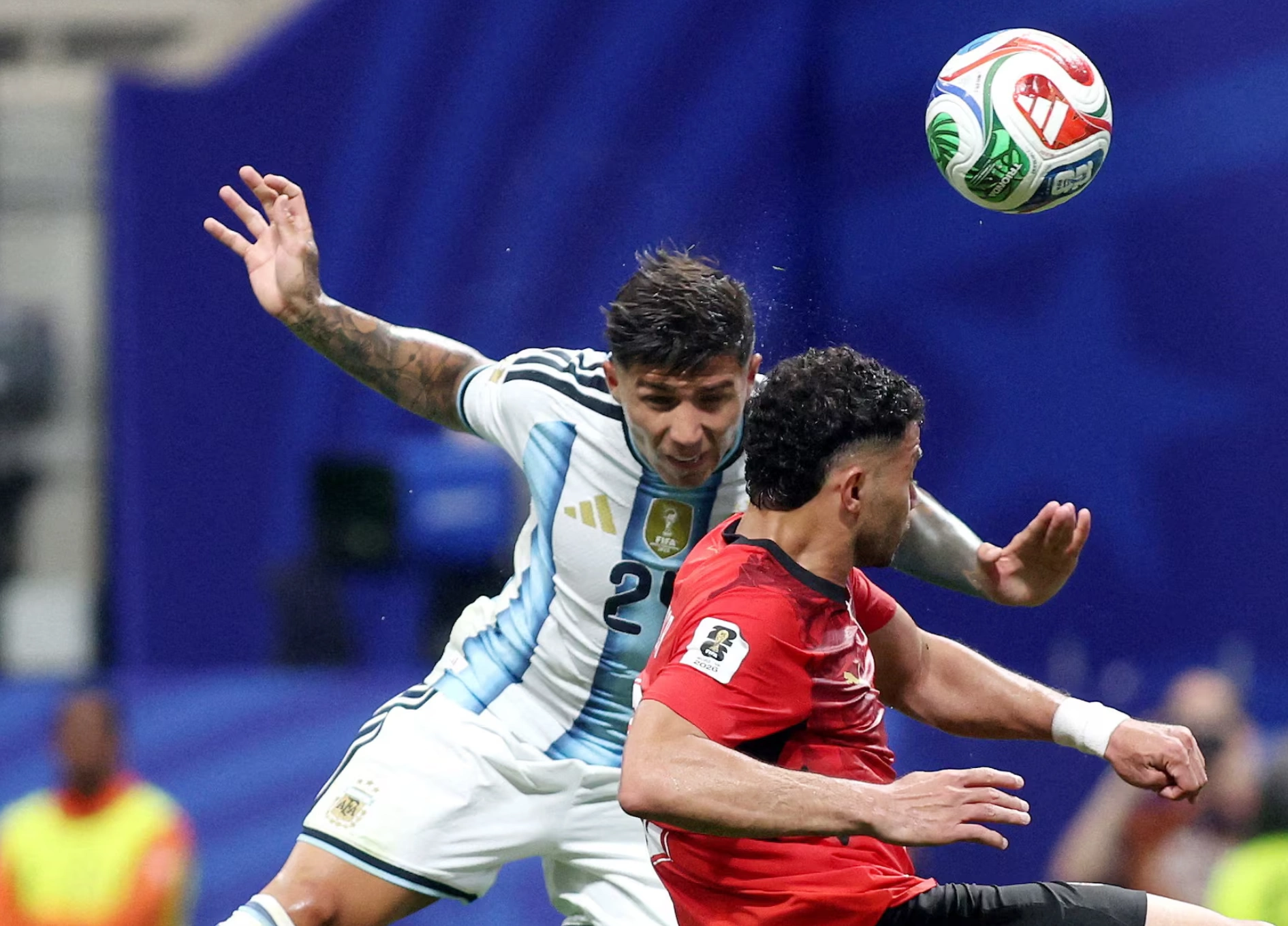 |
Enzo Fernandez heads the ball to score during the Argentina – Egypt round of 16 match at the 2026 World Cup in Atlanta, Georgia, USA on 7/7/2026. Photo: Reuters |
That maturity, according to Alvarengue, is a characteristic quality of the best players. "Their teammates would recognize that Alvarez and Fernandez had something special," she said. "Not necessarily because they were leaders or always wore the captain's armband, but because they were willing to frankly point out to others if they weren't playing well. You can see a very different sense of discipline in footballers. I always say that goalkeepers are the most disciplined."
A football career always demands sacrifices. Alvarengue remembered a time when Alvarez was very upset because he couldn't join a class camping trip due to a match schedule. Young athletes were forbidden from participating in regular school physical education classes to avoid injuries, but teachers constantly had to act as "unwilling referees" to intervene whenever students organized spontaneous games, using a crumpled piece of paper or an empty can as a ball. "We were always worried they would get hurt," Alvarengue shared.
Balancing general education with a demanding competition schedule has never been an easy task, and that is one of the reasons River established this school. It was common for students to travel for matches or participate in away tournaments for two weeks or more. At such times, teachers would prepare assignments for students to take with them, and coaches would be responsible for encouraging and helping them complete the assigned work. The key was to convince students that education was an essential part of an athlete's development.
"At that time, their minds were truly just thinking: ‘I want to play football, I want to succeed in sports’," Alvarengue confided. "They didn't yet understand that education helps with quick reflexes to stimuli, helps in understanding instructions, or increases thinking speed to achieve goals on the field. Therefore, we always tried to direct academic knowledge toward things they could immediately see in their training process. For example, in math, we frequently worked with statistics. Like: ‘How are your stats lately? How many matches have you played? How many goals have you scored?’. They needed to see that what we taught was actually useful for their sports careers."
 |
Julian Alvarez (left) and Enzo Fernandez celebrate a goal during the Poland – Argentina group stage match at the 2022 World Cup at Stadium 974, Doha, Qatar on 30/11/2022. Photo: AP |
Fernandez actually paused his schooling at 14 years old. However, recognizing the importance of knowledge, he completed his distance learning program in his late teens, while playing for River's first team.
If they hadn't found fame in football, what would Alvarez and Fernandez be doing now? Alvarengue hesitated to answer, saying she couldn't imagine the two Argentine stars doing any other job. But then she finally agreed that, with his abilities, Alvarez could certainly pursue university-level professions like a lawyer or an accountant. And Fernandez? "He really liked breaking things," she quipped. "So maybe… a drummer?"
A footballer is never molded by just one club or one coach, but by a combination of many factors and influences. As she watched Argentina defeat France in the thrilling final at Lusail Stadium four years ago, and followed Argentina's journey in North America this summer, Alvarengue has every right to be proud that she played a small part in that team. "I will always remember that they passed through our classroom. I hope they took something meaningful with them," the now 40-year-old teacher said.
Hoang Thong (according to Guardian)