Phil Gore concluded his week-long continuous running challenge on 30/8, having completed 152 hourly laps at Alfred Skeet Reserve in Forrestdale, Western Australia. This achievement was 16 laps short of his target of 168 laps.
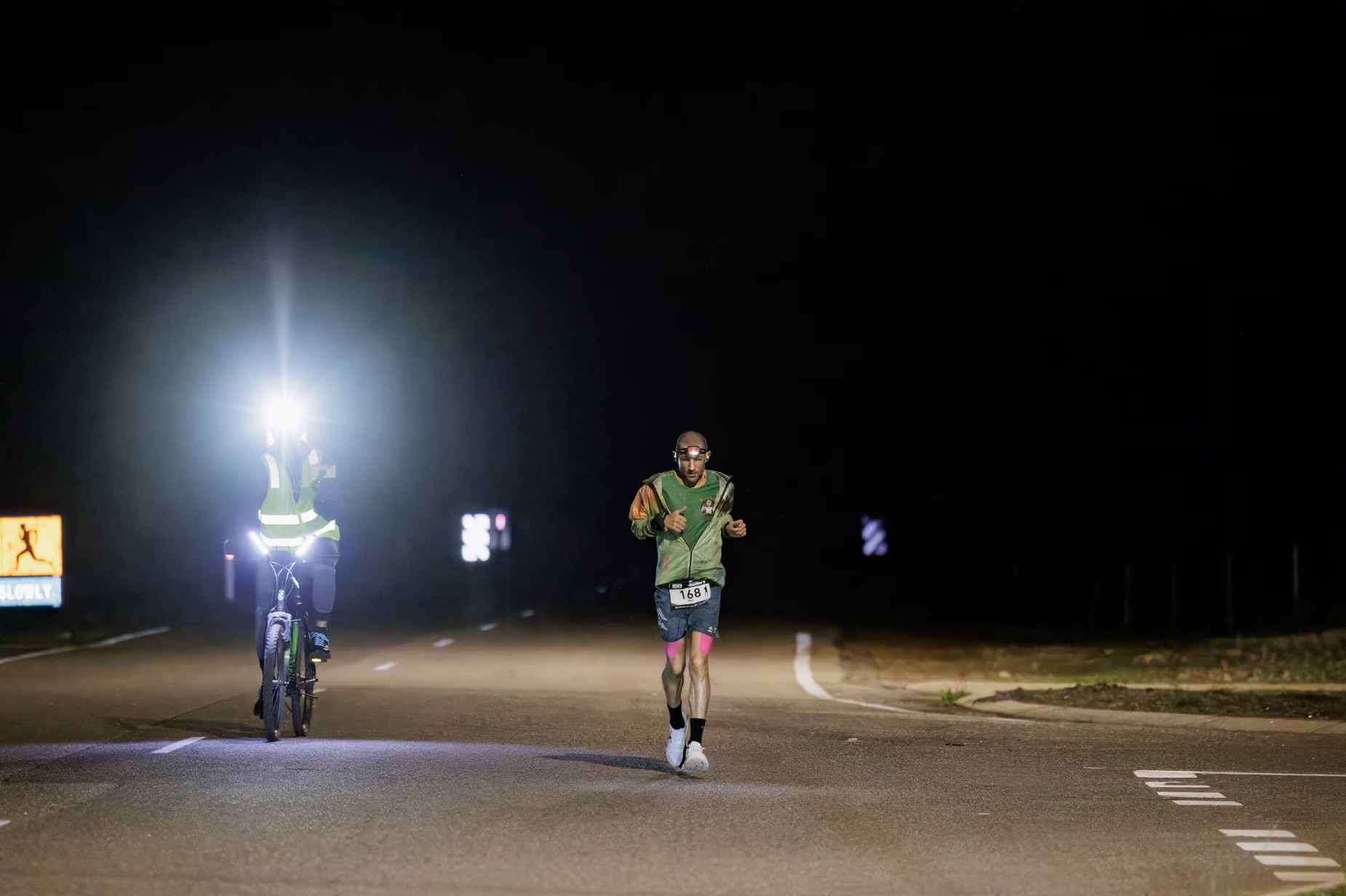 |
Phil Gore runs at night during "Project 168" at Alfred Skeet Reserve in Forrestdale, Western Australia. Photo: William Buck
Gore, a firefighter and father of four children, began the challenge at 8:00 on 23/8, naming the endeavor "Project 168". His plan was to complete a 6,71 km lap at the start of every hour for seven consecutive days, totaling 168 hours. If he had completed the entire challenge, Gore would have run a total of 1.127 km, nearly 700 miles.
However, he stopped after 152 laps, equivalent to 633,75 miles. The official challenge tracking sheet recorded Gore's result as DNF, a term indicating "did not finish".
The format Gore used is similar to a backyard ultra race, where athletes must begin a new lap at the start of each hour. Participants who cannot start or complete a lap within the one-hour time limit are eliminated. The remaining time after each lap is all an athlete has to eat, change, and rest before the next lap begins.
Gore undertook the challenge alone, without competitors on the course or external support. Each lap he completed also contributed to a fundraising campaign for Telethon 7, a Western Australian charity supporting sick and disadvantaged children. By the morning of 31/8, the campaign had raised approximately 191.152 USD.
Lap statistics show Gore's pace decreased significantly towards the end of the challenge. His fastest lap was completed in 37 minutes 17 seconds, occurring on the 65th lap. The average time for his 152 laps was 46 minutes 3 seconds.
On his final lap, Gore took 58 minutes 1 second, his slowest of the entire challenge, leaving him with less than two minutes before the next lap was due to start. Jared Beasley, a writer for UltraRunning Magazine who followed the challenge throughout the week, reported on X that Gore "collapsed on the 153rd lap".
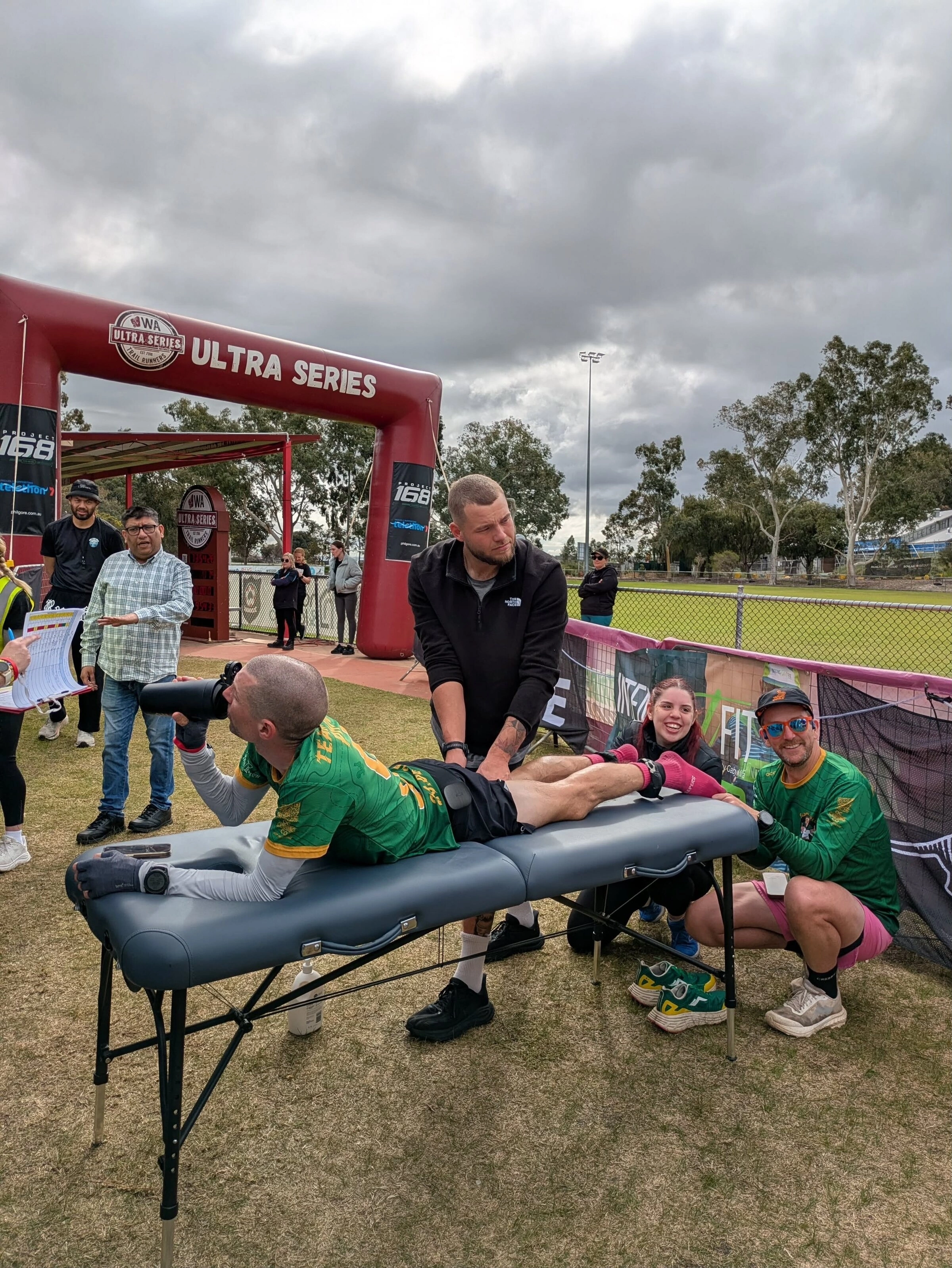 |
Phil Gore relaxes after completing a lap. Photo: Instagram / hr_sports_massage_
Despite completing 152 laps, Gore's achievement will not be recognized as an official backyard ultra record. The athlete himself acknowledged this before starting the challenge.
According to backyard ultra rules, a race only ends when all but one athlete fail to start a new lap on time. Therefore, the number of laps for the winner is determined by the number of laps completed by the second-place finisher, plus one lap.
The current world record was set by Gore himself with 119 laps (equivalent to 798,02 km) at Dead Cow Gully, Queensland, in June 2025. At that event, Sam Harvey, an athlete from New Zealand, completed 118 laps before stopping, which allowed Gore to establish the record.
In Forrestdale, there was no second athlete participating to compete with Gore. Consequently, his 152 completed laps cannot be converted into an official achievement under backyard ultra rules.
"This isn't just about seeing how far I can push my limits. I want to set a new benchmark for endurance athletes, much like Roger Bannister made the four-minute mile possible", Gore told Max Kagi of Your Local Examiner before starting the challenge.
Gore's 152 laps far exceed what has been officially recognized in backyard ultra history. Before Gore set his record, Lukasz Wrobel of Poland held the best performance with 116 laps, equivalent to 777 km.
In June, Russian athlete Dmitry Klimov completed 123 laps at the Biotropika Backyard Ultra in the Leningrad region. However, Gary Cantrell, the creator of the backyard ultra format, nullified this result in July after video evidence showed non-athletes on the course.
Therefore, no athlete in an officially recognized race has surpassed Gore's 119-lap mark.
When considering total distance, Gore's challenge offers a different perspective. Yiannis Kouros once ran 1.036,8 km in six days, an achievement still listed by the International Association of Ultrarunners (IAU) in his record list. This distance is longer than what Gore achieved after 152 hours.
The difference lies in the competition format. An athlete completing a lap in 40 minutes must wait an additional 20 minutes before the next lap begins, rather than continuing to run immediately.
Hong Duy (according to Marathon Handbook)