The SEA Games regularly feature seven martial arts disciplines: boxing, taekwondo, karate, judo, wushu, pencak silat, and muay thai, excluding wrestling. Other disciplines, such as jujitsu, kickboxing, and vovinam, have appeared more recently, while arnis makes occasional appearances.
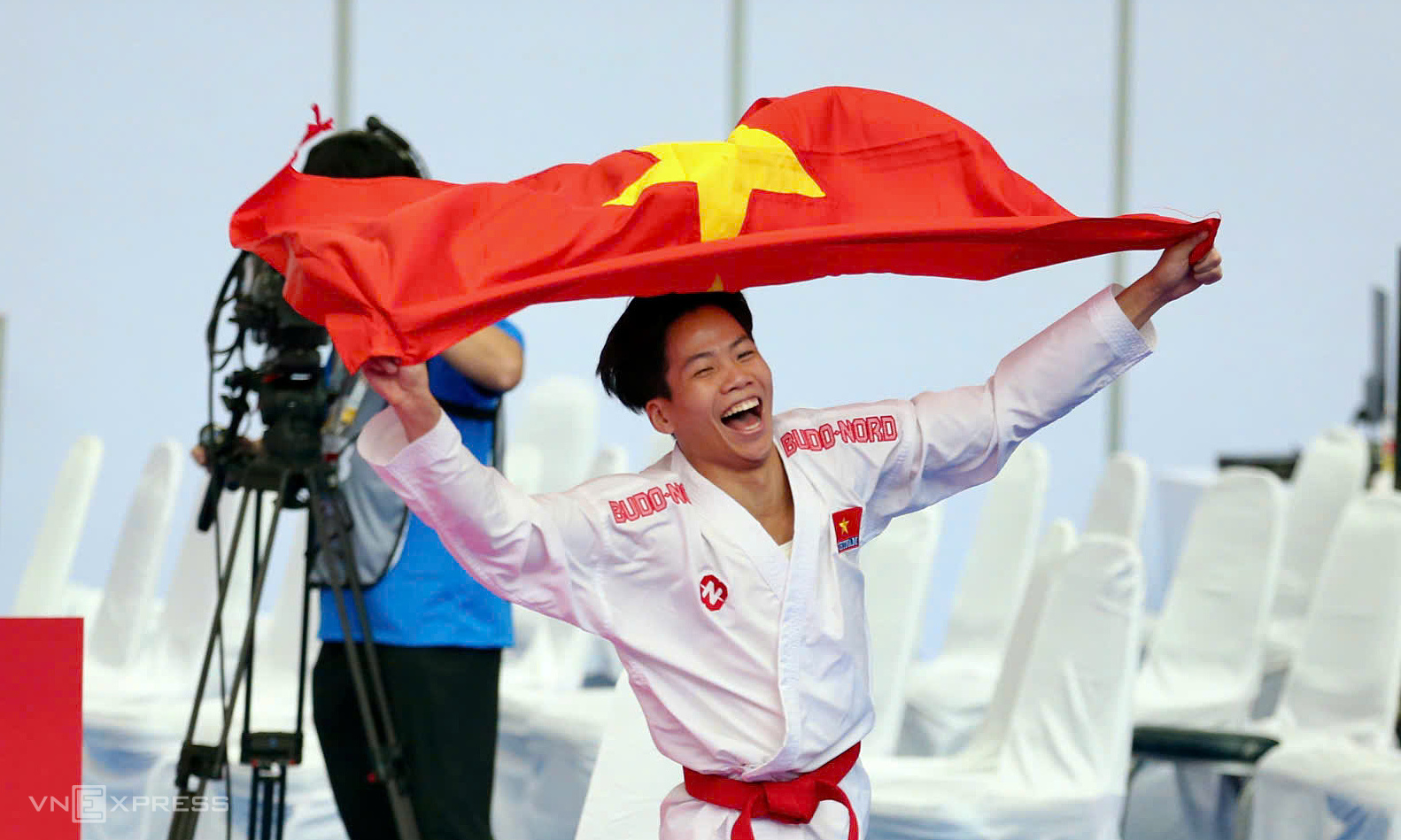 |
Khuat Hai Nam celebrates his victory in the men's kumite under 67kg final at SEA Games 33, held at the Chaeng Watthana Government Complex in Bangkok, Thailand on 12/12. Photo: Hieu Luong |
Among these seven martial arts, only Vietnamese karate has topped the medal standings for three consecutive editions: SEA Games 31, 32, and 33. While the judo and wushu teams have also led for two consecutive editions, they could not maintain this streak for a third. Vietnamese judo, for example, topped SEA Games 31 and 32 but secured only one gold medal this edition, finishing third overall.
At SEA Games 33, Vietnamese karate earned six gold, three silver, and two bronze medals. Host Thailand finished second with four gold, five silver, and two bronze medals. While the total medal counts for both delegations were equal, the crucial difference lay in the four finals where Vietnam defeated the host nation.
The six events that brought gold medals for Vietnamese karate this edition were: women's kumite under 61kg (Hoang Thi My Tam), women's kumite under 68kg (Dinh Thi Huong), men's kumite under 67kg (Khuat Hai Nam), men's kumite under 84kg (Nguyen Thanh Truong), women's team kumite (Nguyen Thi Dieu Ly, My Tam, Nguyen Thi Thu, Dinh Thi Huong), and women's team kata (Hoang Thi Thu Uyen, Bui Ngoc Nhi, Nguyen Ngoc Tram, Nguyen Thi Phuong).
Among these medalists, My Tam and Dinh Thi Huong each secured two gold medals. Both team gold medals came from victories against Thailand in the finals, specifically on 11/12 and 14/12, respectively, for karate events. In individual matches, My Tam and Hai Nam also defeated host nation opponents to claim gold.
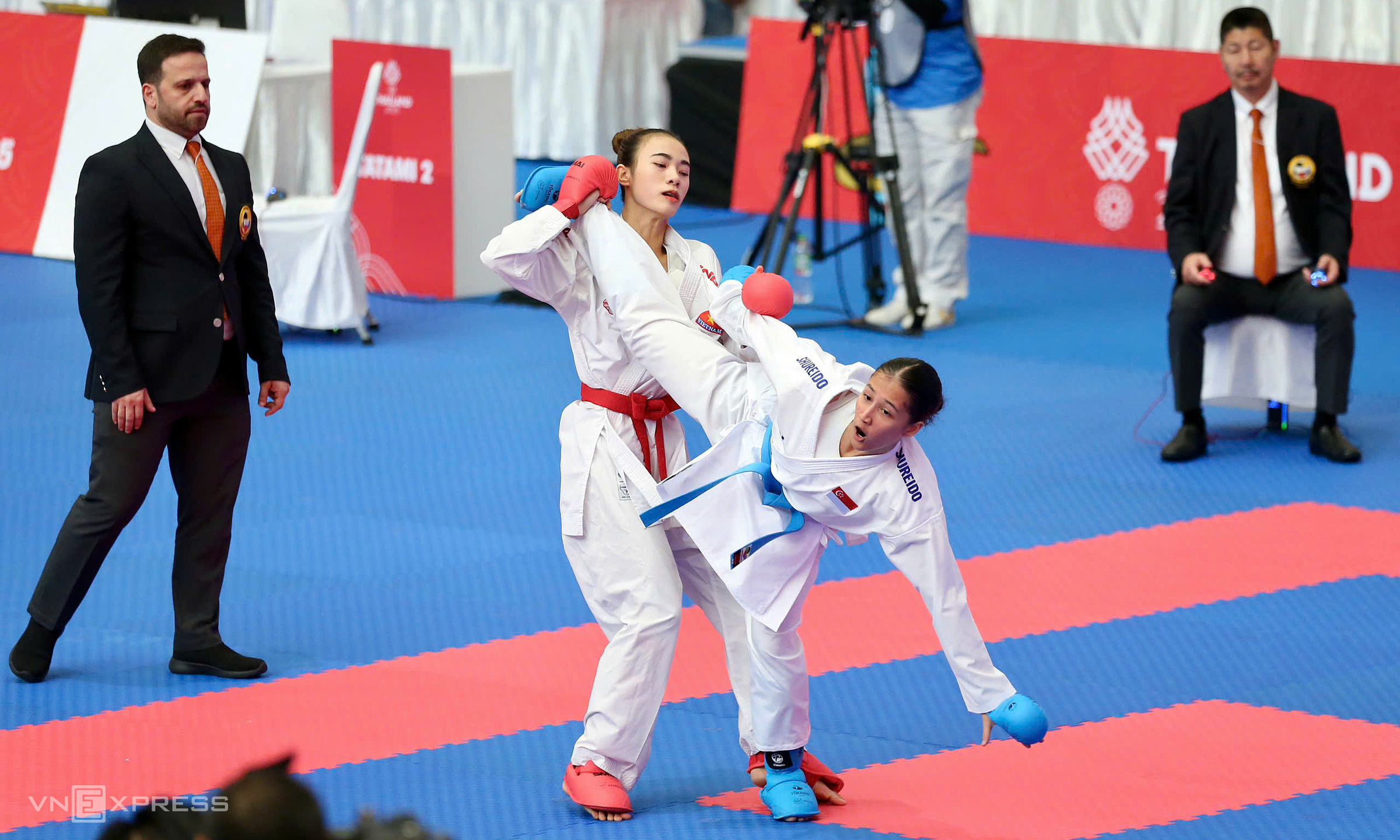 |
Nguyen Thi Dieu Ly (red belt) in the women's under 55kg final against Marissa Hafezan (Singapore) on 12/12. Photo: Hieu Luong |
In the past 20 years, Vietnamese karate also topped the SEA Games in 2009 in Laos. However, the team could not maintain this position, subsequently being surpassed by Indonesia and then Malaysia. At SEA Games 31 in Ninh Binh, Vietnamese karate reclaimed the top spot. The team continued to hold its position at the previous edition in Cambodia, securing six gold medals.
While not a regular Olympic discipline, karate is a familiar presence at the SEA Games and Asiad. It has contributed the most gold medals to Vietnam's history at the Asiad, with five gold medals, accounting for 26% of the total. The peak of Vietnamese karate occurred in the first decade of the 21st century, with gold medals from Vu Kim Anh and Nguyen Trong Bao Ngoc in 2002, Vu Thi Nguyet Anh in 2006, and Le Bich Phuong in 2010.
At Asiad 19 in 2022, Vietnamese karate ended its gold medal drought with the women's team kata championship won by Thu Uyen, Ngoc Tram, and Nguyen Thi Phuong. In the same year, Vu Son Ha, head of the karate department, became the first Vietnamese person elected as president of the Southeast Asian Karate Federation.
The continuous success at the SEA Games will serve as a foundation for Vietnamese karate to achieve further glory at Asiad 20 in Japan in september 2026. Japan, the birthplace of karate, will feature 15 events for the discipline at the upcoming Asian Games, the highest number among all martial arts.
It is time for Vietnamese karate to set its sights on the continental stage.
Xuan Binh