Tourist exploitation frequently recurs at popular destinations in Vietnam.
On 24/2, a US tourist reported being charged one million dong by a motorbike taxi driver for a ride from Nguyen Van Huyen street, Nghia Do ward, to Trang Tien street, Hoan Kiem ward. Despite clearly stating her destination, the driver circled aimlessly, forcing the tourist to use Google Maps to guide him.
Just over one month prior, Hoan Kiem ward police fined a street vendor for charging an international visitor 250,000 dong for a conical hat. A group of Philippine tourists also faced overcharging, paying more than 1.4 million dong for a journey of about one kilometer in the Old Quarter in 7/2025. Two months later, an Australian family was charged 1.2 million dong for a cyclo ride, which was three times the regulated price.
These incidents of overcharging foreign visitors, widely shared on social media, have led to calls for stronger measures to address behavior that damages Vietnam's image internationally.
 |
Western tourists buying conical hats on Hang Gai for 250,000 dong. *Screenshot*.
Similar instances of tourist exploitation occur in several countries across the region. In Thailand, tourists often complain about taxi and tuk-tuk drivers refusing to use meters, instead demanding prices five to ten times higher or pressuring passengers to visit jewelry stores for commissions. According to data from the Thai Department of Land Transport (DLT), the agency received over 10,600 complaints related to taxi services during a five-month period from 10/2023 to 2/2024.
In Singapore, an incident involved a customer receiving a bill of nearly 1,000 Singapore dollars (780 USD) for a crab dish at Clarke Quay.
In South Korea, Gwangjang traditional market, a popular Seoul tourist spot, faced a crisis of public and tourist trust. This followed viral social media videos at the end of 2025 accusing vendors of overcharging and short-changing portions.
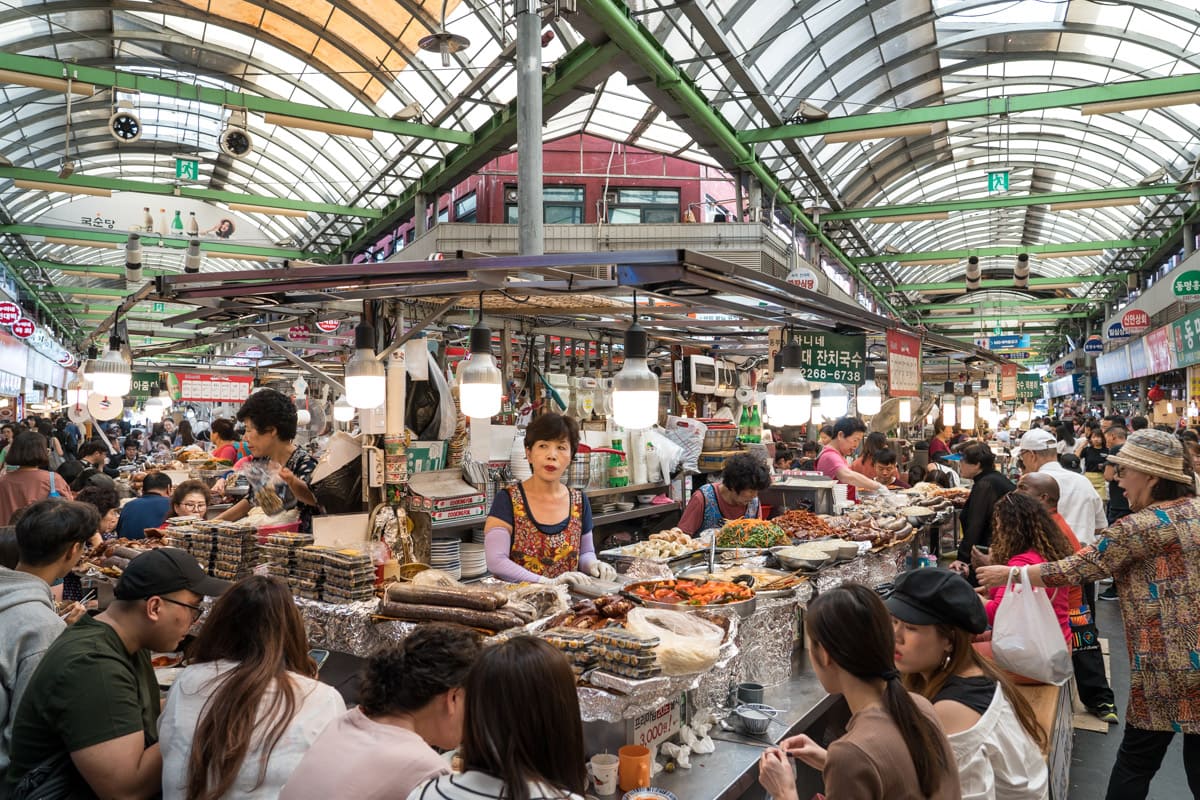 |
Gwangjang traditional market attracts tourists in Seoul. *The Seoul Guide*.
Beyond administrative penalties, countries like Thailand, China, South Korea, and Singapore have implemented various management solutions, ranging from administrative reforms to technological integration.
The Thai government has declared regaining tourist confidence a national strategy. The Tourist Police force has seen its authority enhanced and technology integrated into its operations.
A rapid response tool, the "Police I Lert U" app, allows tourists to send images and live location data directly to a 24/7 operations center. When a report of taxi or tuk-tuk fraud is received, the nearest patrol unit can intervene within 15-30 minutes.
 |
Tourist police in Pattaya, Thailand. *Pattaya Tourist Police*.
The Department of Land Transport (DLT) imposes maximum administrative fines of 5,000 Baht (4.1 million dong) and suspends driving licenses for 30-90 days for first-time offenders. Permanent license revocation is applied if drivers repeatedly violate regulations or pose a serious threat to passenger safety.
The deployment of AI cameras at hotspots such as Khao San and Wat Phra Kaew has helped identify frequent touts, placing them on police watchlists and reducing negative feedback in these areas.
China focuses on regulating travel agencies and protecting consumer rights through strict legal provisions. In key provinces like Yunnan, authorities have implemented a policy allowing tourists to return tour-purchased goods within 30 days without reason, provided the store is on a list of affiliated travel businesses.
The Chinese Ministry of Culture and Tourism requires all tour contracts to be registered on a national electronic system for monitoring cash flow and itineraries. Businesses that violate these rules are blacklisted, banned from the market, and their information is publicly disclosed on mass media portals.
In Singapore, the Consumer Protection (Fair Trading) Act (CPFTA) empowers the Consumers Association of Singapore (CASE) to intervene and demand compensation or closure from fraudulent shops. For street food stalls (hawker centers), price listing is mandatory. Business owners who violate this rule accumulate penalty points and risk losing their stall lease.
Singapore has established Small Claims Tribunals, enabling tourists to resolve financial disputes quickly and at low cost, without complex legal proceedings.
The incident at Gwangjang market in South Korea at the end of 2025 led to an unprecedented move. The merchant association filed a lawsuit seeking 300 million won (205,000 USD) in damages against stalls that tarnished the market's image. The Seoul government also deployed a team of "mystery shoppers" to verify quantities and prices, immediately suspending businesses found to be fraudulent.
South Korea also maintains a dedicated Tourist Police force with strong foreign language skills to assist and handle complaints from international visitors on the spot. The Seoul government applies a "yellow card, red card" system for transportation services. Taxi drivers who receive three complaints for overcharging or refusing service will have their operating licenses permanently revoked.
In Thailand, South Korea, China, and Singapore, controlling tourist exploitation is achieved through inter-agency coordination among tourist police, transport authorities, and trade associations. These policies aim to standardize service information, from transport fares to food portions, to maintain the competitiveness of these destinations within the global tourism supply chain.
Mai Phuong