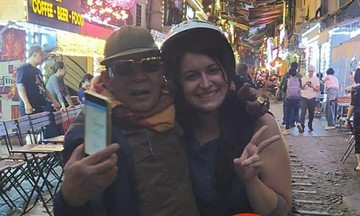
"Even locals buying 200 grams of two mixed fruits in the Old Quarter without asking for the price first are still overcharged by double; it is not surprising for international visitors to be scammed four to five times," said Chi Mai, a 35-year-old tour guide whose family has lived in Hanoi for three generations.
Each time she reads news of foreigners being overcharged in Vietnam, the tour guide feels saddened by the "timeless" issue.
"If this situation is not thoroughly addressed, the tourism industry's efforts to promote Vietnam to the world will be like building sandcastles against the tide," Mai said.
On 24/2, an American tourist was charged one million VND by a motorbike taxi driver for a trip from Nguyen Van Huyen street, Nghia Do ward, to Trang Tien street, Hoan Kiem ward. Although she clearly stated her destination, the driver circled aimlessly, forcing the female passenger to use Google Maps to guide him.
More than a month prior, Hoan Kiem Ward Police fined a street vendor for charging an international visitor 250,000 VND for a conical hat. A group of Filipino tourists was also overcharged 1.4 million VND for a distance of about one kilometer in the Old Quarter in 7/2025. Two months later, an Australian family paid 1.2 million VND for a cyclo ride, three times the regulated price.
The problem of price gouging and persistent hawking is not limited to Hanoi but occurs in many provinces and cities. According to Nguyen Tien Dat, CEO of AZA Travel, the frequency is higher in popular international tourist destinations.
"The problem of price gouging persists; the only difference is whether customers complain or ignore it, or if the media reports on it," stated Nguyen Tien Dat, General Director of AZA Travel. Dat recounted his own incident when taking a taxi from Da Nang airport to his hotel. Noticing he was busy on the phone, the driver took a roundabout route to increase the fare. After being discovered and confronted, the driver charged the correct price.
"If long-time tourism professionals like tour guides and travel agency leaders are still scammed, how can international visitors avoid it?" Chi Mai asked. She has assisted many tourists in resolving issues of persistent hawking and price gouging at various destinations.
Speaking to VnExpress, Tran Trung Hieu, Deputy Director of the Hanoi Department of Tourism, acknowledged that "price gouging still exists," particularly in large, open tourist areas like the Old Quarter and festivals that attract many tourists and businesses. Hieu affirmed that not listing prices and pressuring customers to buy are deliberate acts of fraud and exploitation.
Pham Hai Quynh, Director of the Asia Tourism Development Institute, likened the current situation of price gouging and hawking to "a hard-to-heal scar on the face of Vietnamese tourism." The problem spreads like an "octopus," with new issues appearing as old ones are addressed. In many tourist areas, such as Central Vietnam's beaches and major tourist markets nationwide, overt hawking has decreased but has shifted to more sophisticated tricks, exploiting language barriers to obscure prices. This issue affects not only international visitors but also domestic tourists.
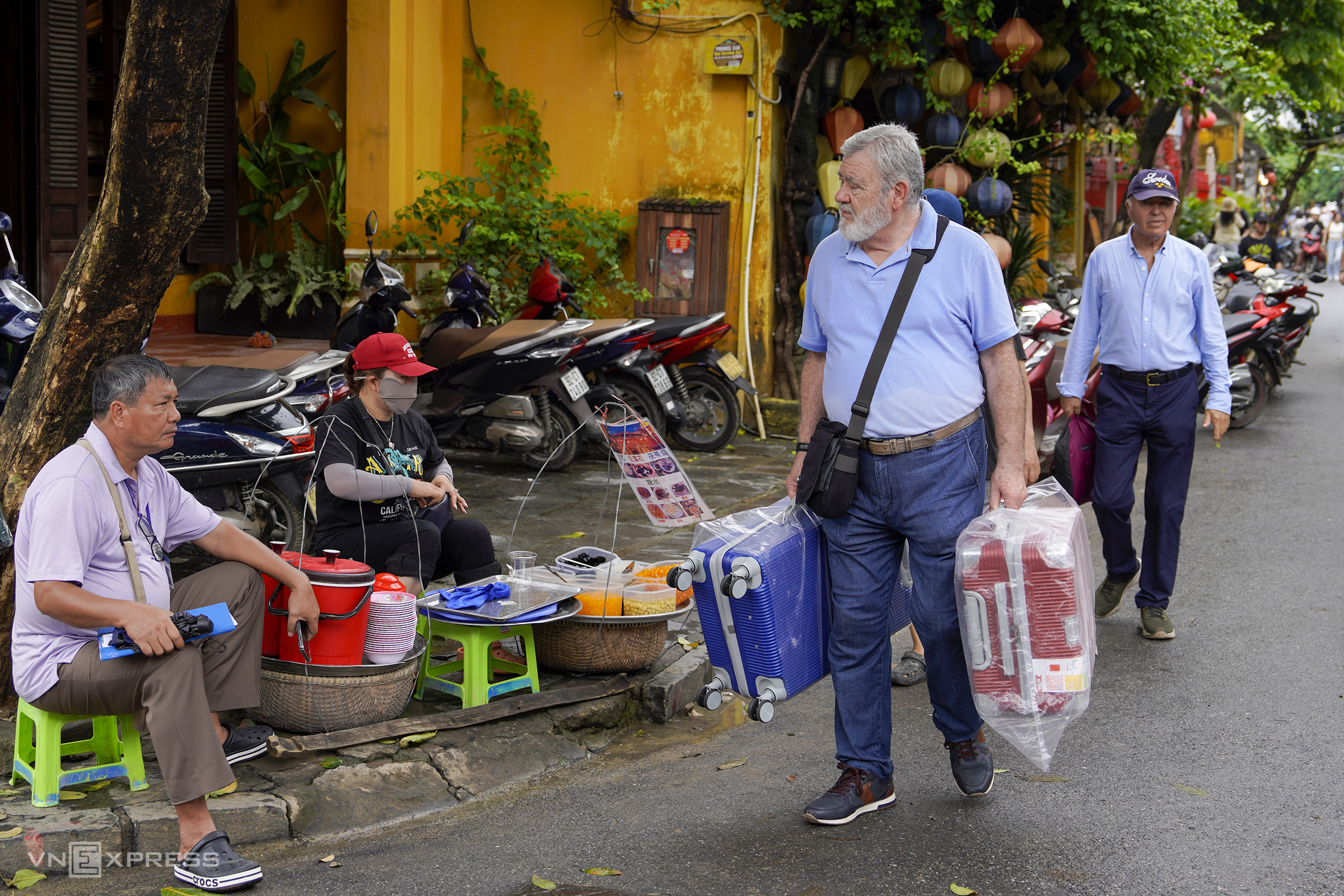 |
Tourists visit Hoi An Ancient Town, 1/11. Photo: Nguyen Dong |
Deputy Director Tran Trung Hieu stated that the Department and destination management units have established hotlines for tourists and increased security personnel in pedestrian areas on weekends to prevent price gouging.
"We categorize violations for immediate on-site handling or coordinate with relevant parties for swift and strict action. Price gouging negatively affects tourist psychology; at worst, it makes them not want to return," Hieu said.
A representative from the Da Nang Department of Culture, Sports and Tourism reported that the city has a Tourism Rapid Response Team to address emerging issues promptly. Additionally, authorities continuously inspect and monitor tourism service businesses. Many inter-agency teams have been formed to detect and handle commercial fraud, counterfeit goods, substandard products, and unlisted or incorrectly priced items.
Not only Hanoi and Da Nang, but provinces and cities nationwide also implement policies to prevent price gouging, which "blemishes" the national tourism image internationally. However, according to Hieu, this issue cannot be completely eradicated, only "minimized."
Institute Director Pham Hai Quynh identified the main reason price gouging persists: small businesses do not view tourism as a sustainable economic sector, prioritizing immediate profit over long-term reputation. Quynh cited the incident of selling a conical hat for 250,000 VND, where the 225,000 VND fine was "too low" compared to the illicit profit. Furthermore, Vietnam cannot deploy police officers on every street corner 24/7. Relying on surveillance cameras or citizen intervention to help tourists is spontaneous, not a tightly knit community system.
"If the fine is lower than the profit earned, people are willing to violate," he said.
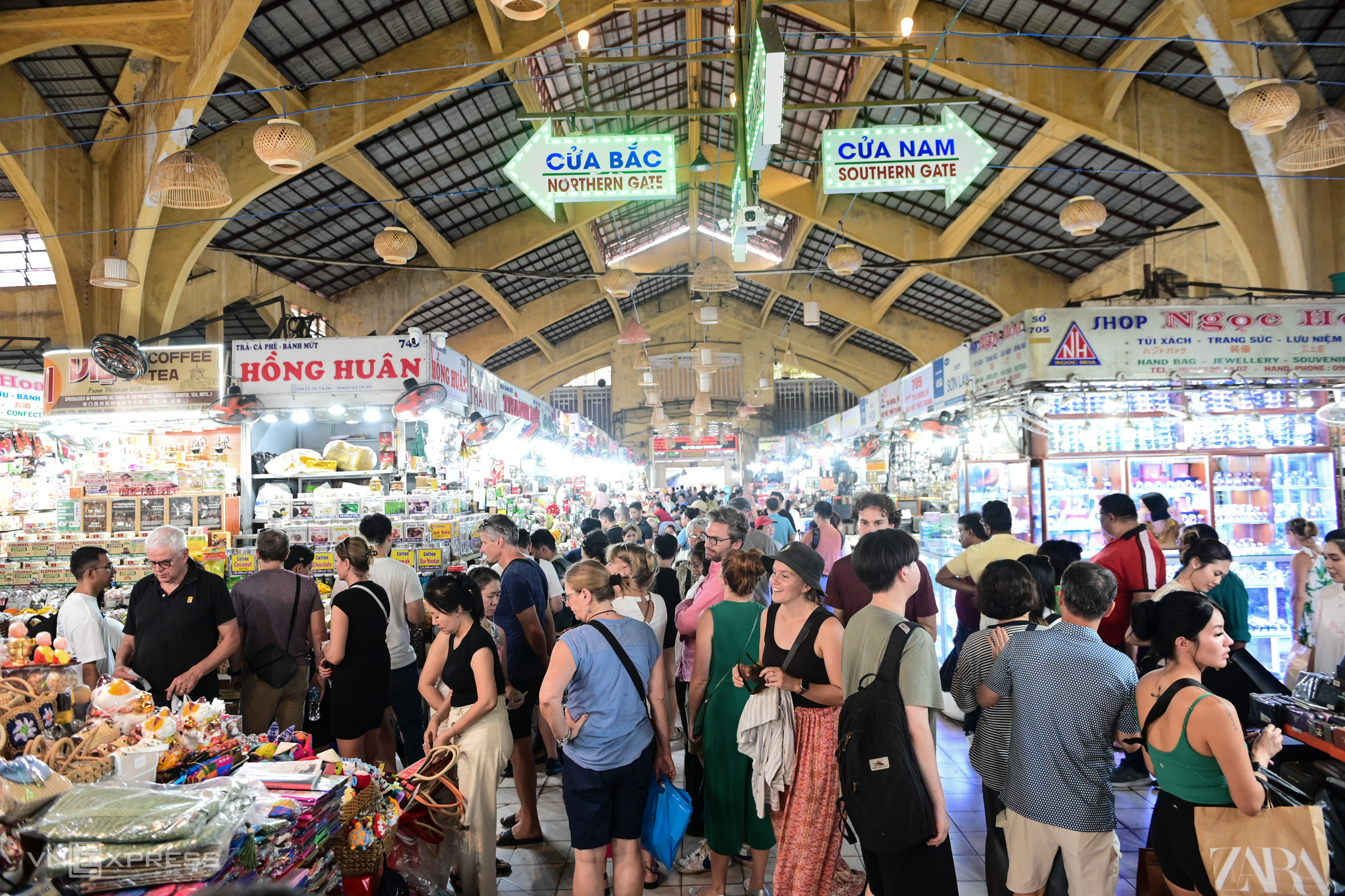 |
Tourists shop at Ben Thanh Market, Ho Chi Minh City. Photo: Quynh Tran |
AZA CEO Nguyen Tien Dat believes that price gouging cannot be completely resolved due to greed. Street vendors rely on the anonymity of not being known and constantly moving between locations, believing that scamming each customer once is "enough to live."
Monthly income from scamming tourists may be substantial for a group of individuals making a living, but it is small compared to the consequences the tourism industry bears.
Institute Director Pham Hai Quynh considers price gouging "a poison" for the national brand. A scammed tourist not only loses money but also feels insulted and deceived. A bad customer experience can turn into thousands of warnings on popular global forums like TripAdvisor, Lonely Planet, or social media.
A study by UK insurance company AllClear, published on 19/2, showed that Vietnam ranked 4th among the top 10 countries with the most taxi scams globally, after Turkey, India, and Thailand. This result was based on an analysis of thousands of tourist complaints on major forums like Reddit.
Tourism is an economic sector based on emotion and trust. If customers feel financially insecure as soon as they step onto the street, they will choose nearby destinations with more professional and transparent tourism ecosystems. "And thus, Vietnam loses customers," Quynh said.
According to tourism experts, measures like price listing or hotlines currently only address symptoms – dealing with issues after they have occurred. To address the root cause, Vietnam needs a three-pronged strategy: implementing integrated tourism applications with digital maps where tourists can look up ceiling prices for souvenirs and services and immediately rate vendors.
According to Quynh, heavy financial penalties should be applied, even permanent business bans in tourist areas for repeat offenders. Additionally, he proposed training programs and signed commitments between authorities and businesses.
"Just fine them dozens of times the scammed amount, and violators will be scared immediately," Mai Chi said. Instead of a few hundred thousand, fines reaching 5-10 million VND would deter violators from re-offending.
In addition to management efforts, the Da Nang Department of Culture, Sports and Tourism regularly promotes and encourages businesses and households to implement the Green Tourism criteria and the "Danang Smile" Da Nang Tourism Culture criteria. These actions aim to build a civilized, friendly tourism business environment, with tourist satisfaction as the foundation for sustainable development.
Beyond raising awareness among businesses, Hieu encourages residents and tourists to proactively report incidents to authorities. Tourists should not hesitate or fear confrontation, thereby overlooking improper vendor behavior.
Hieu called on every citizen to become a "tourism ambassador" to raise awareness of preserving the national image. "When everyone understands this role, they will take responsibility for protecting the tourism environment," the Deputy Director of the Hanoi Department of Tourism said.
Phuong Anh