When checking in with checked luggage, passengers must weigh their suitcases before airport staff move them onto the conveyor belt for further processing.
While correctly orienting suitcases isn't a mandatory rule at all airports, staff often advise passengers to turn the wheels outwards. This position helps prevent direct force on the wheels and makes it easier for baggage handlers.
Typically, passengers should place suitcases with the wheels facing upwards or towards the back, aligning with the conveyor belt's direction of travel. This minimizes the risk of damage during transport.
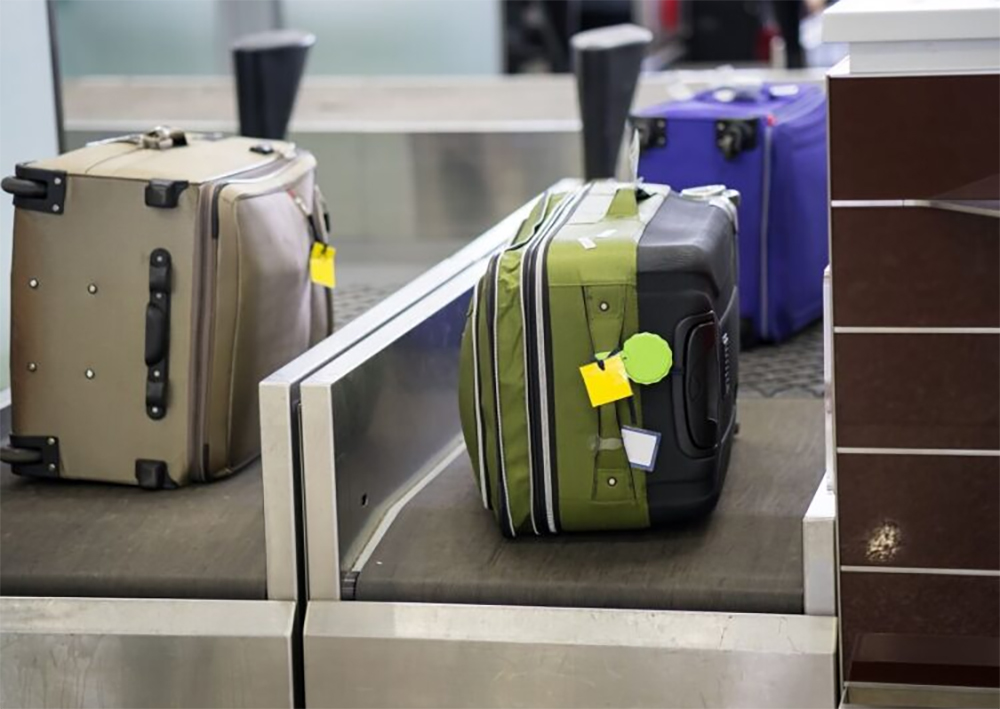 |
Luggage placed on a scale before entering the conveyor belt, with wheels recommended to face outwards. Photo: Bamboo
Reducing the risk of jams
Luggage on conveyor belts travels through many curves, connections, gaps, and diverters. Wheels are the most vulnerable part, prone to getting caught in crevices, guide rails, or spinning in place, stopping the suitcase and disrupting the entire process.
When wheels face upwards or outwards, the flat surface of the suitcase makes it slide more stably. If wheels face inwards or lie flat, they are more susceptible to breaking, or the plastic housing can crack upon impact or when stuck.
If a suitcase stops or gets stuck, staff can see the wheels more clearly, making it easier to pull or adjust.
Protecting suitcases from damage
If wheels face inwards or are compressed, they are prone to axle breakage, misalignment, and cracking. This orientation also reduces direct pressure on the wheels. It protects the wheels, the most fragile component, from sharp turns and strong impacts during transit.
Passengers should use durable suitcases, secure locks, and luggage covers for optimal protection.
At major airports like Changi (Singapore) and Tokyo Haneda (Japan), conveyor systems are complex, featuring numerous curves and inclines. Correctly orienting suitcases helps reduce congestion, increases baggage processing speed, and ensures smoother movement within the automated system.
Tam Anh (according to Quora, Tripadvisor)