Hoai Anh, a traveler from Dak Lak, first visited Hanoi five years ago and still remembers a meal with a friend's family. When the meal was served, her friend said, "Moi ong ba, bo me xoi com" (inviting grandparents and parents to eat). Hoai Anh followed suit but did not understand why, as at her home, everyone simply sat down to eat without inviting each other. Later, she understood this is a cultural practice in many northern provinces, where younger individuals invite older family members to eat when sharing a meal.
"When that friend came to my house and invited people to eat during a meal, everyone laughed loudly because they did not understand why she did that," she recounted.
According to cultural researcher Nguyen Hung Vi, the act of inviting others to eat before a meal is not merely a habit but a family educational ritual. This custom has existed for a long time, and there is a folk saying: "An thi co moi, lam thi co muon" (Eat with an invitation, work with a loan, implying proper etiquette for both). He stated that a Vietnamese family meal is a "communal meal," where the whole family eats together. This tradition emphasizes seating positions and conduct.
Vietnamese people, especially those in Northern Vietnam, always remember the saying "An trong noi, ngoi trong huong" (meaning be mindful of others and your surroundings while eating). This serves as a reminder for everyone to be considerate, maintain moderation, and respect family hierarchy, acting as a form of family conduct education. The expert added that in ancient times of famine, most people did not have enough food, making meals very important. Therefore, everyone had to show respect to the elderly and care for children.
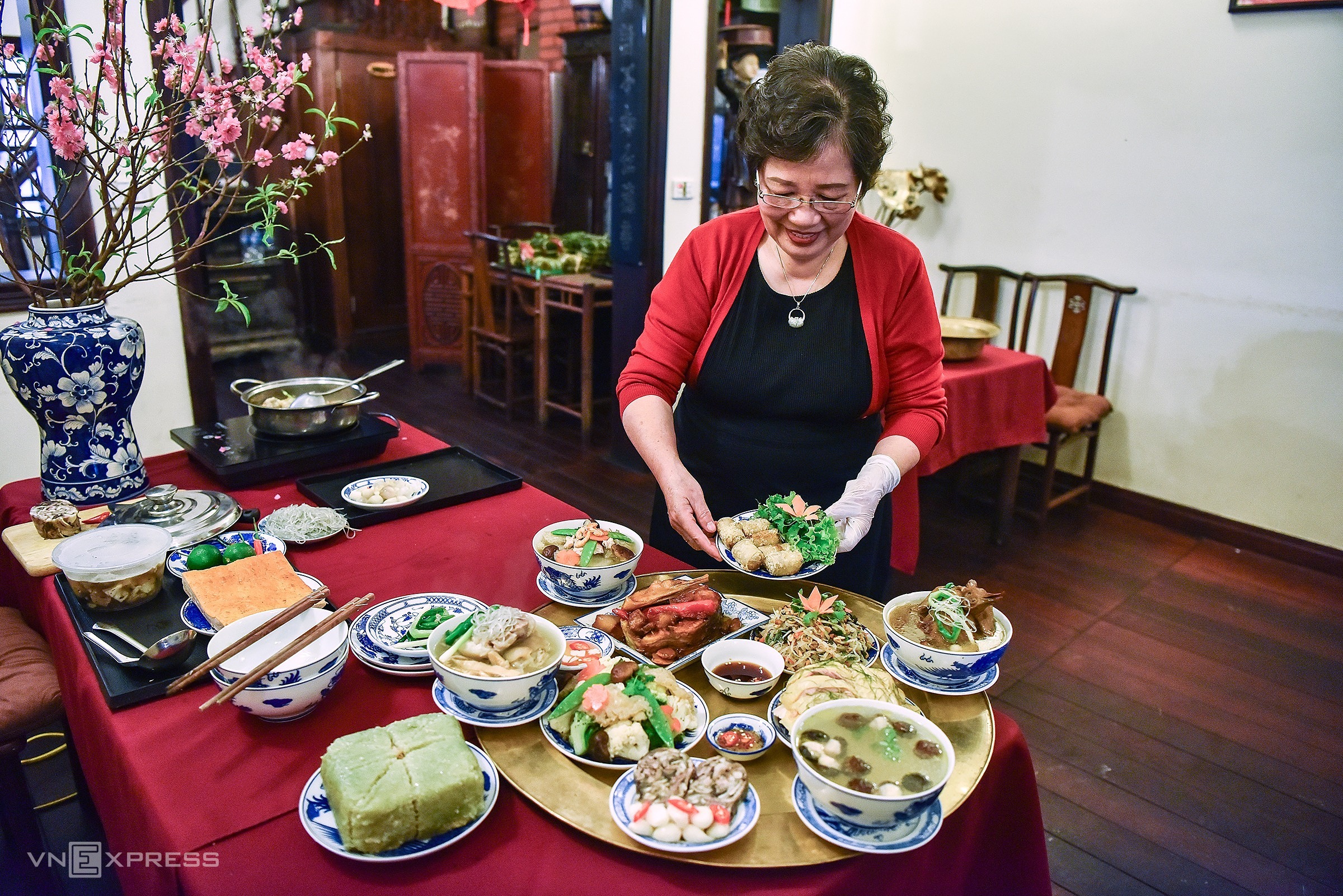 |
Artisan Anh Tuyet prepares a traditional Hanoi Tet feast. *Photo: Giang Huy* |
Regarding the invitation ritual, Mr. Vi explained that it is typically performed in a top-down order within families. The youngest person in the household is usually reminded to invite first, then successively inviting grandparents, parents, and older siblings. This ritual creates clarity, thoughtfulness, and reverence.
Traditionally, after children and grandchildren finished inviting, they often had to wait for grandparents to pick up their chopsticks before eating. In contemporary life, after the invitation, older individuals often respond with permission, "Thoi an di con, an di chau" (Go ahead and eat, my child/grandchild). The act of inviting, therefore, signifies a request for permission from superiors.
Explaining why some regions, especially Southern Vietnam, do not practice the meal invitation as strictly as the North, researcher Nguyen Hung Vi suggested that the cause lies in family structure and living conditions.
In Northern Vietnam, stable agricultural life led to a very tight-knit family organization, where meals were only eaten when everyone was present. In contrast, in Southern Vietnam, the riverine and orchard-based lifestyle made daily habits more flexible. He cited the image of children in orchard areas often running from house to house, eating wherever they found food, and sleeping wherever night fell. Due to this nature, meal invitations in Southern Vietnam are often not recited as a top-down list but are general invitations like "Xin moi" (Please come) or "An thoi" (Let's eat).
"The invitation does not mean one place has better education; it is simply a cultural difference," he said. Additionally, northerners often extend a meal invitation when guests unexpectedly visit their home. He explained that this is more like a polite greeting rather than a genuine invitation to eat.
The expert emphasized that the meal invitation is not a "cumbersome procedure," regardless of how society has changed. According to him, through the invitation, people learn how to respect elders and yield to those above them, live consciously, and follow rules, which is always necessary at any time.
By Tu Nguyen