Replacing traditional brick bathroom walls with frosted glass panels or half-height partitions has been hailed as an innovative architectural solution in many contemporary hotels. However, this design choice is proving to be a significant inconvenience for guests.
In major cities such as London and New York, many newer hotels opt for toilets installed within partially frosted glass cabins. This design often allows the silhouette of the person inside to be visible from the sleeping area, failing to address issues of sound and odor. For new couples, families with young children, or colleagues traveling together, this design creates uncomfortable scenarios where private activities inadvertently become shared experiences.
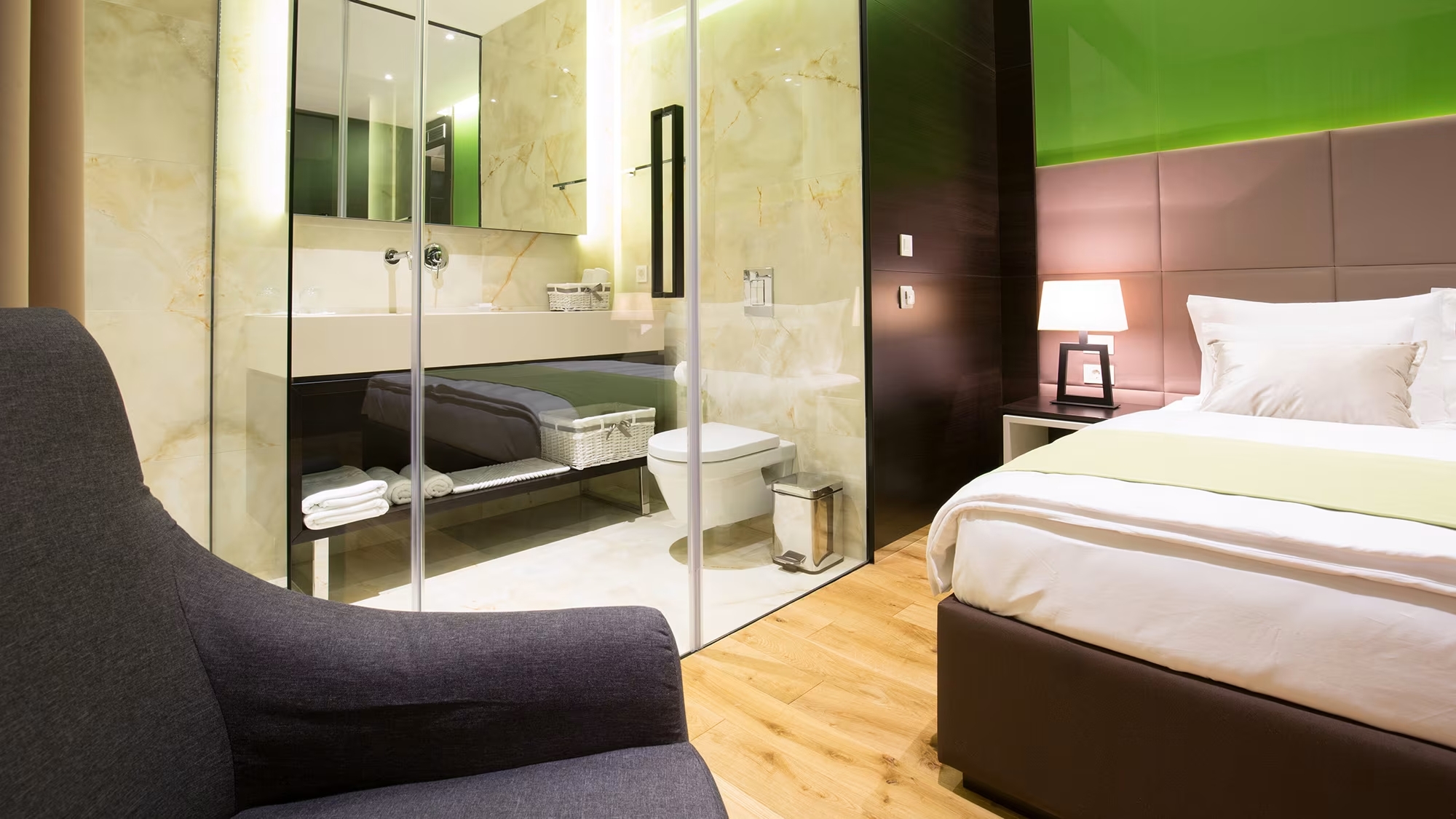 |
Hotel room with open-plan bathroom featuring glass partition. Photo: rilueda/iStockphoto
The problem of inadequate bathroom privacy spans various hotel segments, from economy guesthouses to luxury resorts. Typical forms include bathtubs placed in the center of the room, sliding doors with large gaps, or even curtains installed on the exterior of the bathroom window. On travel forums like TripAdvisor and Reddit, a growing wave of opposition to this trend highlights a disconnect between the aesthetic vision of architects and the practical needs of users.
To address this issue, Sadie Lowell, an American marketing specialist, launched the website Bringbackdoors.com in late 2025. This platform serves as a database to help travelers identify hotels that offer private bathrooms.
Lowell's website categorizes hotels into several levels: The "most serious violations" group includes bathrooms that force guests to exit into the common area to avoid awkwardness with their roommates. The "50% private" group features glass partitions, where guests must improvise by hanging towels for cover. The final category offers visual privacy but fails to block sound or odor issues.
The idea for the website originated after Lowell and her father booked a twin room in London, only to find a room without a toilet door. She believes that booking a twin room explicitly signals a need for privacy, a detail often overlooked by current hotel designs.
Paula O’Callaghan, a partner at the global design group HBA, notes that the trend of using frosted glass began three decades ago. Hotels favor this material to maximize space in smaller rooms, leverage natural light, and create a modern aesthetic. In densely populated cities like London or New York, every centimeter saved by replacing brick walls with thin glass makes a room feel visually larger. However, O'Callaghan believes many current designs have gone too far.
"According to industry standards, the toilet area still needs to be fully enclosed and not directly visible from the bed," O’Callaghan stated.
 |
Hotel room with bathtub open to sleeping area. Photo: Jon Lovette/Digital Vision
Heritage hotels and older buildings typically avoid the open-plan bathroom design. Due to rigorous preservation regulations and a goal to recreate traditional lodging styles, these establishments maintain robust bathroom structures with solid doors. This creates a distinct contrast: while modern brands pursue unconventional designs, heritage hotels gain favor through their discretion and practicality.
Experts suggest that the backlash against open-plan bathrooms demonstrates that the demand for personal boundaries remains a top priority for travelers when choosing accommodation. The emergence of platforms that verify hotel room privacy shows guests are willing to forgo superficial aesthetics for essential comfort. This situation compels hotel designers and investors to adjust architectural standards, ensuring resting spaces better align with actual market needs.
Mai Phuong (Via CNN)